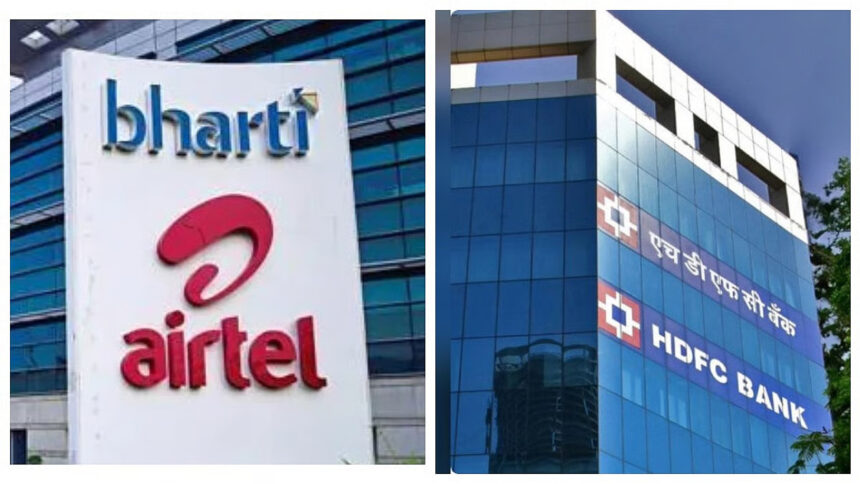
Bharti Airtel has created a major milestone in the Indian corporate landscape after overtaking HDFC Bank in market capitalisation to become the second most valuable listed company in India. The telecom giant now stands behind only Reliance Industries in terms of overall market value, marking a significant shift in investor confidence and sector leadership within the Indian stock market.
The development has generated strong interest across financial markets because it reflects the changing dynamics of India’s corporate economy where telecommunications and digital infrastructure companies are increasingly attracting higher investor valuations than traditional banking institutions.
Bharti Airtel’s remarkable rise comes after a strong rally in its share price over recent months despite earlier concerns related to market volatility and sector competition. Investors have rewarded the company for consistent revenue growth, rising average revenue per user, expanding digital services and improving profitability across multiple business segments.
The achievement is particularly significant because HDFC Bank has long been regarded as one of India’s strongest and most valuable private sector companies. For many years, the banking giant maintained its position among the top listed firms due to stable earnings growth, strong retail banking operations and investor confidence in the financial sector.
However, the rapid transformation of India’s digital economy has shifted investor focus toward companies benefiting from rising internet penetration, mobile data consumption and digital connectivity. Airtel has emerged as one of the biggest beneficiaries of this structural economic transformation.
Analysts believe the telecom sector has entered a new phase where companies with strong networks, large subscriber bases and digital ecosystems are likely to command premium market valuations. Airtel’s aggressive investments in fifth generation network infrastructure, enterprise services, broadband expansion and digital platforms have strengthened investor optimism regarding long term growth potential.
The company’s improving financial performance has also contributed significantly to the surge in market capitalisation. Over the last several quarters, Airtel has reported growth in revenues and operational profitability supported by tariff increases, premium customer additions and higher data usage among subscribers.
Market experts note that telecom companies previously struggled with intense price wars and heavy debt burdens. However, industry consolidation and gradual tariff improvements have significantly improved the financial health of leading operators. Airtel in particular has managed to strengthen its balance sheet while continuing large scale investments in network modernization.
The expansion of digital services has become another key driver behind Airtel’s valuation growth. Beyond traditional voice and data operations, the company has increasingly focused on digital payments, cloud services, cybersecurity solutions, enterprise connectivity and streaming platforms.
India’s broader digital transformation has also played a major role in reshaping market sentiment. Rising smartphone adoption, expanding online commerce, digital banking growth and increasing internet usage across smaller cities have created massive long term opportunities for telecom operators.
Investors now view telecommunications infrastructure as one of the most strategic sectors within the modern economy. As digital dependence increases across businesses, households and government services, companies controlling connectivity networks are expected to remain central to economic growth.
Bharti Airtel’s rise in market capitalisation therefore represents not only corporate success but also a broader shift in how investors value technology enabled infrastructure businesses. Telecommunications companies are no longer viewed merely as utility providers but increasingly as digital ecosystem leaders.
The company’s leadership strategy under its management team has also received positive attention from investors. Airtel has consistently focused on premiumization, customer retention, network quality and operational efficiency rather than purely competing on low pricing.
Industry observers believe this disciplined business approach helped Airtel improve profitability even during periods of intense market competition. The company’s ability to maintain premium brand positioning while expanding subscriber engagement has strengthened investor confidence.
Another factor supporting Airtel’s valuation growth has been optimism surrounding India’s fifth generation network rollout. The transition toward advanced digital infrastructure is expected to create new revenue opportunities in areas such as industrial automation, smart cities, connected devices and enterprise digital solutions.
Analysts believe companies with strong network capabilities and spectrum holdings are likely to benefit substantially from future digital demand. Airtel’s large scale investment in advanced telecom infrastructure has therefore strengthened expectations regarding future earnings expansion.
The stock market rally in Airtel shares also reflects broader optimism regarding India’s economic growth story. As one of the fastest growing major economies globally, India continues witnessing rising digital consumption, expanding middle class spending and rapid technological adoption.
Telecommunications remains central to this transformation because digital services increasingly influence education, healthcare, finance, entertainment and commerce. Companies capable of supporting this digital expansion are attracting growing investor interest.
At the same time, HDFC Bank continues to remain among India’s strongest financial institutions despite losing its second position in market capitalisation rankings. The bank retains a dominant presence in retail lending, digital banking and financial services with a large nationwide customer base.
Market analysts emphasize that fluctuations in market capitalisation rankings do not necessarily reflect weakness in banking fundamentals. Instead, they highlight the exceptional investor enthusiasm currently surrounding digital infrastructure and technology linked sectors.
The competition among India’s largest listed companies also reflects evolving sectoral leadership within the economy. Earlier decades were dominated primarily by traditional industries such as energy, manufacturing and banking. Today, technology, telecommunications and digital services are rapidly gaining strategic importance.
Reliance Industries continues to hold the top position largely because of its diversified business model spanning energy, retail, telecommunications and digital platforms. Airtel’s rise behind Reliance further underlines the growing dominance of connectivity driven businesses within Indian capital markets.
Foreign institutional investors have also played an important role in supporting Airtel’s valuation growth. Global investors increasingly seek exposure to India’s expanding digital economy and often view leading telecom companies as direct beneficiaries of rising internet consumption and technological modernization.
The telecom industry’s improved regulatory environment has further strengthened market confidence. Policy clarity, spectrum reforms and industry consolidation have helped stabilize the sector after years of intense financial stress and pricing competition.
Airtel’s market performance additionally highlights how investor preferences can shift rapidly based on future growth expectations rather than traditional valuation benchmarks alone. Sectors associated with digital transformation currently command stronger market enthusiasm because investors anticipate sustained long term expansion.
Corporate earnings visibility remains another important factor. Airtel’s recurring revenue model supported by monthly subscriber payments provides relatively predictable cash flow generation. This stability combined with long term digital growth potential makes telecom businesses increasingly attractive to institutional investors.
Several analysts also point toward the company’s international operations as an additional growth engine. Airtel maintains a presence across multiple African markets where rising mobile penetration and digital adoption continue creating expansion opportunities.
The company’s broadband and enterprise businesses have similarly emerged as important contributors to revenue diversification. Demand for high speed internet connectivity, cloud infrastructure and enterprise digital services has increased sharply following accelerated digitalization trends.
The symbolic significance of Airtel overtaking HDFC Bank has generated strong discussion within financial circles because it demonstrates how India’s corporate leadership structure is evolving alongside technological transformation.
Many investors now believe that companies enabling digital connectivity and data driven services may increasingly dominate market valuations in the coming decade. Telecommunications infrastructure is becoming as strategically important to modern economies as banking and energy sectors.
Despite the celebratory mood surrounding Airtel’s achievement, market experts caution that stock market valuations remain dynamic and can change depending on earnings performance, economic conditions, competition and investor sentiment. Rankings among top listed companies frequently shift over time.
Nevertheless, Bharti Airtel’s emergence as India’s second most valuable listed company marks an important moment in the evolution of the Indian stock market. The development reflects not only the company’s financial strength but also the broader transformation of India into a rapidly expanding digital economy driven by connectivity, technology and consumer data demand.
As competition intensifies across telecommunications, banking and digital services, investors are likely to continue closely monitoring which sectors and companies define the next phase of India’s corporate growth story. For now, Airtel’s remarkable rise represents one of the strongest indicators of how rapidly India’s digital future is reshaping market leadership.