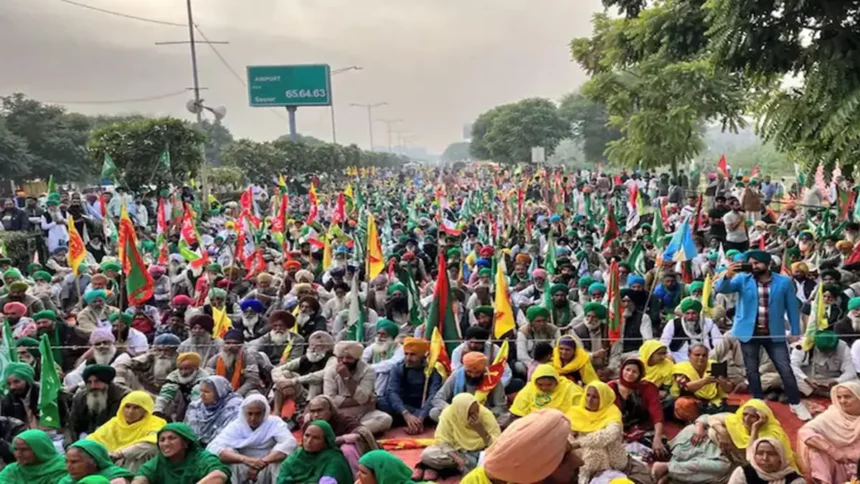
India is facing significant uncertainty today as multiple trade unions and farmers’ organisations observe a nationwide Bharat Bandh on February 12, 2026. The strike call has raised questions across the country about the functioning of essential and non-essential services, including banks, schools, colleges, public transport, government offices, and markets. With support extending across several states, particularly Kerala and Punjab, the bandh reflects growing discontent among organised labour and agrarian groups over recent economic and policy decisions taken by the central government.
The nationwide strike has been called by a joint platform of central trade unions, supported by farmer bodies, and is being positioned as a protest against what organisers describe as anti-worker and anti-farmer policies. While there is no formal declaration of a national shutdown, the scale of participation has created apprehension among citizens about daily routines, financial transactions, travel plans, and access to public services. The bandh is also politically significant, as it comes amid debates over labour law reforms and India’s evolving trade relationships with global partners.
Authorities have advised citizens to remain alert to local advisories, as the impact of the strike is expected to vary widely depending on region, level of union participation, and law-and-order preparedness. While emergency services are expected to function normally, the broader economic and social disruption remains a concern for millions across the country.
Why trade unions and farmers have called Bharat Bandh
The Bharat Bandh has been called by a joint forum of ten central trade unions, including INTUC, AITUC, HMS, CITU, AIUTUC, TUCC, SEWA, AICCTU, LPF, and UTUC. Together, these unions represent workers from a wide range of sectors, including banking, insurance, transport, manufacturing, construction, and public services. The unions have been mobilising for weeks, issuing strike notices across industries and urging workers to participate in what they describe as a decisive protest against systemic erosion of labour rights.
At the core of the unions’ agitation are the four labour codes that replaced 29 existing labour laws last year. According to union leaders, the new labour codes dilute long-standing protections for workers, weaken collective bargaining rights, and make employment more insecure by easing hiring and firing norms. They argue that the changes disproportionately favour employers and corporations while reducing safeguards related to wages, working hours, safety, and social security.
Beyond labour codes, unions have raised objections to what they see as aggressive privatisation of public sector undertakings, stagnation in wages, rising contractualisation of jobs, and inadequate social security coverage for informal and gig workers. The unions claim that despite economic growth projections, workers’ real incomes have failed to keep pace with inflation and rising living costs, deepening economic inequality.
Farmer organisations have thrown their weight behind the bandh, broadening its scope beyond urban and industrial concerns. Groups such as the Samyukt Kisan Morcha and the All India Kisan Sabha have framed the strike as a necessary response to policy decisions that they believe threaten India’s agrarian economy. Their opposition is particularly focused on the proposed India–US trade deal, which they argue could open domestic markets to heavily subsidised agricultural imports, harming Indian farmers and cooperatives.
Farmer leaders have expressed fears that increased imports of dairy products, animal feed, soybean oil, and other agricultural commodities could destabilise prices and undermine livelihoods. They have accused the government of prioritising multinational corporate interests over small and marginal farmers. The demand for the resignation of the Commerce Minister has further escalated the political tone of the protests, turning the bandh into a wider challenge to the government’s economic direction.
In addition to trade and labour concerns, the protesting groups have listed several legislative demands, including the withdrawal of the Draft Seed Bill, the Electricity Amendment Bill, and the SHANTI Act related to nuclear energy. They are also demanding restoration of MGNREGA in its earlier form and the repeal of the Viksit Bharat – Guarantee for Rozgar and Ajeevika Mission (Gramin) Act, 2025, which they claim undermines employment guarantees in rural areas.
Impact on banks, schools, transport, markets and daily life
One of the most immediate concerns for citizens during the Bharat Bandh is the functioning of banks. Public sector banks are likely to see partial disruption, as major banking unions such as the All India Bank Employees Association, the All India Bank Officers Association, and the Bank Employees Federation of India have called on members to participate in the strike. While February 12 has not been declared a bank holiday by either banks or the Reserve Bank of India, customer services may be affected depending on staff participation.
State Bank of India has acknowledged that a nationwide bank strike is scheduled for the day and has cautioned customers that operations may be impacted to a limited extent. Branch services such as cash deposits, withdrawals, cheque clearing, and document processing could face delays. IDBI Bank has also received strike notices from unions, indicating potential service disruptions. While online banking platforms and ATMs are expected to remain operational, minor technical or transaction delays cannot be ruled out. Private sector banks may function more normally, but service availability could vary by location.
Educational institutions present another area of uncertainty. There is no nationwide directive ordering the closure of schools and colleges. However, in states where transport services are disrupted or protests are intense, local administrations or institutions may choose to suspend classes as a precaution. States such as Kerala, Karnataka, and Odisha are being closely watched, as trade unions there traditionally observe strikes with high participation. Parents and students have been advised to check official communications from schools, colleges, and universities before heading out.
Public transport is expected to be among the most visibly affected sectors. In several regions, bus services, auto-rickshaws, and taxis may operate at reduced capacity or remain off roads altogether due to strike participation or safety concerns. Protest activities such as road blockades and chakka jams could lead to traffic congestion and delays, particularly in urban centres and industrial belts. Train services are generally expected to continue, but passengers may experience delays in some areas due to protests near railway tracks or stations.
Markets and shops may also remain closed in protest-hit areas, especially in states where trader associations or local unions have extended support to the bandh. In other regions, commercial activity may continue with caution, depending on local law-and-order conditions. Government offices in several states could witness reduced attendance, as employees affiliated with unions join the strike, potentially slowing administrative work and public service delivery.
Despite the widespread nature of the bandh, emergency and essential services are expected to remain operational. Hospitals, ambulances, and emergency medical services have been exempted from the strike call. Airports and essential utilities such as electricity and water supply are also likely to function normally, although travellers have been advised to leave early to account for possible road disruptions.
The Bharat Bandh has underscored the continuing tension between economic reforms and social resistance in India. For supporters of the strike, it is a demonstration of collective strength and a warning against policy decisions made without adequate consultation. For critics, it raises concerns about economic losses, inconvenience to the public, and the effectiveness of nationwide shutdowns as a tool of protest.
As the day unfolds, the real impact of the bandh will depend on regional participation, administrative response, and the balance between protest activity and public order. What remains clear is that February 12 has become a focal point for debates over labour rights, farmer interests, and the direction of India’s economic policies, with implications that extend well beyond a single day of protest.