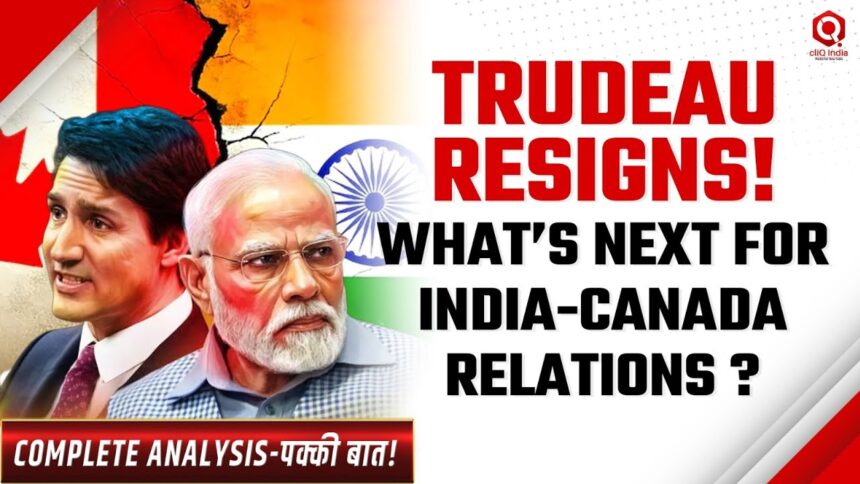
Justin Trudeau Resigns: What Does It Mean for India-Canada Relations?
In a major political development, Canadian Prime Minister Justin Trudeau has resigned from office after nearly a decade in power. His resignation not only marks a significant turn in Canadian politics but also opens up new possibilities for its strained ties with India.
Trudeau’s tenure as Prime Minister was characterized by progressive policies on climate change, LGBTQ+ rights, and social justice. However, his leadership also faced criticism for controversies, internal party pressure, and economic challenges that ultimately led to his resignation.
Reasons Behind Trudeau’s Resignation
- Internal Party Pressure:
Trudeau’s leadership faced growing dissent within his own Liberal Party, with reports suggesting that 24% of MPs demanded his resignation due to declining public support and poor crisis management. - Public Controversies:
From the 2019 blackface incident to allegations of sexual misconduct, Trudeau’s public image took a significant hit, eroding trust among voters and within his party. - Economic Challenges:
Rising inflation and a ballooning federal deficit further alienated Canadians, who expected stronger economic management during his tenure. - Tensions with India:
Trudeau’s controversial allegations that India was involved in the killing of a Sikh activist in Canada added strain to already tense diplomatic relations between the two nations.
Impact of Trudeau’s Resignation on India and the World
- For India:
Trudeau’s departure offers a potential “reset” in India-Canada relations. Diplomatic ties, which had reached a historic low during his leadership, could see improvement under new leadership. Key sectors like agriculture and trade, which were disrupted, may benefit from restored cooperation. - Global Implications:
Trudeau’s absence will impact global forums where he championed climate action and social justice. Canada’s stance on these issues may evolve under the new leadership, affecting international collaborations.
Economic Relations Between India and Canada
- Current Trade Dynamics:
Bilateral trade between India and Canada stands at approximately $11 billion. India exports pharmaceuticals, textiles, and IT services, while Canada supplies energy resources and potash. - Future Opportunities:
The stalled Comprehensive Economic Partnership Agreement (CEPA) talks could be revived, and Canada’s energy resources might play a pivotal role in India’s energy transition.
A Strategic Partnership
India and Canada’s relationship extends beyond trade, encompassing strategic and cultural dimensions. Over 3.2 lakh Indian students are currently studying in Canada, contributing significantly to its education sector. Additionally, collaborations in green energy and technology hold immense potential for both nations.
\A Diplomatic Reset or Continued Strain?
Trudeau’s resignation is both an opportunity and a challenge for India. If the new Canadian leadership adopts a neutral stance and seeks balanced policies, bilateral ties could improve significantly. However, if Trudeau’s allegations against India remain a focal point, the strained relationship may persist.
As Canada enters a new chapter, it remains to be seen whether this change will pave the way for stronger ties with India or deepen the divide further.
Watch full video here: https://www.youtube.com/watch?v=PpGaed9mcoM