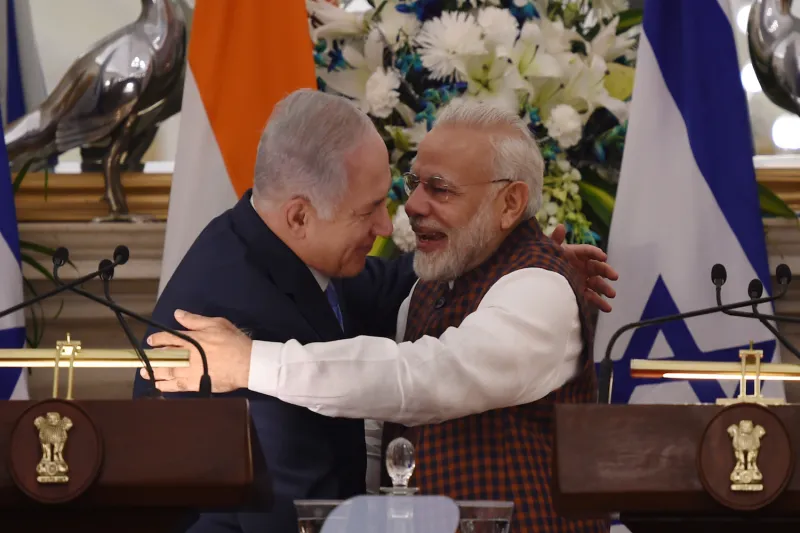
In a wide-ranging conversation with Indian journalists, Israeli Prime Minister Benjamin Netanyahu touched upon crucial issues spanning diplomacy, defence, and geopolitics. Speaking candidly about his relationships with Indian Prime Minister Narendra Modi and US President Donald Trump, Benjamin Netanyahu described them both as “terrific friends”. He said he would give PM Modi “some advice privately” on dealing with Donald Trump while stressing that the India-US relationship has a strong and enduring foundation despite recent tensions.
The Israeli Prime Minister’s remarks came shortly after the US announced tariff hikes on Indian goods over its purchase of Russian oil. Benjamin Netanyahu, however, expressed confidence that India and the US would find common ground, saying a resolution would benefit not only both nations but also Israel, which counts both countries as strategic allies.
Defence Ties and Cooperation with India
Benjamin Netanyahu revealed that Israel supplied military equipment to India ahead of Operation Sindoor, highlighting that the gear had performed effectively in combat conditions. “We don’t develop our defence equipment in labs but in the battlefield. That makes it battle-tested,” he said, underlining the depth of defence collaboration between the two nations.
He pushed for quicker finalisation of mutual defence and economic agreements, saying there is scope to elevate bilateral cooperation, especially in the areas of intelligence, counterterrorism, and high-end technology. He also noted that India’s surveillance capability could benefit from Israeli air-surveillance systems, stressing the need to stay ahead of emerging terror threats.
Benjamin Netanyahu praised India’s evolving foreign policy under PM Modi, saying that the traditional policy of neutrality has transformed into a vibrant and active friendship between India and Israel. The two nations, he said, are well-positioned to deepen cooperation across various sectors.
Gaza Conflict and Humanitarian Concerns
Discussing the ongoing war in Gaza, Benjamin Netanyahu stated that Israel’s primary goal is to dismantle Hamas and secure the release of hostages. He dismissed claims of a long-term Israeli occupation or annexation of Gaza, stating instead that once Hamas is defeated, the territory would be handed over to a transitional government.
“We will not give Gaza back to Hamas or the Palestinian Authority. We will maintain a security perimeter to ensure stability,” he said. Benjamin Netanyahu emphasized that the war could end quickly if Hamas laid down arms and freed hostages. He also claimed that even some Palestinians in Gaza are now fighting against Hamas.
On allegations of a humanitarian crisis in Gaza, Benjamin Netanyahu pushed back, arguing that Israel had allowed over 2 million tonnes of food into the territory. He said that the problem lay not in the supply of aid but its distribution, which he blamed on Hamas. He also denied reports of starvation, calling them fabricated while asserting that Israeli hostages were the ones truly suffering.
Broader Geopolitical Landscape and Regional Projects
Benjamin Netanyahu expressed optimism about the India-Middle East-Europe Economic Corridor (IMEEC), calling it a promising initiative in the changing geopolitical environment. He said Israel is eager to cooperate in the corridor, which he believes can drive future economic growth across regions.
He reiterated Israel’s stance on Iran, claiming success in neutralising nuclear and missile threats. Benjamin Netanyahu described Iran as a regime on the verge of internal collapse, citing increased dissent within the country. He argued that Israel’s operations serve broader global interests, quoting German Chancellor Friedrich Merz’s remarks that Israel is doing the world’s “dirty work”.
He noted that the so-called “axis of evil” has crumbled and suggested that regime change in Iran could be a realistic outcome—though he clarified that such change must come from within the Iranian people.
India-Israel People-to-People and Economic Ties
Benjamin Netanyahu spoke warmly of Indian caregivers and workers in Israel, calling them beloved members of Israeli society. He expressed a desire to reduce bureaucratic hurdles to enable more Indian workers to join Israel’s workforce.
He also suggested expanding direct connectivity between the two countries, proposing a direct flight route from Tel Aviv to Bangalore. He highlighted how such routes would significantly shorten travel time and boost tourism and business.
Looking forward, Benjamin Netanyahu said he wishes to visit India again soon. Reaffirming his admiration for the country and its leadership, he emphasized the vast scope for future cooperation, especially in data analytics, social media screening technologies, and joint efforts in security and counterterrorism.
In all, Benjamin Netanyahu’s address painted a picture of strategic optimism, grounded in long-standing friendships, mutual goals, and a shared vision for peace, stability, and development in an increasingly complex global landscape.