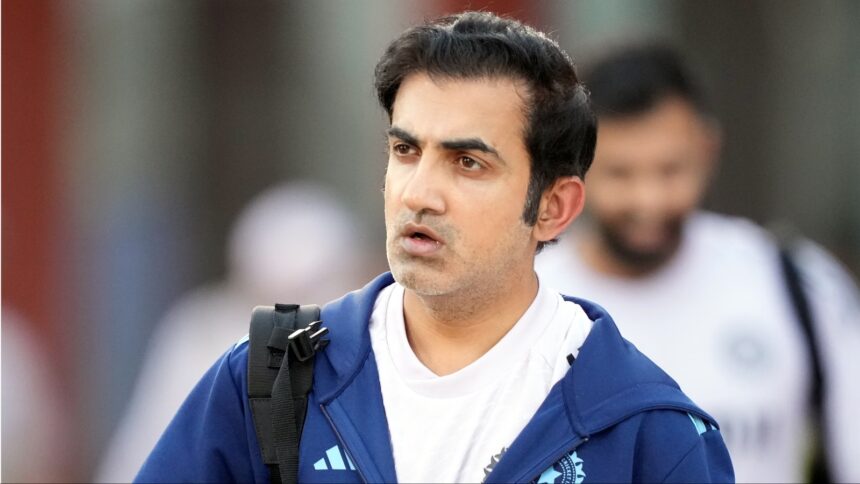
The Board of Control for Cricket in India has categorically denied reports suggesting any plan to remove or replace Gautam Gambhir as head coach of the Indian Test team, seeking to put an end to growing speculation triggered by recent on-field setbacks. Senior board officials have stressed that the current coaching structure remains intact and that no discussions have taken place about appointing a new coach for the longest format, despite heightened criticism following India’s unprecedented back-to-back home Test whitewashes.
The debate around Gambhir’s future intensified after India suffered a 0–2 Test series loss at home to South Africa, coming on the heels of a humiliating 0–3 defeat against New Zealand the previous year. These results marked a rare low point for a team that had enjoyed near-dominance in home Tests for more than a decade. As criticism mounted, media reports claimed that former India batter VVS Laxman had been approached to take over as Test coach, fuelling uncertainty and public debate. The BCCI’s leadership has now moved decisively to reject those claims and publicly reaffirm its confidence in Gambhir.
Bcci leadership rejects rumours and reiterates support for gambhir
Responding to the speculation, the Board of Control for Cricket in India vice-president Rajeev Shukla made it clear that the reports circulating in the media were incorrect and misleading. He stated unequivocally that there was no plan to remove Gautam Gambhir or to appoint a new head coach for India’s Test side. According to Shukla, both he and the board’s senior leadership remain aligned on the issue, and the speculation has no factual basis.
Shukla’s comments echoed earlier remarks by BCCI secretary Devajit Saikia, who had also dismissed the reports as completely baseless. Saikia said the board had not initiated any process to alter the coaching leadership and described the rumours as a figment of imagination. He expressed concern that even reputed platforms were amplifying unverified claims, adding that the BCCI “straight away denies” such reports.
The strong and coordinated response from top officials underlined the board’s intention to provide clarity and stability at a time when public scrutiny is intense. By openly backing Gambhir, the BCCI signalled that it does not believe in making reactionary decisions based solely on short-term results. Officials stressed that coaching appointments, particularly in Test cricket, are made with a long-term vision and are not subject to abrupt changes after a few disappointing series.
The speculation had largely been driven by India’s rare struggles at home, where the team had built a formidable reputation over years of consistent performances. The back-to-back whitewashes were seen as symbolic of deeper issues, prompting questions about tactics, selections and overall direction. However, the board’s leadership appears determined to separate performance analysis from administrative stability, arguing that rebuilding phases and transitional challenges are part of elite sport.
Test setbacks, world championship impact and shifting focus across formats
India’s recent Test defeats have had consequences beyond immediate results, notably affecting the team’s standing in the ICC World Test Championship cycle. The whitewash against New Zealand cost India a place in the 2025 final, ending what had been a largely consistent presence in the championship’s decisive stages. The subsequent loss to South Africa further compounded concerns, raising the possibility that India’s dominance in red-ball cricket may be entering a period of transition.
Critics have pointed to batting collapses, inconsistent shot selection and an apparent inability to adapt under pressure against quality pace attacks. Selection decisions and squad balance have also come under scrutiny, with questions raised about whether the team has adequately managed the transition from senior stalwarts to younger players. Supporters of Gambhir, however, argue that such transitions are inevitable and that no coaching regime can be immune to periods of adjustment, especially in Test cricket’s demanding environment.
Amid the Test cricket debate, the BCCI’s immediate priorities extend beyond the red-ball format. Attention is increasingly turning toward limited-overs cricket, particularly the upcoming ICC Men’s T20 World Cup, where India will defend the title they won last year. That triumph came under the captaincy of Rohit Sharma, but the forthcoming tournament will see a new-look leadership group and squad composition.
India’s T20 World Cup campaign is scheduled to begin on February 7, with the opening match set to take place in Mumbai against the United States cricket team. Placed in Group A alongside the Pakistan cricket team, Namibia cricket team, and Netherlands cricket team, India will face a combination of traditional rivals and emerging teams.
The T20 side, led by Suryakumar Yadav, has impressed over the past year with an aggressive brand of cricket and a largely unbeaten run in bilateral series. The absence of long-time icons Rohit Sharma and Virat Kohli in a home World Cup, however, presents both a challenge and an opportunity. For the first time in several years, India will contest a major global tournament without these stalwarts, placing greater responsibility on younger players to perform under intense scrutiny.
Against this broader backdrop, the BCCI appears keen to compartmentalise challenges across formats rather than allowing difficulties in Test cricket to destabilise the entire system. By publicly reaffirming its support for Gambhir, the board has sought to insulate the Test setup from speculation and allow the coaching staff time to address issues without external pressure.
The episode highlights the unique environment of Indian cricket, where coaching tenures are often debated as passionately as team selections and match results. The BCCI’s firm stance suggests a preference for continuity and measured evaluation rather than reactive change. As India navigates a complex phase across formats, the board’s message is clear: speculation will not dictate policy, and long-term planning will take precedence over short-term noise.