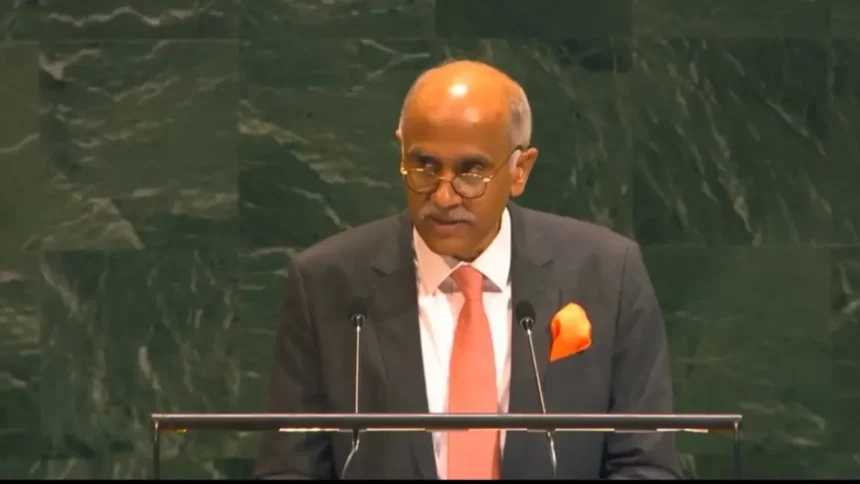
India has reinforced its commitment to peace and stability in Afghanistan, urging the international community to prevent terrorist groups from exploiting Afghan territory while highlighting the need for coordinated humanitarian and developmental support for the Afghan people. Addressing the UN Security Council on Afghanistan, India’s Permanent Representative, Ambassador Harish Parvathaneni, stressed that entities and individuals designated by the UN, including ISIL, Al Qaeda, and their affiliates such as Lashkar-e-Tayyiba and Jaish-e-Mohammed, along with those facilitating their operations, must not be allowed to use Afghanistan as a safe haven for terrorism. Ambassador Parvathaneni also outlined India’s immediate priorities in Afghanistan, including humanitarian assistance, capacity-building programs, and continued support for long-term development, health, and education initiatives, emphasizing the need for sustained international cooperation.
India’s Strong UNSC Message on Terrorism and Regional Security
During his address at the UN Security Council briefing on Afghanistan, Ambassador Parvathaneni highlighted India’s unwavering position against the misuse of Afghan territory by terrorist groups. He emphasized that coordinated global efforts are essential to prevent organizations such as ISIL, Al Qaeda, Lashkar-e-Tayyiba, and Jaish-e-Mohammed from exploiting Afghanistan. The ambassador also pointed to those who support and sponsor these organizations, indirectly referencing Pakistan’s role in enabling such activities. He stressed that these actors, whether directly or indirectly involved, must no longer be allowed to operate from Afghan soil, and the international community has a responsibility to ensure accountability and prevent any resurgence of cross-border terrorism.
Parvathaneni welcomed Afghanistan’s condemnation of the Pahalgam terrorist attack on April 22, 2025, which killed civilians in Jammu and Kashmir, reinforcing India’s longstanding position that acts of terrorism must be collectively condemned and addressed. He underscored that global coordination is crucial to tackling terrorism comprehensively, noting that Afghanistan’s security and stability are intertwined with broader regional security. The ambassador highlighted that sustained engagement with all relevant parties, including regional stakeholders and international organizations, is vital to ensuring that Afghanistan does not revert to becoming a breeding ground for extremist ideologies and violent organizations.
India’s approach, as articulated by Parvathaneni, combines immediate humanitarian assistance with long-term capacity-building initiatives to address the root causes of instability. He stressed that supporting the Afghan people through educational scholarships, rehabilitation programs, and healthcare initiatives not only improves lives but also reduces the susceptibility of communities to extremist influences. India has consistently engaged with the UN Assistance Mission in Afghanistan (UNAMA), maintaining close cooperation with the Special Representative of the Secretary-General, Roza Otunbayeva, and reinforcing its commitment to UN-led initiatives that promote stability, governance, and human development in Afghanistan.
Humanitarian Aid and Developmental Initiatives in Afghanistan
Ambassador Parvathaneni detailed India’s swift response to natural disasters and humanitarian crises in Afghanistan, highlighting the country’s immediate assistance following the 6.0 magnitude earthquake on September 1, which resulted in over 2,000 deaths and thousands of injuries. India quickly dispatched relief materials, including 1,000 family tents, 15 tons of food, and an additional 21 tons of essential supplies such as medicines, hygiene kits, blankets, and generators, ensuring rapid support to the affected provinces. This proactive response demonstrates India’s commitment to humanitarian principles and highlights its readiness to assist Afghanistan during times of urgent need.
Beyond emergency relief, India has contributed significantly to Afghanistan’s long-term development, focusing on healthcare, education, rehabilitation, and social support programs. Through collaboration with the UN Office on Drugs and Crime, India has provided over 84 metric tons of assistance and medicines for drug rehabilitation programs, especially targeting women. Additionally, India has supported Afghan students by offering scholarships and fellowships for undergraduate and postgraduate studies. Since 2023, India has provided educational opportunities to over 2,000 Afghan students, including approximately 600 girls and women, reflecting a commitment to inclusive development and empowerment.
Parvathaneni emphasized that these initiatives are integral to building resilience within Afghan communities, reducing vulnerability to extremist influence, and promoting sustainable development. He underscored that capacity-building and humanitarian programs should be complemented by strategic international cooperation to ensure a stable environment conducive to peace, security, and progress. India’s engagement demonstrates a comprehensive approach to Afghanistan, balancing immediate humanitarian needs with long-term developmental goals to foster stability and strengthen social institutions.
The ambassador also stressed the importance of a coordinated international strategy to address Afghanistan’s evolving challenges, noting that conventional approaches are insufficient. He advocated for a fresh policy framework that leverages innovative instruments to support Afghan communities, arguing that “business as usual” strategies will only preserve the status quo and fail to meet the expectations of Afghanistan’s people. Parvathaneni’s remarks underscored India’s commitment to pursuing adaptive, responsive measures that are aligned with international norms and regional stability objectives.
India’s focus on Afghanistan reflects a multidimensional strategy encompassing counterterrorism, humanitarian support, and long-term development. By calling on the international community to prevent terrorist exploitation of Afghan territory, India seeks to reinforce accountability mechanisms and ensure that UN-designated entities and their affiliates cannot operate with impunity. At the same time, India emphasizes the significance of regional cooperation, particularly among neighboring countries, to maintain security, promote economic development, and stabilize governance structures in Afghanistan.
Ambassador Harish Parvathaneni’s address at the UN Security Council highlighted India’s proactive stance on Afghanistan, emphasizing that terrorist groups and their sponsors must be prevented from exploiting the region. India remains committed to supporting peace, stability, and development through humanitarian aid, educational initiatives, and capacity-building programs. By combining immediate relief measures with strategic engagement, India aims to contribute to a stable and secure Afghanistan while ensuring that the international community upholds shared responsibilities in countering terrorism and promoting human development.
This address reaffirms India’s position as a key partner in Afghanistan’s reconstruction and as a nation advocating for coordinated global action against terrorism, highlighting the importance of sustained, multilateral efforts to foster peace, security, and inclusive growth in the region.