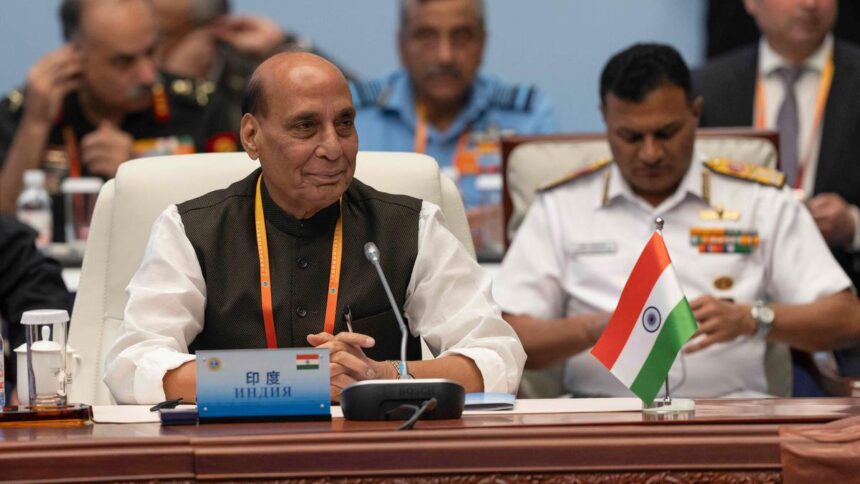
India’s Defence Minister Rajnath Singh issued a powerful message on terrorism during the Shanghai Cooperation Organisation (SCO) Defence Ministers’ Meeting held in Qingdao, China, on Thursday. Emphasizing India’s zero-tolerance stance against terrorism, Rajnath Singh said that the country will not hesitate to strike at terrorist strongholds and hold their sponsors accountable. His address highlighted India’s recent counter-terror operations and called for united international efforts to combat radicalisation, extremism, and cross-border terror.
India’s stance on terrorism draws clear lines
In a firm and direct message to the member states, Rajnath Singh declared that peace and prosperity cannot coexist with terrorism, especially when weapons of mass destruction fall into the hands of non-state actors. “The biggest challenges in our region are related to peace, security and trust deficit,” Rajnath Singh stated, urging SCO nations to confront terrorism as a shared global threat rather than an isolated issue.
“We have shown that epicentres of terrorism are no longer safe and we will not hesitate to target them,” Rajnath Singh said. Without naming countries, his words seemed to be a veiled warning to nations that provide safe havens and financial support to terror groups. He also reiterated India’s position that all nations must collectively fight terrorism and not allow political or strategic considerations to cloud this effort.
Rajnath Singh stressed that any response to terrorism must be decisive. “Dealing with these challenges requires bold and unified action,” he said, urging the SCO to adopt strong mechanisms of cooperation and reformed multilateralism. According to him, no single country—regardless of its size or power—can fight terrorism alone. He emphasized the importance of collaborative security models built on mutual trust, dialogue, and respect for sovereignty.
Operation Sindoor and India’s right to defend
Making a direct reference to India’s military response to recent terror incidents, Rajnath Singh highlighted Operation Sindoor, conducted on May 7, 2025, as a decisive strike against cross-border terrorist infrastructure. This came in the aftermath of the Pahalgam terror attack, which Rajnath Singh said bore clear similarities to previous attacks carried out by the Lashkar-e-Taiba (LeT), a Pakistan-based terror group.
“In exercising its right to defend against terrorism and deter further cross-border attacks, India launched Operation Sindoor to dismantle terrorist bases across the border,” Rajnath Singh said. He added that the operation was not just a military response but a statement of intent—that India will act swiftly and decisively when its national security is threatened.
Rajnath Singh also called upon SCO members to ensure accountability for all those involved in acts of terror—whether they are perpetrators, organisers, financiers, or sponsors. “We reiterate the need to bring them to justice,” he said, pushing for a unified global framework to hold such actors responsible.
Rajnath Singh’s remarks reflect India’s growing assertiveness on security and counter-terrorism on the global stage. They also underline the country’s broader call for reforming multilateral institutions to ensure that international cooperation against terror becomes more efficient, inclusive, and outcome-oriented.