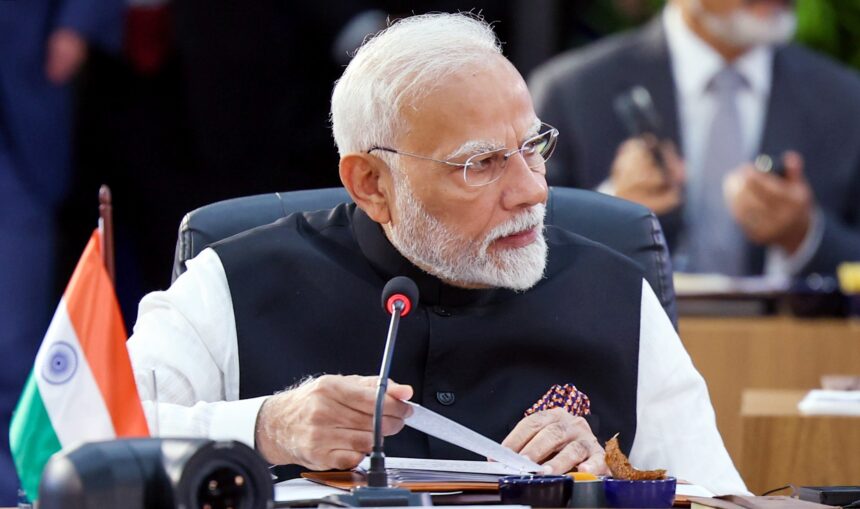
Prime Minister Narendra Modi, addressing the 17th BRICS Summit in Brazil, delivered a clear message on the urgent need to reform global governance structures while strongly condemning terrorism as a threat to humanity. His remarks, made during the session on ‘Peace and Security and Reform of Global Governance,’ reflected India’s commitment to strengthening the voice of the Global South and ensuring global institutions evolve to address modern-day challenges effectively.
According to the Ministry of External Affairs, PM Modi welcomed the unified condemnation by BRICS members of the April 22 terror attack in Pahalgam, emphasizing that terrorism is an assault on all of humanity and those who finance, promote, and provide safe havens to terrorists must face the harshest action. MEA Secretary (Economic Relations) Dammu Ravi highlighted that PM Modi’s remarks came in the context of discussions on strengthening multilateralism and ensuring peace and security in a rapidly changing global environment.
Focus on Global Governance Reform
During the session, Prime Minister Modi highlighted that many international institutions, created in the 20th century, lack the capacity to address the challenges faced by developing nations today, particularly in sustainable development, climate finance, and technology access. He emphasized the need for urgent reforms in global governance structures, including the United Nations Security Council, the IMF, the World Bank, and the WTO, to reflect contemporary realities and ensure a multipolar and inclusive world order.
PM Modi reiterated India’s commitment to supporting the Global South, stating that developing nations require enhanced support to meet sustainable development goals and tackle climate challenges effectively. He stressed the importance of reforming multilateral organizations so they can better serve the legitimate aspirations of emerging and developing countries, ensuring fair representation and effective decision-making processes in global governance.
Strengthening BRICS for a Multipolar World
Speaking on the role of BRICS, PM Modi expressed confidence that the group could play a pivotal role in shaping a more balanced and multipolar global order. He noted that the diversity and multipolarity within BRICS are strengths that enable the group to contribute to global stability and equitable growth. During discussions on strengthening multilateralism, economic and financial affairs, and artificial intelligence, PM Modi suggested creating a research and science repository within BRICS, focusing on critical mineral supply chains and cooperation in responsible AI development.
PM Modi’s proposals aimed at reinforcing BRICS’ capabilities in addressing global challenges while ensuring the collective interests of the Global South are represented effectively in global forums. He emphasized that collaboration on advanced technologies like AI and sustainable resource management could help BRICS nations secure resilient supply chains and drive inclusive development across member states.
Looking ahead, PM Modi is set to address sessions on environment, climate goals, and health at the summit, where he will outline India’s initiatives in promoting sustainable and inclusive growth. He will also highlight India’s efforts through initiatives like the International Solar Alliance, Coalition for Disaster Resilient Infrastructure, Global Biofuels Alliance, International Big Cats Alliance, and Mission LiFE, reflecting India’s commitment to pro-planet, pro-people development pathways.
The leaders at the BRICS Summit adopted a joint declaration capturing key priorities, with India’s concerns and objectives reflected significantly in the final document. The declaration strongly emphasized the need for reforming global multilateral institutions, particularly the UN and the Security Council, to make them more democratic, representative, effective, and efficient. It recognized the importance of increasing the representation of developing countries in global decision-making processes, aligning with India’s call for a reformed multilateral system that reflects current global realities.
The document reiterated the Johannesburg-II Leaders’ Declaration, supporting comprehensive reforms in the United Nations system to ensure that developing countries, including BRICS members, play a greater role in international affairs, particularly within the Security Council. This reaffirmation of the need for reform aligns with India’s vision of a balanced and inclusive global governance structure capable of addressing 21st-century challenges while upholding the aspirations of developing nations across Africa, Asia, and Latin America.