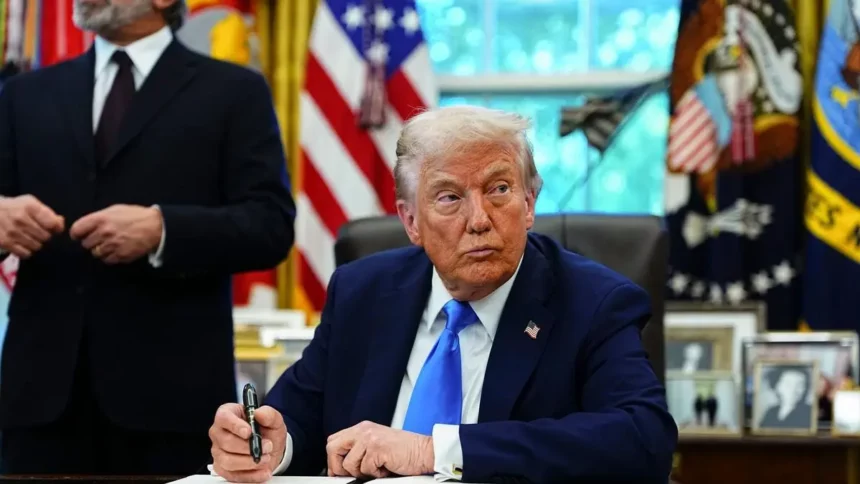
The United States under President Donald Trump has set off ripples of concern across India’s technology and science community with its dramatic clampdown on H-1B visas. Once considered the primary gateway for skilled Indian professionals seeking opportunities in Silicon Valley and other innovation hubs, the visa programme is now facing unprecedented restrictions. At the same time, countries such as Germany, the United Kingdom, and Canada are positioning themselves as attractive alternatives for India’s vast pool of highly educated workers, offering flexible visa regimes, tax incentives, and targeted recruitment schemes. The reshaping of global migration pathways underscores a growing contest to attract and retain Indian talent in a climate of tightening immigration norms worldwide.
The Trump Administration’s New Barriers to Entry
On September 21, the Trump administration clarified that its sudden decision to raise the H-1B visa fee to $100,000 would only apply as a one-time payment for new petitions and would not affect existing visa holders. While this reassured thousands of Indian professionals already working in the US, it did little to soften the blow of a policy that many view as designed to discourage new entrants. The announcement had initially triggered panic among the Indian diaspora, given that Indians account for nearly three-quarters of all H-1B visas issued annually.
In a further move, the administration proposed a fundamental restructuring of the H-1B programme. The existing lottery system, which randomly allocates the 85,000 visas available each year, is set to be scrapped. In its place, Washington plans to introduce a weighted selection system, giving preference to applicants offered higher wages and possessing advanced skills. Officials have argued that this is necessary to protect American workers from wage suppression and to ensure that only “the best and brightest” foreign professionals qualify. Critics, however, warn that the changes threaten to price out younger talent, mid-level engineers, and fresh graduates who have traditionally relied on the H-1B as a stepping stone into the US labour market.
The cumulative effect of these measures, coupled with Trump’s combative rhetoric on immigration, marks a decisive shift in US policy. Immigration lawyers point out that even those who qualify under the new framework may face delays, additional scrutiny, and unpredictable hurdles. For Indian students and workers who once saw the H-1B as an assured path to global careers, the landscape now appears uncertain and unwelcoming.
Europe and Canada Step Into the Breach
As Washington hardens its stance, European powers are accelerating their efforts to lure Indian professionals. Germany has positioned itself at the forefront of this race, branding itself a stable and reliable destination for skilled migration. In a recent video message, German Ambassador to India Philipp Ackermann highlighted that Indians in Germany earn, on average, more than native Germans—a reflection of their high skill levels and strong integration into the economy. Ackermann emphasised that Berlin’s strategy is to offer “the best jobs to the best people,” and noted that India’s pool of STEM graduates fits neatly into Germany’s future economic priorities.
The United Kingdom, too, has launched what it calls a “global talent taskforce,” aimed at attracting elite scientists, academics, and technology professionals. London is actively considering slashing or even eliminating visa fees for candidates with top-tier university degrees or globally recognised awards. Chancellor Rachel Reeves has suggested that the reforms could be accompanied by tax incentives designed to make Britain a hub for knowledge workers. However, the UK’s track record is mixed: while these measures are aimed at high-value professionals, earlier tightening of skilled worker visa rules caused a sharp decline in applications from Indian students and mid-level workers. Critics argue that Britain risks prioritising prestige hires over broader, sustainable inflows of skilled migrants.
Canada, long viewed as one of the most immigrant-friendly destinations, is facing its own challenges. Despite its inclusive image, Ottawa has reported a 50 percent year-on-year drop in work permit issuances between January and June 2025. The decline stems from tighter integrity checks across student and temporary worker pathways, reflecting rising domestic concerns over fraud and exploitation. Nevertheless, Canadian policymakers continue to stress their openness to highly skilled migrants, particularly in technology and healthcare, sectors where India remains a key supplier of talent.
China has also entered the fray with its new K-visa category designed specifically for science and technology specialists. While Beijing remains a less conventional choice for Indian professionals compared to Western countries, the initiative illustrates how the competition for human capital is becoming globalised, with India at the centre of this demand.