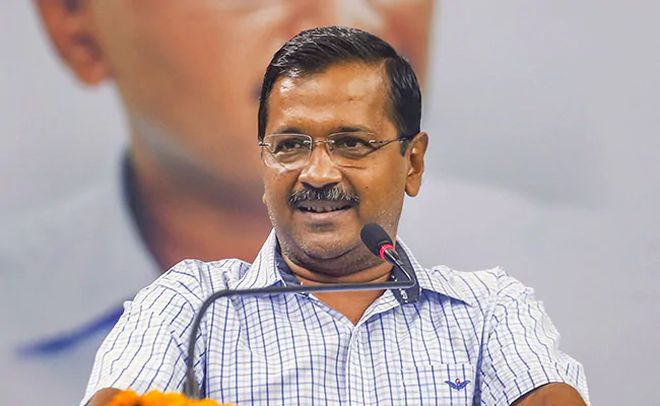
Delhi Chief Minister and Aam Aadmi Party (AAP) supremo Arvind Kejriwal raised serious questions regarding the apparent selective enforcement of law in the National Herald case, questioning why no senior leaders of the Congress have been arrested while repeatedly highlighting alleged collusion between the BJP and the grand old party. Speaking to AAP MLAs and councillors at the Constitution Club in Delhi, Arvind Kejriwal expressed his concern over what he described as a compromising political environment and the selective targeting of opposition leaders, drawing parallels with instances where AAP leaders faced incarceration in cases he deemed politically motivated. The Delhi chief minister’s remarks came amidst recent Enforcement Directorate (ED) raids at the residence of the AAP Delhi unit chief, Saurabh Bharadwaj, which have added fuel to the ongoing political debate over law enforcement impartiality and the broader implications for India’s democratic institutions.
AAP’s Stand Against Political Compromises and Alleged Nexus Between BJP and Congress
Addressing the gathered party MLAs and councillors, Arvind Kejriwal emphasized that political compromises have long plagued India’s political landscape. He remarked that the ongoing National Herald case is a clear-cut legal matter, yet no senior Congress leader has faced arrest, raising questions about the impartiality of law enforcement and the possible collusion between political parties. Highlighting the perceived bias in the system, Arvind Kejriwal pointed out that several AAP leaders were sent to jail under cases he termed false or fabricated, contrasting their treatment with the lack of accountability for senior figures in other parties. He further accused the Congress of entering into an informal compromise with the BJP, framing such political maneuvers as detrimental to democratic norms and justice.
Arvind Kejriwal recounted previous high-profile cases such as the 2G spectrum and coal scam, noting that many were abruptly closed without accountability, suggesting an ongoing pattern where politically powerful individuals escape legal consequences. He asserted that the AAP entered politics with a commitment to serve the nation rather than indulge in party compromises or personal gains. Urging his cadres to maintain integrity, he exhorted them never to compromise on principles for the sake of party positions, power, or family interests. His remarks underscored a core message: political loyalty should align with public service and ethical governance, rather than being subject to backroom negotiations and opportunistic alliances.
Further criticizing the BJP, Arvind Kejriwal claimed that the central and state governments often manipulate political narratives to deflect attention from genuine governance concerns, arguing that selective legal actions and compromises harm public trust in political institutions. By drawing attention to the treatment of AAP leaders in allegedly fabricated cases, he aimed to highlight systemic biases in the political and judicial process. His statements were a call for both accountability and transparency, asserting that the National Herald case is symptomatic of broader challenges facing India’s democracy where political power often influences legal outcomes.
Delhi Governance Issues and Criticism of Current Administration
Beyond the National Herald case, Arvind Kejriwal extensively criticized the Delhi BJP government for what he described as a series of governance failures, including widespread power cuts, rising private school fees, deteriorating road infrastructure, and jammed sewer systems. He highlighted that the capital city, once better managed under AAP governance, now faces daily inconveniences and hardships for residents. Notably, Arvind Kejriwal cited his personal observations from Lutyens Delhi, emphasizing that power outages occur multiple times a day, reflecting the administration’s inability to maintain basic services. The former chief minister contrasted these failures with AAP’s previous tenure, claiming that during their rule, such infrastructure and service issues were largely mitigated.
Arvind Kejriwal also highlighted ongoing challenges for Delhi’s marginalized communities, accusing the BJP administration of demolishing slums and implementing policies that disproportionately affect the poor. He expressed concern over reports that the Chief Minister Rekha Gupta-led administration is planning to terminate electricity subsidies, framing this as another example of governance decisions that could harm ordinary citizens. By linking these administrative shortcomings to the broader narrative of political compromise and collusion, Arvind Kejriwal sought to connect governance failures with the lack of accountability and ethical conduct in Indian politics.
Addressing party members, he urged them to remain engaged with the public, emphasizing the importance of staying connected to grassroots issues ahead of the next elections. He framed electoral participation not merely as a political contest but as an opportunity to restore governance, implement fair policies, and protect citizens’ welfare. Arvind Kejriwal’s remarks underlined a strategy of direct engagement, positioning AAP as a people-centric alternative to parties he accused of prioritizing political expediency over public service.
The Delhi chief minister also reflected on the broader implications of selective law enforcement, suggesting that the lack of arrests for senior Congress leaders in high-profile cases sends a negative message about the rule of law in India. By contrasting this with instances where AAP leaders faced incarceration, Arvind Kejriwal reinforced his narrative of political victimization while simultaneously advocating for reforms in both governance and legal accountability. His speech sought to mobilize party members around a unified message of integrity, vigilance, and ethical commitment to the electorate.
In his address, Arvind Kejriwal combined sharp critiques of current Delhi administration policies with broader allegations of political collusion, presenting a dual narrative: one of defending AAP’s record and integrity and the other of exposing perceived failings and compromises by rival parties. By framing governance issues, legal accountability, and political ethics as interconnected, he sought to provide a comprehensive critique of the contemporary political environment. This strategy was designed to strengthen AAP’s positioning ahead of future elections while fostering a narrative of principled opposition and advocacy for transparent governance.
The emphasis on remaining connected to citizens and prioritizing public welfare aligns with AAP’s long-standing political messaging, which highlights participatory governance and accountability as core pillars of the party’s philosophy. By invoking both legal and administrative issues, Arvind Kejriwal reinforced the idea that political power must be exercised responsibly, transparently, and with a focus on serving the nation rather than individual or party interests. His call for unwavering commitment among party members aimed to cultivate a culture of resilience, vigilance, and public service within AAP, emphasizing ethical responsibility as a defining feature of political leadership.
Arvind Kejriwal’s observations regarding selective law enforcement and alleged BJP-Congress collusion also touch upon broader systemic concerns in Indian politics. By framing high-profile cases like the National Herald matter within a context of political compromise, he highlighted perceived inconsistencies in the application of justice, which could erode public confidence in democratic institutions. His remarks sought to underscore the need for both transparency and accountability, positioning AAP as a party committed to fairness and principled governance while drawing contrasts with the perceived behavior of rival political entities.
Throughout his speech, Arvind Kejriwal maintained a focus on ethical conduct, public service, and the importance of principled political engagement. He framed the challenges faced by Delhi under the BJP administration as not merely policy failures but as symptoms of broader issues related to political priorities and accountability. By combining detailed critiques of infrastructure, public services, and governance policies with allegations of selective legal actions against political opponents, Arvind Kejriwal provided a comprehensive narrative linking political ethics, administrative efficiency, and public welfare.
His address also served as a call to action for AAP members, urging them to maintain vigilance, stay grounded among citizens, and uphold the party’s mission of transparent and accountable governance. By intertwining critiques of rival parties with reflections on AAP’s governance philosophy, Arvind Kejriwal highlighted both the shortcomings of the current administration and the potential for a principled alternative. The speech sought to consolidate support within the party while sending a clear message to the electorate about the importance of integrity, transparency, and dedication to public service in political leadership.
The remarks further emphasized the intersection of legal accountability, political ethics, and administrative responsibility in shaping public perceptions. By highlighting the treatment of AAP leaders in allegedly false cases and contrasting this with the absence of action against senior Congress figures, Arvind Kejriwal reinforced the theme of selective justice. His speech aimed to mobilize party cadres around a vision of ethical governance, citizen-centric policies, and principled political conduct, positioning AAP as a credible alternative committed to fairness and the nation’s long-term welfare.
Arvind Kejriwal’s narrative also explored the implications of governance failures on citizens’ daily lives, from electricity shortages and fee hikes to deteriorating infrastructure, emphasizing how administrative neglect can exacerbate social inequalities. By linking these challenges with broader political dynamics and allegations of party compromises, he provided a holistic critique of Delhi’s current political and administrative landscape.
In addressing his party members, Arvind Kejriwal underscored the importance of grassroots engagement, participatory governance, and active citizen involvement. He encouraged AAP leaders and councillors to maintain consistent interaction with communities, monitor service delivery, and act as intermediaries between the public and the administration. This approach was framed as critical for both electoral success and the broader goal of fostering a responsive, accountable government that prioritizes citizens’ welfare.
By situating allegations of selective law enforcement alongside detailed critiques of governance and public services, Arvind Kejriwal’s speech wove together a comprehensive vision for political accountability and administrative efficiency. He emphasized that ethical conduct, principled opposition, and citizen-centric policies are essential to restoring public trust and strengthening democratic processes in India. His call for uncompromising dedication within AAP served to reinforce party unity, commitment to governance, and a broader vision of ethical political engagement.