
• English
  • Hindi
  • Punjabi
  • Marathi
  • German
  • Gujarati
  • Urdu
  • Telugu
  • Bengali
  • Kannada
  • Odia
  • Assamese
  • Nepali
  • Spanish
  • French
  • Japanese
  • Arabic
  • Home
  • Noida
  • National
    • BulletsIn
    • cliQ Explainer
    • Government Policy
    • New India
  • International
    • Middle East
    • Foreign
  • Entertainment
  • Business
    • Tender News
  • Sports
    • IPL2025
  • Services
    • Lifestyle
    • How To
    • Spiritual
      • Festival and Culture
    • Tech
Notification
  • Home
  • Noida
  • National
    • BulletsIn
    • cliQ Explainer
    • Government Policy
    • New India
  • International
    • Middle East
    • Foreign
  • Entertainment
  • Business
    • Tender News
  • Sports
    • IPL2025
  • Services
    • Lifestyle
    • How To
    • Spiritual
      • Festival and Culture
    • Tech
  • Home
  • Noida
  • National
    • BulletsIn
    • cliQ Explainer
    • Government Policy
    • New India
  • International
    • Middle East
    • Foreign
  • Entertainment
  • Business
    • Tender News
  • Sports
    • IPL2025
  • Services
    • Lifestyle
    • How To
    • Spiritual
      • Festival and Culture
    • Tech
  • Noida
  • National
  • International
  • Entertainment
  • Business
  • Sports
CliQ INDIA > National > Scientists used data from more than 6,000 open clusters to map dusty veil of Milky Way
National

Scientists used data from more than 6,000 open clusters to map dusty veil of Milky Way

cliQ India
cliQ India
Share
3 Min Read
SHARE

New Delhi [India], September 16 (ANI) Astronomers have mapped in details the invisible layers of cosmic dust that veils our Milky Way and reddens the light of the stars. This may help trace the locations where next generation of stars may be forming.

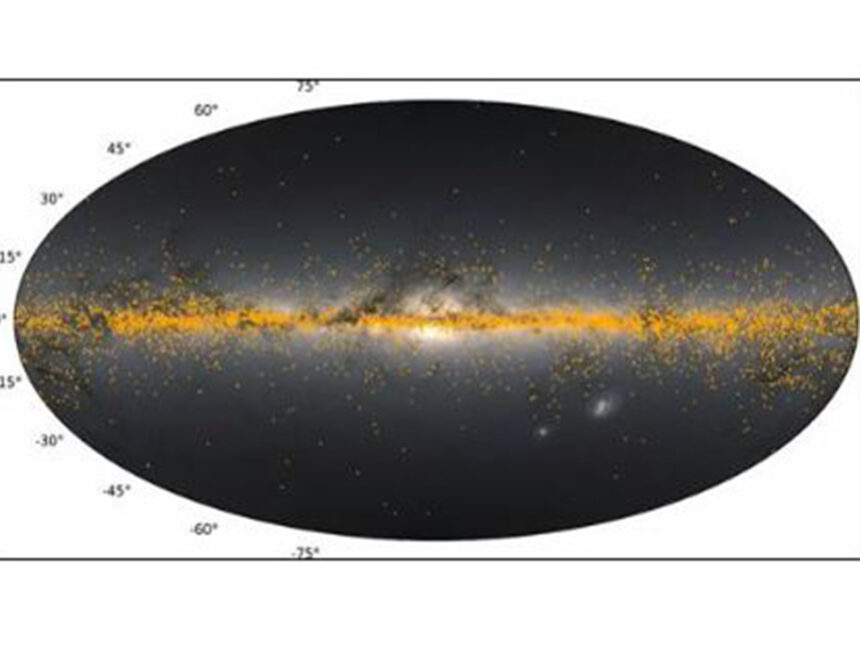
Scientists from Aryabhatta Research Institute of Observational Sciences (ARIES), an autonomous institute under the Department of Science and Technology, used the data from more than 6,000 open clusters (a type of star clusters), to chart the distribution of this interstellar dust across the Milky Way’s galactic plane or disk. Most of these clusters lie close to the Galactic disk which is the thin plane of the Galaxy where interstellar matter is predominantly concentrated and star formation takes place. Therefore, they act as reliable tracers for mapping the distribution of interstellar dust, which absorbs and dims their light.

According to a release by Ministry of Science and Technology, the study led by Dr YC Joshi reveals that the dust is not evenly distributed. Instead, it forms a thin, wavy layer that does not align perfectly with the central plane of the Galaxy, but rather lies below it.

This “reddening plane,” as scientists call it, shifts up and down in a wave-like pattern as one looks around the Galaxy. Most of the dust is found in the direction of Galactic longitude 41°, while the least is around 221°. Interestingly, the Sun is located about 50 light-years (or roughly 15.7 parsecs) above this dusty layer, the release said.

The thickness of the dust layer also varies, being denser in some regions, especially toward the Galactic center, and thinner in others. This uneven distribution points to the dynamic and complex nature of our Galaxy’s structure. This mapping gives astronomers a clearer picture of how dust is arranged in our part of the Galaxy, which is crucial for accurately studying stars and other galaxies. It also confirms that much of the dust is packed into a narrow band where new stars are actively forming.

“The study highlights the need for future observations, especially of more distant regions, to build an even more complete three-dimensional view of the Milky Way’s dusty structure,” the release said.

Upcoming missions like Gaia’s next data release and the Vera C. Rubin Observatory’s Legacy Survey of Space and Time (LSST) will play a key role in this effort, it said.

The release said that our galaxy, the Milky Way, is filled with vast clouds of interstellar dust and gas that can block or dim the light from stars.

This is called as ‘extinction’ of star light. Understanding how the dust is spread across the Galaxy helps scientists learn more about where stars form and the structure of the Milky Way. (ANI)

, https://www.aninews.in/news/national/general-news/scientists-used-data-from-more-than-6000-open-clusters-to-map-dusty-veil-of-milky-way20250916235908


You Might Also Like

"Sanatana Dharma has always worked for the welfare of the country and its people": CM Yogi
Punjab police arrest four accused for assault on Army soldiers at Kiratpur Sahib
Tamil Nadu: Former chief minister Panneerselvam files nomination from Ramanathapuram
Karnataka declared India’s first ‘Naxal-free’ state as last rebel surrenders | CliqExplainer
Prime Minister Narendra Modi Embarks on Second Leg of Gulf Tour with Visit to Qatar

Sign Up For Daily Newsletter

Be keep up! Get the latest breaking news delivered straight to your inbox.
By signing up, you agree to our Terms of Use and acknowledge the data practices in our Privacy Policy. You may unsubscribe at any time.
Share This Article
Facebook Whatsapp Whatsapp Telegram Copy Link Print
Share
What do you think?
Love0
Sad0
Happy0
Angry0
Wink0
Previous Article Driven by rising data traffic and use of AI, India's data centre capacity to rise 5x by 2030: Jefferies
Next Article Mahesh Bhatt, Anu Malik, Suhrita Das reflect on creative journey in 'Tu Meri Poori Kahani'

Stay Connected

FacebookLike
XFollow
InstagramFollow
YoutubeSubscribe
TelegramFollow
- Advertisement -
Ad imageAd image

Latest News

Bengal Falta Repoll 2026: Massive Security Deployment After Election Controversy | Cliq Latest
National
May 21, 2026
Peddi Promotion Event In Bhopal: Ram Charan And AR Rahman Ready For Mega Show | Cliq Latest
Entertainment
May 21, 2026
Junior NTR Dragon Teaser Out: NTR Stuns Fans With Intense Assassin Avatar | Cliq Latest
Entertainment
May 21, 2026
KKR Vs MI IPL 2026: Manish Pandey And Bowlers Revive Kolkata Playoff Dream | Cliq Latest
Sports
May 21, 2026

//

We are rapidly growing digital news startup that is dedicated to providing reliable, unbiased, and real-time news to our audience.

We are rapidly growing digital news startup that is dedicated to providing reliable, unbiased, and real-time news to our audience.

Sign Up for Our Newsletter

Sign Up for Our Newsletter

Subscribe to our newsletter to get our newest articles instantly!

Follow US

Follow US

© 2026 cliQ India. All Rights Reserved.

CliQ INDIA
  • English – अंग्रेज़ी
  • Hindi – हिंदी
  • Punjabi – ਪੰਜਾਬੀ
  • Marathi – मराठी
  • German – Deutsch
  • Gujarati – ગુજરાતી
  • Urdu – اردو
  • Telugu – తెలుగు
  • Bengali – বাংলা
  • Kannada – ಕನ್ನಡ
  • Odia – ଓଡିଆ
  • Assamese – অসমীয়া
  • Nepali – नेपाली
  • Spanish – Española
  • French – Français
  • Japanese – フランス語
  • Arabic – فرنسي
Welcome Back!

Sign in to your account

Username or Email Address
Password

Lost your password?



