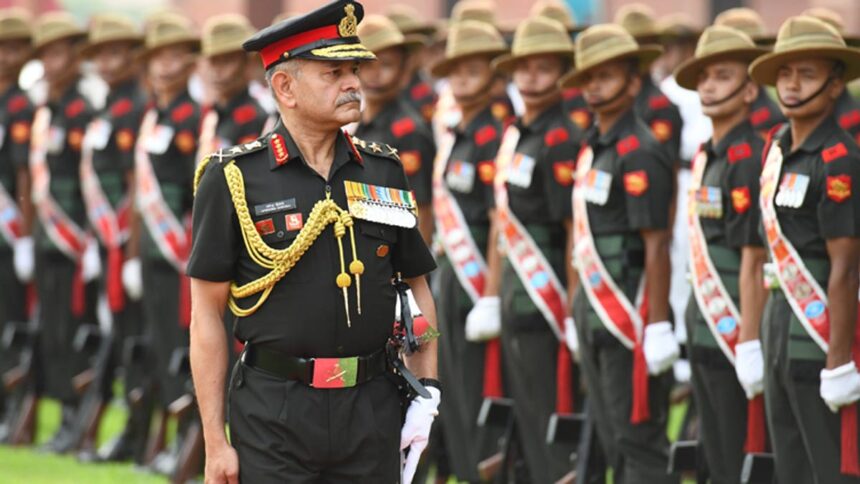
Army Chief General Upendra Dwivedi on Friday reiterated that theaterisation, the integration of the Indian Army, Air Force, and Navy capabilities under unified command, is an inevitable development for India’s defense preparedness. Speaking to the media after launching his book Operation Sindoor: The Untold Story of India’s Deep Strikes Inside Pakistan at Manekshaw Centre, Upendra Dwivedi emphasized that while theaterisation is certain, the only question remains the timeline for its implementation. According to the Army chief, the process involves careful planning, integration, and joint coordination across multiple agencies, reflecting the modern complexity of warfare and the growing need for unified command structures.
The Necessity and Strategic Importance of Theaterisation
General Dwivedi stressed that the modern battlefield no longer allows a single service to operate in isolation. He explained that an army in combat interacts with multiple forces and agencies, including the Border Security Force, Indo-Tibetan Border Police, tri-services elements, defense cyber agencies, defense space agencies, and even emerging domains such as cognitive warfare. Additionally, civilian and semi-civilian institutions like ISRO, Civil Aviation authorities, railways, and state or central administrations play a role in national security operations. Upendra Dwivedi stated that to achieve effective coordination, a single commander is essential, and theaterisation provides precisely that structure.
He emphasized that theaterisation ensures unity of command and efficiency in execution. “When we fight a battle, an Army doesn’t fight alone,” he said. Upendra Dwivedi noted that integrating various services and agencies would require multiple discussions and phased steps, underlining that the process of theaterisation is complex but essential. This statement comes nearly two weeks after divergent views were expressed by the chiefs of the Air Force and Navy during the Ran Samwad seminar at the Army War College in Mhow. Air Chief Marshal A P Singh and Navy Chief Admiral Dinesh K Tripathi highlighted differences regarding the theaterisation process, with the Air Force cautioning against hasty implementation of theatre commands. The Chief of Defence Staff General Anil Chauhan had previously assured that any dissonance among services would be addressed with the nation’s strategic interests in mind.
Upendra Dwivedi’s comments indicate that the Army views theaterisation as a critical enabler for modern, multi-dimensional warfare. By ensuring jointness across land, air, and sea operations, the Army aims to reduce redundancy, streamline command protocols, and improve responsiveness in high-stakes scenarios, including counterterrorism operations and large-scale conventional conflicts. The integration is seen not only as a tactical improvement but also as a strategic necessity in the evolving security landscape, which increasingly involves cyber, space, and unmanned platforms.
Impact of GST Reduction on Defense Modernisation and Technological Advancement
In addition to discussing theaterisation, General Upendra Dwivedi addressed recent reductions in the Goods and Services Tax (GST) on military equipment, noting the significant positive impact on defense modernization and investment in the sector. The GST on heavy military equipment has been reduced from 18 percent to 5 percent, and this, according to Upendra Dwivedi, will substantially support research, development, and procurement efforts. He pointed out that this move would particularly benefit MSMEs and startups, which often face funding constraints, by providing them with greater incentives to participate in defense manufacturing.
Upendra Dwivedi highlighted that modern warfare increasingly relies on cutting-edge technologies, including drones, unmanned aerial vehicles (UAVs), and counter-UAV systems. The GST reduction on UAVs and related systems is expected to give a major boost to India’s capabilities in this domain. “In future wars, drones, UAVs, and counter UAVs will have a big role. So keeping that in mind, it is good news for us,” he said. He also emphasized that the Army’s modernization focuses on three main areas: research and development, training, and upgradation of equipment. The tax relief, he noted, will accelerate progress in all three segments, helping the force remain prepared for contemporary and future threats.
Upendra Dwivedi also addressed queries about the situation along the Line of Control (LoC) in the context of Operation Sindoor. While he refrained from giving immediate assessments, he underlined the importance of a long-term perspective when evaluating operational outcomes. “Has state-sponsored terrorism stopped today? I don’t think so. Infiltration attempts are still being made at the LoC. How many terrorists we have neutralized and how many have run away—it’s already reported in the media,” he said. These remarks underscore the continuing operational challenges faced by Indian security forces and the necessity of joint and integrated responses, which theaterisation aims to facilitate.
The Army chief’s insistence on theaterisation comes at a time when India faces a highly dynamic security environment. From cross-border terrorism to conventional military threats and the expanding scope of cyber and space operations, the Indian armed forces are being called upon to adapt to multi-domain warfare scenarios. Theaterisation is being positioned as a solution to these challenges, offering centralized command and improved inter-service coordination, which in turn enhances operational effectiveness.
Upendra Dwivedi’s remarks also highlighted the broader strategic context of integrating military operations. He explained that, historically, India’s defense strategy has relied on the Army, Air Force, and Navy functioning with significant autonomy. While this approach has worked in many scenarios, contemporary threats require rapid decision-making, seamless coordination, and cross-domain integration. Theaterisation addresses these requirements by enabling unified planning, synchronized execution, and streamlined communication across all services and allied agencies.
The Army chief further reiterated that theaterisation would also enhance India’s ability to respond to hybrid threats, including cyber-attacks, space-based threats, and the use of cognitive warfare techniques. By consolidating command structures and operational planning, the armed forces aim to reduce delays, avoid miscommunication, and optimize the deployment of resources. This integrated approach, Upendra Dwivedi emphasized, is critical for both deterrence and effective response in modern warfare.
In conclusion, while the precise timeline for theaterisation remains under discussion, General Upendra Dwivedi’s remarks make clear that its implementation is inevitable and necessary. The phased introduction will consider inter-service inputs, operational realities, and the broader strategic objectives of the nation. The Army chief’s focus on modernization, tax reforms, and operational readiness highlights the multi-pronged approach India is taking to strengthen its defense posture. Theaterisation, coupled with improved fiscal incentives for defense R&D and technology adoption, positions India to respond effectively to evolving threats while ensuring that command structures remain efficient, responsive, and integrated across all domains.
The statement also reflects India’s evolving defense strategy, which balances technological advancement, fiscal prudence, and inter-service cooperation. By addressing both structural reforms, like theaterisation, and practical challenges, like GST-related modernization incentives, General Upendra Dwivedi provides a roadmap for India’s future military preparedness. The integration of forces under unified commands is seen as the next logical step in achieving strategic agility and operational efficiency.
As India’s security environment continues to evolve, the emphasis on theaterisation, coupled with enhanced funding and support for defense technology, ensures that the armed forces remain capable of responding to diverse threats. By fostering jointness, integrating command, and leveraging new technologies, India is positioning itself to meet the challenges of the 21st-century battlefield while maintaining a strategic edge. The Army chief’s statements, therefore, provide insight into the ongoing transformation of India’s military doctrine, signaling a forward-looking approach that combines operational readiness, technological innovation, and cohesive inter-service coordination.