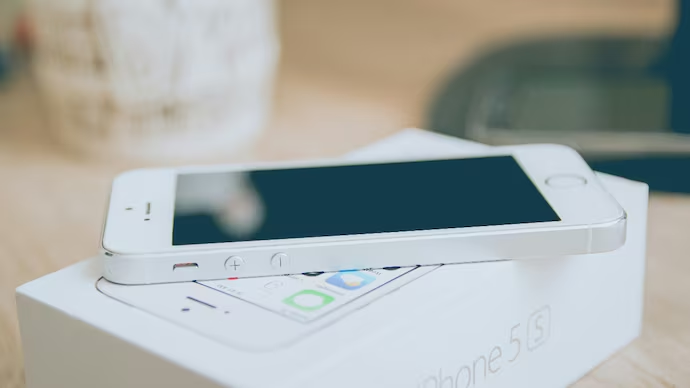
More than a decade after its launch, the iPhone 5s has unexpectedly returned to the spotlight, thanks to a quiet but meaningful software update from Apple. Released in 2013, the compact device was widely assumed to be long past its support life. Yet in 2026, Apple delivered a fresh update that ensures essential services such as iMessage and FaceTime will continue to function for years to come. This move has sparked renewed discussion about Apple’s long-term commitment to its older devices and what extended support really means in an industry known for rapid obsolescence.
A rare software lifeline for a twelve-year-old smartphone
The update, officially labeled iOS 12.5.8, is designed specifically for older iPhones that are unable to run modern versions of Apple’s operating system. Among the devices covered are the iPhone 5s and the iPhone 6, both of which have been technologically outdated for several years. Despite their age, these phones remain in circulation across the world, often repurposed as backup devices, secondary phones, or simple communication tools for children and elderly users.
Rather than introducing new features or performance improvements, the purpose of this update is far more practical. Apple has extended a critical system certificate that underpins several core services, including iMessage, FaceTime, and device activation. These certificates are essential for secure communication between the device and Apple’s servers. Without renewal, such certificates eventually expire, which can lead to sudden service failures even if the hardware itself still works.
Before the release of iOS 12.5.8, there was concern that these services might stop functioning on older devices sometime after January 2027. That scenario would have effectively rendered phones like the iPhone 5s far less useful, as basic messaging and video calling are central to everyday smartphone use. By issuing this update, Apple has ensured that users can continue to rely on these core functions for at least another year beyond that deadline.
This kind of intervention is unusual in the smartphone industry. Most manufacturers limit both security and functional updates to a relatively short window, often three to four years after launch. Even when hardware remains functional, software support tends to fade quickly, pushing users toward newer models. Apple’s decision to maintain service compatibility on a twelve-year-old device stands out against this backdrop, highlighting a different approach to long-term device care.
What extended support reveals about Apple’s broader strategy
Officially, Apple states that it provides security updates for a minimum of five years after a device is released. In practice, however, the company has repeatedly exceeded that baseline. The iPhone 6s, for example, continued to receive updates well into 2025, roughly eleven years after it first reached consumers. The recent update for the iPhone 5s pushes that boundary even further, reinforcing the idea that Apple’s real-world support policies are more flexible and generous than its formal commitments suggest.
This extended support has practical implications beyond brand image. Around the world, millions of older iPhones remain in use, particularly in regions where upgrading to the latest model every few years is neither affordable nor necessary. In many households, older devices are handed down to family members or kept as reliable backups. For elderly users especially, familiarity often matters more than cutting-edge features, and a device like the iPhone 5s can still meet basic needs with ease.
By keeping essential services operational, Apple helps prevent these devices from becoming electronic waste prematurely. From an environmental perspective, prolonging the usable life of hardware reduces the need for constant manufacturing and disposal, both of which carry significant ecological costs. While Apple rarely frames such updates explicitly in environmental terms, the effect aligns with broader sustainability goals that the company has promoted in recent years.
There is also a trust factor at play. Users who see their devices supported far beyond the expected lifespan may be more inclined to remain within the Apple ecosystem when they eventually do upgrade. Long-term software care reinforces the perception that buying an Apple product is a long-term investment rather than a short-lived purchase. In a market where planned obsolescence is often criticized, this approach helps differentiate Apple from many of its competitors.
At the same time, it is important to recognize the limits of this support. The iPhone 5s cannot run modern apps designed for recent versions of iOS, nor can it match contemporary devices in performance, camera quality, or battery efficiency. The update does not transform the phone into something it is not. Instead, it preserves what still works, ensuring that communication services do not suddenly fail due to an administrative or security technicality.
For users who continue to rely on these older devices, that distinction matters. The ability to send messages, make FaceTime calls, and activate or reset a phone without issues is often all that is required. Apple’s decision to step in with a targeted fix acknowledges this reality and shows a willingness to support real-world usage patterns rather than forcing abrupt transitions.
In an industry driven by rapid innovation and frequent upgrades, the quiet release of iOS 12.5.8 may not generate the excitement of a new flagship launch. Yet its significance lies precisely in its subtlety. By extending the life of the iPhone 5s and similar devices, Apple demonstrates that long-term software stewardship can coexist with technological progress, offering users continuity alongside change.