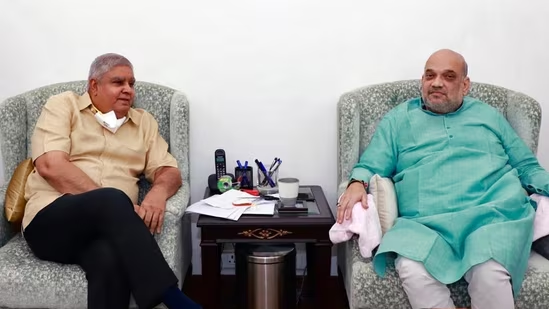
The resignation of Jagdeep Dhankhar as Vice President of India last month has stirred widespread political discussion, speculation, and media attention, especially as it comes just weeks before the upcoming Vice Presidential elections scheduled for September 9. Union Home Minister Amit Shah, addressing the media on Monday, reacted to Jagdeep Dhankhar’s decision, emphasizing that the resignation should not be overanalyzed or used as a source of political controversy. Praising Jagdeep Dhankhar for his tenure, Amit Shah stated that the former Vice President performed his constitutional duties diligently and made valuable contributions while occupying one of the highest constitutional offices in the country. According to Amit Shah, the resignation was primarily motivated by personal health considerations, and there is no need to read deeper political connotations into the decision. The remarks by Amit Shah, a senior leader of the ruling party, come amid a backdrop of heightened political scrutiny, Opposition speculation, and public curiosity regarding the reasons behind Jagdeep Dhankhar’s sudden exit from the post.
Jagdeep Dhankhar’s resignation letter, submitted last month, cited personal health concerns as the primary reason for stepping down. Reports suggest that the decision followed medical advice recommending prioritization of his health, prompting him to relinquish the demanding responsibilities associated with the Vice Presidential office. Amit Shah, in his remarks, highlighted that Jagdeep Dhankhar’s resignation was thoughtful, deliberate, and motivated entirely by personal reasons. “Jagdeep Dhankhar ji was sitting on a constitutional post and during his tenure, he did good work according to the constitution. He has resigned due to his personal health problem. One should not try to stretch it too much and find something,” Amit Shah said, conveying that the former Vice President’s contribution should be respected without unnecessary political conjecture.
The resignation of Jagdeep Dhankhar has created a political vacuum in the Vice President’s office, generating conversations across party lines and media platforms. Given that the Vice President also serves as the Chairperson of the Rajya Sabha, the second chamber of Parliament, his departure has intensified political focus on the procedural and electoral implications of the vacancy. The upcoming Vice Presidential elections, scheduled for September 9, have become a focal point for both the ruling NDA and the Opposition, with candidates being finalized and electoral strategies being actively debated. CP Radhakrishnan, former Governor of Maharashtra, has been named as the NDA’s candidate, while the Opposition has nominated former Supreme Court judge B Sudershan Reddy, setting the stage for a competitive electoral contest. The political environment has been further charged by media speculation, Opposition commentary, and public discourse around the circumstances surrounding Jagdeep Dhankhar’s resignation.
Amit Shah’s Emphasis on Constitutional Duty and Health Considerations
Union Home Minister Amit Shah’s response to Jagdeep Dhankhar’s resignation has been measured, focusing on the constitutional responsibilities of the Vice President and the personal health considerations that motivated his decision. Amit Shah emphasized that the resignation letter itself was clear, transparent, and respectful, expressing gratitude toward the Prime Minister, cabinet colleagues, and government officials for their cooperation during Jagdeep Dhankhar’s tenure. According to Amit Shah, the former Vice President’s conduct reflected dignity, adherence to constitutional principles, and a commitment to public service. “Dhankar Sahab’s resignation letter is clear in itself. He has cited health reasons for his resignation. He has also expressed heartfelt gratitude towards the Prime Minister and other ministers and government members for his good tenure,” Shah said. By framing the resignation within the context of personal health rather than political strategy, Shah sought to defuse speculation about political motives and reassure the public regarding the constitutional propriety of the process.
The timing of Jagdeep Dhankhar’s resignation also attracted significant attention due to the delayed public response by key government figures, including Prime Minister Narendra Modi. His resignation was officially announced through the Vice President’s office handle at 9:25 pm on July 21, while the Prime Minister’s response came 15 hours and 18 minutes later. This delay fueled speculation among political analysts, journalists, and Opposition leaders regarding the circumstances of Jagdeep Dhankhar’s decision, with questions raised about potential behind-the-scenes political negotiations or pressures. Despite such conjecture, Amit Shah’s comments sought to anchor the narrative around Jagdeep Dhankhar’s personal choice and health priorities, discouraging overinterpretation or politically motivated narratives around the resignation.
Opposition parties, particularly the Congress, have raised questions and speculated about the underlying reasons for Jagdeep Dhankhar stepping down. Congress leader Rahul Gandhi, in particular, suggested that Jagdeep Dhankhar’s sudden silence in political discourse, after being a prominent voice in the Rajya Sabha, hinted at deeper issues. Gandhi remarked on the unusual circumstances surrounding the resignation, suggesting that the former Vice President had been compelled into withdrawal or was under duress, calling the situation unprecedented in contemporary parliamentary practice. “Suddenly, the person who used to burst forth in the Rajya Sabha has gone silent, completely silent. So this is the time we’re living in,” Gandhi commented, framing the resignation as a potential indicator of broader political dynamics at play. Despite such Opposition theories, government officials, led by Amit Shah, have consistently emphasized that health considerations remain the sole and primary reason behind the resignation.
Political and Procedural Implications Ahead of Vice Presidential Polls
Jagdeep Dhankhar’s resignation has significant procedural and political implications for the functioning of Parliament, the Chairpersonship of the Rajya Sabha, and the strategic calculations of both ruling and opposition parties ahead of the upcoming Vice Presidential elections. As the constitutional framework dictates, the Vice President not only holds the second-highest office in the country but also serves as the presiding officer of the Rajya Sabha, responsible for maintaining order, facilitating legislative debate, and ensuring procedural adherence. The absence of an incumbent Chairperson heightens the importance of timely electoral processes and emphasizes the need for both transparency and impartiality in selecting the next officeholder. Political analysts have noted that the election is being closely monitored by parties for its symbolic and practical significance, as it reflects both the balance of power in the Rajya Sabha and broader parliamentary strategy.
Further scrutiny has emerged around Jagdeep Dhankhar’s reported involvement in legislative matters and potential actions regarding key political issues. Sources indicate that Jagdeep Dhankhar had urged certain Opposition leaders to move a notice in the Rajya Sabha regarding the impeachment of Justice Yashwant Varma, associated with the “cash-at-home” controversy. The government, however, preferred that such notices be introduced only in the Lok Sabha. This divergence has fueled narratives suggesting strategic maneuvering within parliamentary procedures, highlighting the intricate balancing act that constitutional officeholders often navigate between formal responsibilities, political pressures, and legal frameworks. While such reports have generated media attention, Amit Shah’s remarks underline the importance of contextualizing Jagdeep Dhankhar’s actions within the broader framework of constitutional duty and personal decision-making, rather than attributing undue political significance to every procedural move.
Amit Shah also addressed charges from Opposition parties suggesting that Jagdeep Dhankhar had been “silenced” or placed under “house arrest,” dismissing such claims as exaggerations. “We shouldn’t make a fuss out of all this. Dhankar held a constitutional post and discharged his duties as per the constitution. He resigned due to personal health reasons. One should not deliberate much on the issue,” Amit Shah clarified, emphasizing that speculation about political coercion or pressure undermines public understanding of constitutional processes and the personal agency of officeholders. By framing the resignation within the lens of health-driven choice, Amit Shah’s remarks aim to redirect the discourse from partisan conjecture toward respect for institutional norms, individual wellbeing, and procedural propriety.
The resignation has catalyzed political activity ahead of the September elections, prompting parties to announce candidates, mobilize support, and strategize campaigns. CP Radhakrishnan, the former Maharashtra Governor, has emerged as the NDA candidate, bringing administrative experience and party alignment to the contest, while the Opposition has nominated former Supreme Court judge B Sudershan Reddy, emphasizing judicial experience and independence. The electoral contest thus represents not only a procedural necessity to fill the Vice President’s office but also a reflection of the political balance and strategic posturing between ruling and opposition coalitions. Analysts note that while the election is constitutionally straightforward, its political symbolism has been magnified by the timing of Jagdeep Dhankhar’s resignation, preceding party mobilization, and the broader political narrative around institutional authority.
Amit Shah’s measured reaction to Jagdeep Dhankhar’s resignation underscores the government’s emphasis on respecting personal health considerations, constitutional propriety, and procedural adherence in high office resignations. By discouraging overanalysis and speculation, Amit Shah reinforces the principle that constitutional decisions should be viewed in light of formal responsibilities and personal agency rather than conjectured political motives. As the Vice Presidential elections approach, the political landscape remains dynamic, shaped by the strategic calculations of both the ruling coalition and the Opposition, while observers, media, and citizens closely monitor developments that carry both constitutional and symbolic significance in India’s parliamentary democracy.