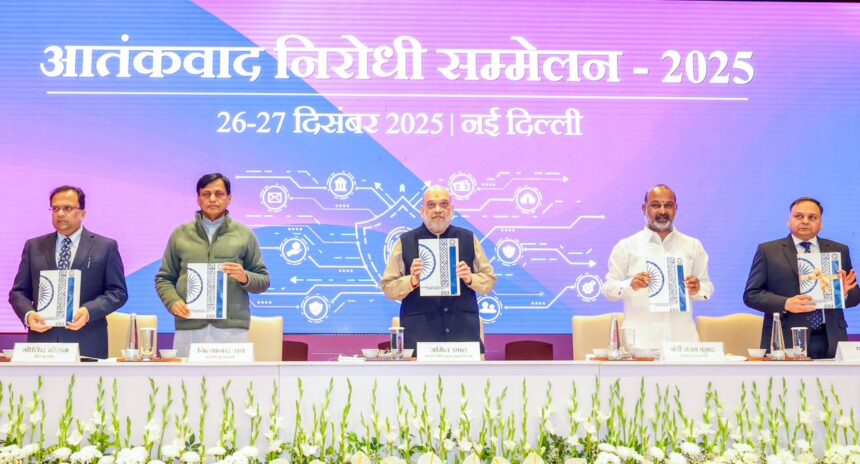
At the Anti-Terrorism Conference 2025, Union Home Minister Amit Shah presented a sweeping vision for India’s internal security architecture, urging the creation of what he described as an “impenetrable grid” to counter terrorism and organised crime. Addressing senior police leaders, intelligence officials, and security experts, Shah announced a comprehensive “360-degree strike” strategy aimed at dismantling criminal and terror networks through seamless coordination, technological integration, and proactive operations. His remarks framed internal security as a continuously evolving challenge that demands anticipation, speed, and unity of purpose across institutions.
The Home Minister stressed that India’s security threats are no longer confined to traditional borders or singular actors. Instead, they are increasingly hybrid in nature, blending terrorism, organised crime, cyber operations, narco-networks, and financial crimes. Against this backdrop, Shah argued that the country must move beyond reactive policing to a model that integrates prevention, intelligence, investigation, prosecution, and recovery in one continuous loop. The proposed approach, he said, would ensure that hostile actors find no gaps to exploit—geographical, technological, or procedural.
Building an impenetrable national security grid through coordination, technology, and intelligence
Central to Shah’s address was the call to construct an impenetrable national security grid that connects central agencies, state police forces, intelligence units, and local administrations into a single operational ecosystem. He emphasised that terrorism and organised crime thrive in silos, jurisdictional delays, and fragmented data systems. The antidote, in his view, lies in real-time information sharing, common operating protocols, and interoperable technologies that allow agencies to act as one.
Shah highlighted intelligence as the first and most decisive layer of this grid. He argued that timely, actionable intelligence—derived from human sources, technical surveillance, financial tracking, and cyber monitoring—must be fused and analysed rapidly to pre-empt threats. This requires not only modern tools but also trained personnel who can interpret complex data patterns and translate them into operational decisions. He underscored the need for continuous capacity building, suggesting that officers across ranks must be conversant with emerging technologies, digital forensics, and data-driven policing.
Technology, according to Shah, is the backbone that can make the grid truly impenetrable. He pointed to the expanding role of artificial intelligence, big data analytics, facial recognition, and secure communication platforms in enhancing situational awareness. By integrating databases related to immigration, financial transactions, telecommunications, and criminal records, agencies can identify linkages that were previously invisible. Shah cautioned, however, that technology must serve clear operational objectives and be accompanied by robust safeguards to protect civil liberties and data integrity.
Another pillar of the grid is institutional coordination. Shah acknowledged that law and order is a state subject, but argued that national security threats demand cooperative federalism in practice. He called on states to deepen their engagement with central agencies, share best practices, and adopt common standards without compromising local autonomy. Regular joint exercises, interoperable command structures, and shared training platforms were cited as ways to build trust and operational familiarity among agencies.
The Home Minister also addressed the importance of legal and procedural alignment. An impenetrable grid, he said, is weakened if investigations falter at the prosecution stage. He urged closer coordination between investigators and prosecutors from the earliest stages of a case, ensuring that evidence collection meets judicial standards. Fast-tracking cases related to terrorism and organised crime, strengthening witness protection, and using specialised courts were highlighted as necessary complements to policing and intelligence efforts.
The 360-degree strike doctrine and India’s evolving response to organised crime and terrorism
Expanding on the concept of a “360-degree strike,” Shah described it as a doctrine that targets criminal and terror networks across the entire spectrum of their operations. Rather than focusing solely on foot soldiers or isolated incidents, the strategy seeks to dismantle the full ecosystem that sustains these networks. This includes leadership structures, recruitment pipelines, financing channels, logistical support, digital propaganda, and cross-border linkages.
Shah explained that under this approach, enforcement agencies would act simultaneously on multiple fronts. Financial investigations would choke funding sources through asset seizures and anti-money laundering measures. Cyber units would disrupt online radicalisation, encrypted communications, and digital fraud. Ground operations would neutralise operatives and dismantle safe houses, while diplomatic and international cooperation would be leveraged to address cross-border dimensions. The objective, he said, is to deny criminal and terror groups the space and resources needed to regenerate.
Organised crime received particular attention in Shah’s address, reflecting concerns about its growing sophistication and convergence with terrorism. He noted that syndicates involved in drugs, arms trafficking, illegal mining, and extortion increasingly exploit digital tools and transnational routes. The 360-degree strategy, he argued, recognises that tackling such networks requires sustained pressure rather than episodic crackdowns. By aligning intelligence, enforcement, and policy measures, the state can create a hostile environment that makes organised crime economically unviable.
The Home Minister also spoke about the role of states and local policing within the 360-degree framework. He emphasised that while central agencies play a crucial role, local police stations are often the first point of contact and the most familiar with ground realities. Strengthening police infrastructure, improving training, and modernising equipment at the grassroots level were presented as essential to ensuring that the national strategy translates into local effectiveness.
Shah addressed the human dimension of security as well. He argued that public trust and community engagement are indispensable in counter-terrorism and crime prevention. Citizens who feel secure and respected are more likely to share information and resist radicalisation. The 360-degree approach, therefore, also includes outreach programmes, counter-narratives, and social interventions aimed at addressing vulnerabilities that extremist groups exploit.
Looking ahead, Shah framed the Anti-Terrorism Conference as a platform for continuous adaptation rather than a one-time declaration. He urged participants to treat security planning as a living process that evolves with changing threat landscapes. Regular reviews, performance audits, and feedback mechanisms were presented as tools to ensure that strategies remain relevant and effective.
Throughout his address, Shah returned to the idea of resolve. An impenetrable grid and a 360-degree strike doctrine, he said, are not merely administrative constructs but expressions of political will and institutional commitment. By aligning policy, technology, and personnel around a shared mission, India can stay ahead of adversaries who seek to exploit complexity and division.
The conference concluded with a clear message: internal security in the modern era demands integration without rigidity, strength without complacency, and vigilance without fear. Shah’s call for an impenetrable grid and coordinated, all-around action signalled an intent to institutionalise these principles, setting the tone for India’s counter-terrorism and organised crime strategy in the years ahead.