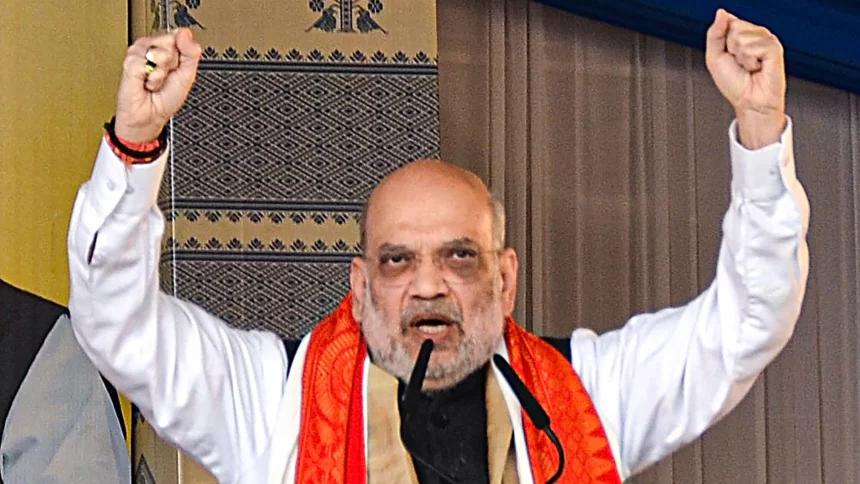
Union Home Minister Amit Shah, while addressing the 10th Mising Youth Festival in Assam, underscored the dramatic demographic changes that Assam witnessed during the Congress rule and emphasized the BJP-led government’s efforts under Prime Minister Narendra Modi to reverse these trends. Speaking at the closing ceremony of the festival organized by the Takam Mising Porin Kebang at Kareng Chapori, Amit Shah appealed to the people of Assam to support the BJP in the upcoming Assembly elections to protect tribal identity, curb illegal immigration, and ensure the security and development of the state. He claimed that unchecked infiltration during the previous Congress regime had significantly altered Assam’s population balance and that only a strong, decisive BJP government could address these challenges effectively. Amit Shah also highlighted the role of the Mising community in safeguarding the region and contributing to national projects, praising their culture, work ethic, and resilience.
Demographic Shifts and BJP’s Efforts to Reverse Infiltration
Amit Shah alleged that Assam’s demography underwent a radical transformation under the Congress regime, with the population of infiltrators rising from almost nil to 64 lakh, making them a majority in seven districts. He claimed that this demographic shift not only posed a threat to the identity of indigenous communities but also strained resources and impacted the social and cultural fabric of the state. The Union home minister stated that the BJP government under Prime Minister Narendra Modi had taken multiple measures to reverse these demographic changes and prevent further infiltration. He urged voters to elect the BJP for a third term in Assam to empower Chief Minister Himanta Biswa Sarma and continue the work of safeguarding the state’s borders and tribal populations.
Amit Shah highlighted the government’s efforts in recovering encroached land, asserting that two BJP administrations had successfully freed 1.26 lakh acres of land from illegal occupation by infiltrators. He also praised the Mising community for its unique contribution to maintaining Assam’s territorial integrity, emphasizing that their adherence to cultural practices, disciplined lifestyle, and strong work ethic had prevented further settlements of infiltrators in Upper Assam. According to Amit Shah, the community’s lifestyle, which emphasizes collective hard work, has served as an effective, non-violent defense against demographic encroachment.
The Union home minister drew attention to the strategic and developmental aspects of infrastructure projects in the region, specifically mentioning the Bogibeel bridge over the Brahmaputra, connecting Dibrugarh and Dhemaji. He credited the Mising community for their contribution to the construction of this landmark, stating that the bridge was a symbol of India’s progress and a representation of the vision of a New India under Prime Minister Modi. Amit Shah pointed out that while former Prime Minister Manmohan Singh, a Rajya Sabha MP from Assam, had served for a decade, the bridge remained incomplete during that period, but under the current government, it was completed in just four years, demonstrating efficiency and focused governance.
In his address, Amit Shah also emphasized the BJP’s commitment to tribal welfare. He noted that during the Congress regime, several tribal communities struggled to preserve their identity and traditional practices. Under the BJP government, the Mising society and other tribal communities have received targeted support through the appointment of a Centre-appointed interlocutor and initiatives aimed at addressing community-specific issues. Amit Shah underlined that the government’s policies are designed not only to safeguard identity and culture but also to ensure inclusive development that strengthens local communities economically and socially.
Cultural Significance, Community Contributions, and National Recognition
Beyond political and demographic concerns, Amit Shah highlighted the rich cultural heritage of the Mising community. He spoke about their traditional stilt houses, known as ‘chang ghar,’ which are ingeniously designed to allow floodwaters to pass through, representing a silent yet effective response to environmental challenges and climate change. He expressed admiration for the community’s commitment to preserving these practices and highlighted the potential of such traditional knowledge to inspire broader ecological solutions. Amit Shah also announced plans for a special recruitment drive to encourage Mising youth to join central paramilitary forces, providing both employment opportunities and pathways for national service.
Amit Shah expressed personal reverence for the Mising community, stating that attending the Mising Youth Festival had been a deeply meaningful experience, connecting him to the community’s cultural and spiritual practices. He praised the ‘Donyi-Polo’ tradition, rooted in the worship of the Sun and the Moon, as an example of nature-centric spirituality with a distinct identity that extends beyond Assam and Arunachal Pradesh, reflecting the global and national significance of indigenous practices. According to Amit Shah, the Mising community’s spiritual and cultural ethos exemplifies the values of resilience, harmony with nature, and social cohesion, offering lessons for India as a whole.
The Union home minister also criticized the Congress for its failure to recognize and protect India’s cultural diversity. He contended that opposition leaders often equate the discussion of India’s rich cultural heritage with marginalizing other communities. Amit Shah emphasized that the BJP believes in the equal right of every culture, language, and tradition to flourish, highlighting that the Mising community’s contributions are emblematic of India’s broader commitment to diversity. He called for the electorate to understand the importance of cultural preservation alongside political governance, linking the protection of tribal communities and heritage with national development and security.
In his concluding remarks, Amit Shah called upon the voters of Assam to consider the implications of demographic changes, historical governance, and the BJP’s achievements in infrastructure, development, and tribal welfare when casting their votes. He reiterated the need for a third consecutive term for the BJP in Assam to continue reversing demographic shifts, curb illegal immigration, and strengthen local governance under Chief Minister Himanta Biswa Sarma. By framing the narrative around security, identity, development, and cultural preservation, Shah aimed to consolidate support among the Mising community and other tribal groups, while presenting the BJP as a party capable of ensuring stability and progress in Assam.
The address highlighted the intertwining of cultural pride, political advocacy, and developmental achievements. Amit Shah’s references to infrastructure projects, tribal contributions, traditional knowledge systems, and religious practices emphasized a governance approach that is inclusive of indigenous communities while promoting broader state and national objectives. By connecting cultural recognition with political decision-making, Amit Shah sought to reinforce the message that electoral choices have direct implications for the protection of Assam’s unique demographic and cultural landscape.
The Union home minister’s speech resonated with both historical narratives and contemporary concerns, linking the Congress period’s alleged mismanagement with the BJP’s proactive measures to restore balance. By citing concrete examples such as land recovery, infrastructure development, and youth employment initiatives, Amit Shah framed the BJP government as effective in both governance and community welfare. He also stressed that the continued participation of tribal communities, including the Mising society, is essential in ensuring that Assam’s unique culture and demographic stability are maintained for future generations.
Through this speech, Amit Shah positioned the BJP’s governance model as one that prioritizes security, cultural integrity, economic development, and national progress, appealing to voters across Assam to support the party in upcoming elections. The emphasis on the role of indigenous communities, particularly the Mising, showcased a blend of respect for tradition and modern governance aimed at strengthening the state’s political, social, and cultural resilience. Amit Shah’s address underscored that political stability and effective governance are inseparable from cultural preservation, infrastructural development, and strategic planning, forming a comprehensive blueprint for Assam’s future under the BJP.
The narrative presented by Amit Shah intertwined the significance of local identity with broader national objectives. He argued that by safeguarding tribal communities, curbing illegal immigration, and advancing development projects such as the Bogibeel bridge, the BJP is simultaneously promoting regional stability and contributing to India’s vision of a modern, secure, and culturally vibrant nation. The Home Minister’s focus on youth participation, traditional practices, and recruitment initiatives for Mising youth exemplified the party’s intent to integrate local communities into the larger framework of national progress while reinforcing cultural and demographic protection.