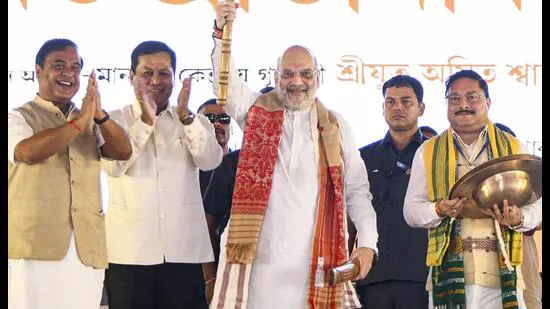
Union Home Minister Amit Shah is set to undertake a significant two-day visit to Assam beginning Friday, reinforcing both governance priorities and political strategy in a state preparing for assembly elections. The visit carries administrative weight through the launch of the Vibrant Villages Programme and symbolic momentum as the ruling Bharatiya Janata Party intensifies efforts to secure a third consecutive term in power. With developmental initiatives aligned alongside public outreach engagements, the tour underscores how infrastructure and electoral preparation are increasingly intertwined in contemporary Indian politics.
The itinerary reflects careful calibration. Shah is scheduled to reach Guwahati around noon before proceeding to the Natanpur border outpost in Cachar district. The launch of the Vibrant Villages Programme at Natanpur village places focus squarely on border communities that have historically remained distant from mainstream development narratives. By addressing a public meeting in the same region, the visit combines administrative announcement with grassroots messaging, signaling that national security, infrastructure expansion, and livelihood generation are central pillars of the government’s regional agenda.
This marks Shah’s third visit to the state since late December, a frequency that reflects the electoral significance of Assam’s 126 assembly constituencies. As the political calendar advances toward the March-April polls, repeated high-level engagements suggest that the national leadership views the northeastern state not merely as a peripheral territory but as a strategic cornerstone in the broader political landscape.
Border Infrastructure and the Vibrant Villages Programme
The launch of the Vibrant Villages Programme during the Amit Shah Assam visit is not an isolated administrative gesture but part of a broader policy architecture aimed at strengthening India’s frontier regions. Border villages have often grappled with connectivity deficits, limited healthcare facilities, restricted educational access, and economic stagnation. By targeting infrastructure, livelihood generation, and community development, the programme attempts to reposition these settlements from vulnerable outposts to thriving gateways of national integration.
Cachar district, chosen as the launch site, carries both geographical and political symbolism. Situated near international borders, it embodies the developmental challenges common to frontier districts. Strengthening road networks, communication infrastructure, and public facilities in such areas serves a dual function: enhancing local living standards and reinforcing national security frameworks. Border infrastructure development has increasingly been viewed as a stabilizing force, discouraging outmigration while fostering economic resilience.
The decision to visit the Natanpur border outpost underscores the security dimension embedded within development initiatives. Border outposts are not only strategic defense points but also hubs of civilian-military interaction. By anchoring the programme launch in this setting, the government signals an integrated approach that links security preparedness with civilian advancement.
Beyond infrastructure, livelihood generation remains a critical objective. Economic empowerment in border regions reduces dependency vulnerabilities and strengthens community participation in governance. Improved market access, agricultural support, small enterprise facilitation, and connectivity upgrades can reshape socio-economic landscapes that were previously marked by marginalization.
The Amit Shah Assam visit also intersects with national narratives emphasizing self-reliance and balanced regional growth. Infrastructure expansion in border districts aligns with broader themes of inclusive development, ensuring that remote communities are integrated into mainstream economic circuits. The political implications are equally significant, as visible infrastructure projects often translate into tangible voter perception shifts.
In the context of Assam’s electoral calendar, the programme launch operates as both policy execution and political signaling. By foregrounding development in sensitive border areas, the ruling establishment reinforces its narrative of stability, security, and progress. Repeated high-level visits create a perception of sustained engagement rather than episodic attention, a factor that can influence electoral outcomes in closely contested constituencies.
Political Mobilization and Security Engagements Ahead of Elections
While infrastructure forms one axis of the visit, political mobilization constitutes another equally important dimension. The Amit Shah Assam visit includes participation in the annual day parade of the Central Reserve Police Force at the Arjun Bhogeswar Baruah Sports Complex. This engagement extends the visit’s focus beyond development into institutional solidarity with security forces. The CRPF has played a pivotal role in maintaining internal security across the country, including in northeastern states where complex socio-political dynamics have historically shaped governance challenges.
Attending the parade sends a message of recognition and reinforcement to paramilitary personnel while symbolically linking national leadership with ground-level security apparatus. In a pre-election environment, such gestures resonate with themes of stability and order, factors that frequently influence voter confidence.
Another major engagement during the visit is the laying of the foundation stone for the new campus of the 10th Assam police battalion at Kasutoli in Sonapur. Expansion of police infrastructure indicates investment in long-term institutional capacity. Modern campuses enhance training standards, improve personnel welfare, and strengthen law enforcement efficiency. In states with diverse demographic and geographical complexities, robust policing infrastructure can significantly influence governance outcomes.
Chief Minister Himanta Biswa Sarma has emphasized that multiple initiatives will be dedicated to the people during the visit, framing it as part of the state’s broader development journey. His public messaging reflects synchronization between state and central leadership, projecting unified governance. This cohesion is strategically valuable during election periods, as it presents a consolidated administrative front.
At the national level, Prime Minister Narendra Modi and other senior leaders have also increased their visits to Assam, reinforcing the state’s prominence in the electoral roadmap. The frequency of such engagements underscores the competitive political environment and the importance of retaining momentum in regions where electoral margins can shift rapidly.
The political narrative surrounding the Amit Shah Assam visit extends beyond immediate announcements. It represents a broader attempt to weave together infrastructure expansion, institutional strengthening, security acknowledgment, and electoral outreach into a coherent campaign strategy. Public meetings, programme launches, and ceremonial engagements are choreographed to reinforce the perception of active governance.
Assam’s electorate has historically responded to issues of identity, development, and security. By addressing border infrastructure and reinforcing law enforcement capabilities, the visit touches upon multiple voter priorities simultaneously. The symbolic weight of launching development schemes in frontier villages contrasts with the ceremonial respect extended to security forces, creating a multifaceted engagement framework.
As the assembly elections approach, the intersection of governance delivery and political communication becomes increasingly pronounced. Development projects provide substantive material for campaign narratives, while repeated high-profile visits maintain media visibility and organizational mobilization. The Amit Shah Assam visit exemplifies this dual-track approach, where policy rollout and political consolidation proceed in tandem.