Air India’s Delhi–Shanghai revival reflects renewed India–China air links and the carrier’s expanding long-haul international ambitions.
After nearly six years of absence from mainland China, Air India is preparing to re-enter one of Asia’s most important aviation and economic corridors with the resumption of non-stop flights between New Delhi and Shanghai. Announced in mid-November 2025, the decision marks a significant step in the airline’s broader international network rebuild and comes amid a gradual reopening of direct air connectivity between India and China following prolonged suspensions during and after the covid period. From February 1, 2026, passengers will once again be able to fly directly between the Indian capital and China’s financial powerhouse, restoring a vital link for business travellers, students, tourists, and the Indian diaspora.
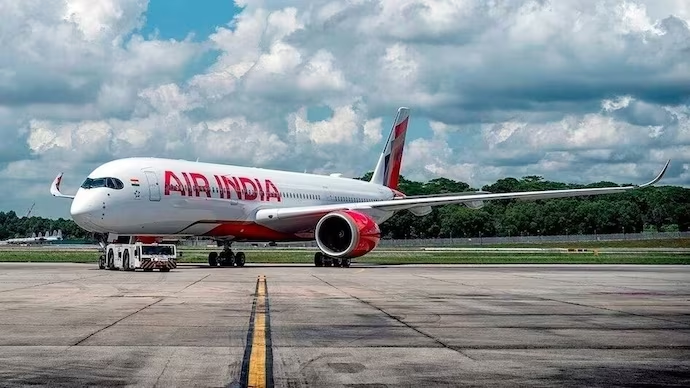
The new service will operate four times a week using Air India’s long-haul Boeing 787-8 Dreamliner aircraft. The airline has positioned the route as a strategic addition to its international portfolio, identifying Shanghai as its 48th overseas destination. Beyond the immediate operational details, the announcement also carries symbolic weight. It signals renewed confidence in demand between the two countries and highlights Air India’s intention to reclaim its role as a key connector between India and major global hubs, particularly in east Asia.
Restoring a long-suspended corridor between india and china
The Delhi–Shanghai route had been absent from Air India’s map for almost six years, a period marked by unprecedented disruption to global aviation. Flights between India and China were among the earliest to be suspended during the outbreak of covid-19 in early 2020, and they remained heavily restricted long after other international routes reopened. Diplomatic tensions, regulatory limitations, and subdued travel demand all contributed to the prolonged pause, leaving passengers dependent on indirect connections through third-country hubs in southeast Asia or the middle east.
By reinstating non-stop services between New Delhi and Shanghai, Air India is helping to normalise air travel ties that had once been among the busiest in the region. Shanghai, served via Shanghai Pudong International Airport, is not only China’s largest city but also a global centre for finance, manufacturing, trade, and technology. Direct connectivity is expected to significantly reduce travel time compared to one-stop itineraries, making the route more attractive for time-sensitive corporate travel as well as cargo movement in the passenger aircraft belly.
Air India has confirmed that the service will be operated by its Boeing 787-8 fleet, an aircraft type known for its fuel efficiency and passenger comfort on long-haul routes. The Dreamliner’s deployment underlines the airline’s confidence in steady demand while allowing flexibility as traffic gradually builds up. Operating four weekly rotations initially also reflects a cautious but optimistic approach, balancing market re-entry with prudent capacity management.
The resumption comes at a time when direct India–China air services are slowly expanding again after years of minimal connectivity. While several foreign carriers have already reintroduced limited frequencies between the two countries, the return of India’s flag carrier holds particular importance. For Indian travellers, Air India’s presence offers familiar service standards, easier domestic connections, and the possibility of integrated itineraries across the airline’s growing network.
Beyond passenger traffic, the route is also expected to benefit trade and logistics. Shanghai’s role as a global shipping and manufacturing hub makes it a key destination for Indian exporters and importers. Non-stop flights can support faster movement of high-value or time-sensitive cargo, strengthening commercial links that go beyond tourism alone.
network expansion, fu==ture plans, and strategic significance
The Delhi–Shanghai announcement fits into Air India’s wider transformation strategy, which has seen the airline steadily rebuild and expand its international footprint. Since coming under new ownership, Air India has focused on restoring routes that were suspended in earlier years while also launching services to new destinations across europe, north america, and asia. Positioning Shanghai as the 48th international destination highlights the scale of the airline’s global ambitions and its intent to be a serious competitor in long-haul markets.
In addition to the Delhi service, Air India has signalled plans to introduce flights between Mumbai and Shanghai later in 2026, subject to regulatory approvals. If implemented, this would further strengthen connectivity between India’s two most important commercial centres and China’s leading financial hub. Mumbai–Shanghai flights would cater to a different but equally significant passenger base, including corporate travellers, financial professionals, and members of the trading community with deep links between the two cities.
The timing of the resumption is also noteworthy. February 2026 coincides with a period when business travel traditionally begins to pick up after the year-end lull, and it positions Air India to capture demand around trade fairs, corporate engagements, and academic exchanges. Shanghai’s importance as a destination for exhibitions and international conferences makes the route especially relevant for Indian companies looking to expand or maintain their presence in the chinese market.
From a competitive perspective, the move places Air India back into direct competition with foreign carriers that have dominated India–China traffic during the years of limited connectivity. Non-stop flights offer a clear advantage over one-stop options in terms of convenience and travel time, and Air India’s growing domestic network allows seamless onward connections from Delhi to cities across India. This hub-and-spoke advantage is likely to be a key selling point as the airline markets the route to travellers from smaller indian cities.
The resumption also carries broader implications for bilateral relations and people-to-people exchanges. Air connectivity often acts as a barometer of broader engagement between countries, and the gradual restoration of flights suggests a willingness on both sides to normalise practical cooperation even amid complex political dynamics. For students, researchers, and professionals who have struggled with indirect routes and higher travel costs in recent years, the return of direct flights represents a meaningful improvement in mobility.
Operationally, the use of the Boeing 787-8 allows Air India to offer modern cabin amenities while maintaining efficiency on a route that is still in its rebuilding phase. As demand stabilises and grows, there is potential for increased frequencies or the deployment of larger aircraft, depending on market response and regulatory frameworks. The airline’s public indication of future Mumbai–Shanghai services suggests that China is once again being viewed as a core market rather than a peripheral one.
Taken together, Air India’s decision to resume non-stop Delhi–Shanghai flights from February 2026 is more than just the launch of another international route. It reflects the gradual healing of disrupted air corridors, the airline’s renewed confidence in long-haul operations, and the enduring importance of direct connectivity between two of Asia’s largest economies.