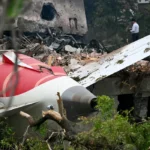
In its initial findings on the tragic Air India crash in Ahmedabad, the Aircraft Accident Investigation Bureau (AAIB) has revealed that both engines of the Boeing 787-8 Dreamliner shut down mid-air just seconds after takeoff, leading to the deadly crash that claimed 260 lives. Despite the alarming discovery, the report has not recommended immediate action against Boeing or General Electric, the engine manufacturer, as the investigation continues to gather and analyse further data.
The Air India flight AI171, bound for London’s Gatwick Airport, crashed shortly after taking off from Ahmedabad’s Sardar Vallabhbhai Patel International Airport on June 12. The aircraft, registered as VT-ANB and in service since 2013, had recently cleared routine maintenance checks and complied with all airworthiness directives, with no technical issues reported before the flight.
Engines Shut Down Seconds After Takeoff
According to the AAIB report released shortly after midnight on Saturday, both engines of the Dreamliner experienced fuel cutoff just seconds after takeoff. The fuel cutoff switches that regulate the engines shifted from the ‘RUN’ to ‘CUTOFF’ position almost simultaneously, within a second of each other. This sudden shutdown led to the deployment of the Ram Air Turbine (RAT) as the aircraft began losing altitude immediately, unable to maintain powered flight.
Data from the Enhanced Airborne Flight Recorder (EAFR) revealed the sequence of events following the shutdown. At 08:08:52 UTC, Engine 1’s fuel cutoff switch transitioned back to ‘RUN,’ followed by the Auxiliary Power Unit (APU) inlet door opening in line with auto-start protocols at 08:08:54 UTC. By 08:08:56 UTC, Engine 2’s fuel cutoff switch also moved back to ‘RUN.’ The report explained that when these switches are moved from ‘CUTOFF’ to ‘RUN’ in flight, each engine’s full authority dual engine control (FADEC) system manages the relight and thrust recovery sequence automatically. However, despite these recovery attempts, the aircraft could not regain stable powered flight, leading to the crash.
Experienced Crew and Cleared Safety Checks
The AAIB report highlighted that the aircraft’s pilots were highly experienced, with the pilot-in-command, Captain Sumeet Sabharwal, aged 56, having logged over 15,000 flying hours, while the co-pilot, Clive Kunder, aged 32, had over 3,400 flying hours. Both pilots were medically fit and had no duty irregularities before the flight, indicating that the crew was fully qualified to operate the flight under standard procedures.
Additionally, the report confirmed that the aircraft had passed all routine maintenance checks, and the fuel quality met all required standards before departure. There were no indications of technical malfunctions in the engines or flight control systems leading up to the incident, reinforcing the complexity of the investigation into what triggered the simultaneous shutdown of both engines in mid-air.
While the report does not recommend immediate action against Boeing or GE, the manufacturers of the aircraft and its engines, it notes that further analysis is ongoing to determine the exact causes and potential preventive measures to avoid such incidents in the future. The AAIB emphasised that the absence of immediate recommendations does not conclude the investigation, as detailed reviews of all system interactions, technical data, and crew responses during the event will continue in the next phase of the probe.