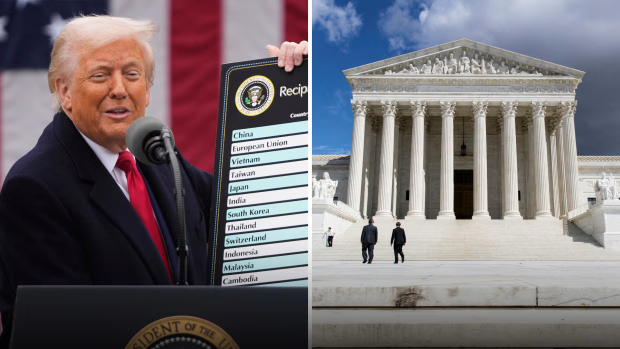
A Supreme Court ruling on tariffs could reshape presidential power, US trade policy, markets, and global economic relations.
A Defining Legal Test for Presidential Authority Over Trade and Economic Policy
The United States stands at a critical legal and economic crossroads as the United States Supreme Court prepares to rule on a case that could fundamentally redefine how tariffs are imposed and who holds ultimate authority over trade policy. At the centre of the dispute is whether a US president can use emergency economic powers to levy wide-ranging tariffs without explicit approval from Congress. While the case may appear technical on the surface, its implications extend deep into constitutional governance, fiscal stability, and the future balance of power between the executive and legislative branches.
Tariffs have long been a core instrument of economic policy, traditionally falling under the authority of Congress. Over time, lawmakers have delegated certain powers to the president, allowing swift action during national emergencies or extraordinary circumstances. The current legal challenge questions whether that delegation has been stretched beyond its intended limits. The tariffs under scrutiny were imposed broadly across sectors and countries, justified under emergency statutes that critics argue were never designed to support such sweeping economic measures.
Supporters of strong executive authority contend that modern global trade requires agility. They argue that presidents must be able to act decisively in response to unfair trade practices, supply-chain disruptions, or national security threats. From this perspective, tariffs are seen as tools of leverage that lose effectiveness if delayed by lengthy legislative processes. A ruling that restricts presidential discretion, they warn, could weaken the United States’ negotiating position and slow responses to fast-moving global challenges.
Opponents, however, see the case as a necessary check on executive overreach. They argue that tariffs function much like taxes, directly affecting prices, businesses, and consumers, and therefore must remain firmly within Congress’s constitutional authority. Allowing presidents to impose them unilaterally, they say, risks undermining democratic accountability and concentrating too much economic power in the executive branch. For these critics, the Supreme Court’s decision is about preserving the constitutional design as much as it is about trade.
The financial stakes are immense. If the court rules that the tariffs were imposed unlawfully, the federal government could face massive refund obligations. Importers and companies that paid duties over several years may be entitled to reimbursement, creating a complex administrative challenge. Calculating claims, determining eligibility, and processing repayments could take years, introducing uncertainty into federal budgeting and economic planning. Even if the government has the capacity to absorb the cost over time, the disruption itself could be significant.
Beyond refunds, the ruling could affect how future revenues are projected. Tariffs have contributed billions to government coffers, and their removal or limitation would force policymakers to reconsider fiscal strategies. This uncertainty has already drawn the attention of markets, investors, and corporate leaders, who are watching closely for signals about the stability and predictability of US trade policy.
Market Reactions, Global Trade Implications, and the Future of Economic Governance
The implications of the Supreme Court’s tariff ruling extend far beyond Washington. Financial markets around the world are sensitive to shifts in US trade policy, and the prospect of a major legal reversal has already influenced investor sentiment. A decision limiting tariff authority could lead to adjustments in equity markets, currency valuations, and bond yields as traders reassess growth prospects and inflation expectations. Industries heavily reliant on imports may welcome relief from duties, while sectors that benefited from protection could face renewed competition.
For businesses, the ruling could prompt strategic recalibration. Companies that restructured supply chains to avoid tariffs may not immediately reverse those decisions, especially if legal uncertainty persists. Others may pursue refunds or renegotiate contracts, adding layers of complexity to global commerce. Small and medium-sized enterprises, which often lack the resources to navigate prolonged legal and administrative processes, could be particularly affected.
Internationally, trading partners are closely monitoring the outcome. A ruling that curtails unilateral tariff authority may reassure allies who viewed aggressive tariff policies as destabilising. It could signal a shift toward more predictable, rules-based trade relations, even if driven by judicial rather than political change. Conversely, if the court upholds broad executive power, future presidents may feel emboldened to deploy tariffs more freely, influencing negotiations and economic diplomacy worldwide.
The decision also carries symbolic weight in the ongoing debate over governance in a globalised economy. As trade increasingly intersects with national security, technology, and geopolitics, the temptation for executives to invoke emergency powers has grown. How the Supreme Court draws boundaries in this case will shape not only trade policy but also the broader use of emergency authorities in economic decision-making.
For policymakers, the ruling may trigger legislative action. If the court narrows presidential authority, Congress could seek to clarify or update statutes governing trade and emergency powers. Such reforms might aim to balance flexibility with oversight, ensuring that future administrations have tools to respond to crises without bypassing democratic processes. If the court affirms executive power, lawmakers may still revisit the issue, concerned about the precedent being set.
The broader public impact should not be overlooked. Tariffs influence consumer prices, employment, and economic confidence. A shift in policy could gradually affect the cost of everyday goods, from electronics to household items. While changes may not be immediate, the long-term direction of trade policy plays a role in shaping living standards and economic resilience.
Ultimately, the Supreme Court’s ruling represents a pivotal moment in US economic law. It will determine not only the fate of existing tariffs but also the framework governing how future leaders can use economic tools to pursue national goals. Whether the decision reinforces congressional authority, preserves broad executive discretion, or strikes a nuanced balance between the two, its consequences will reverberate through markets, politics, and international relations for years to come.