Adani Group has announced one of its most significant industrial expansion plans in central India with a large scale cement manufacturing project and a proposed defence production unit in Madhya Pradesh. The announcements were made during a major public event in Guna district attended by senior political leaders, government officials and company executives.
The development is being projected as a major boost for industrial growth, employment generation and infrastructure expansion in Madhya Pradesh, which has aggressively positioned itself as a preferred destination for large domestic investments in recent years.
Mohan Yadav laid the foundation stone for a new cement manufacturing plant to be established by Ambuja Cements, part of the Adani Group. The project will involve an investment of ₹1,059 crore and is expected to transform the industrial landscape of Guna district.
The proposed facility will have an annual production capacity of 4 million tonnes, making it one of the major cement manufacturing projects currently under development in the state.
According to officials, the plant will be built in Mawan village, situated approximately 10 kilometres from the Guna district headquarters.
Addressing the gathering, Chief Minister Mohan Yadav described the occasion as a “historic day” for Madhya Pradesh and particularly for the Guna region, which has historically remained less industrialised compared to some other parts of the state.
Yadav said the project would create approximately 1,500 direct and indirect employment opportunities while also boosting ancillary industries, transportation networks and local economic activity.
The Chief Minister highlighted that industrial investments of this scale would contribute significantly to the state’s long term development strategy, especially in terms of employment generation for youth and expansion of infrastructure in semi urban and rural regions.
The cement project is expected to be completed in multiple phases, with commercial operations targeted to begin by 2028.
The event also gained attention because of another major announcement involving the Adani Group’s future plans in Madhya Pradesh.
Jyotiraditya Scindia revealed during the ceremony that the Adani Group would additionally establish a defence manufacturing unit in the state with a planned investment of ₹2,500 crore.
According to Scindia, the defence production facility will be developed in Shivpuri district and is expected to strengthen Madhya Pradesh’s role in India’s growing domestic defence manufacturing ecosystem.
Scindia described the cement and defence projects as the beginning of a broader “development chain” that would gradually reshape the economic profile of the region.
He said industrial growth in the state is now moving beyond traditional sectors and entering strategic manufacturing areas linked to national infrastructure and defence production.
The defence manufacturing announcement aligns closely with India’s broader push toward self reliance in defence equipment production under the government’s “Make in India” and defence indigenisation initiatives.
Over the past few years, the central government has strongly encouraged domestic manufacturing of defence systems, weapons, aerospace equipment and military technologies in order to reduce import dependence and strengthen India’s strategic capabilities.
Industrial analysts believe private sector participation in defence manufacturing could significantly expand in coming years due to rising defence spending and increasing policy incentives.
The proposed Adani defence project in Shivpuri may therefore become strategically important not only for Madhya Pradesh but also for India’s long term defence production ambitions.
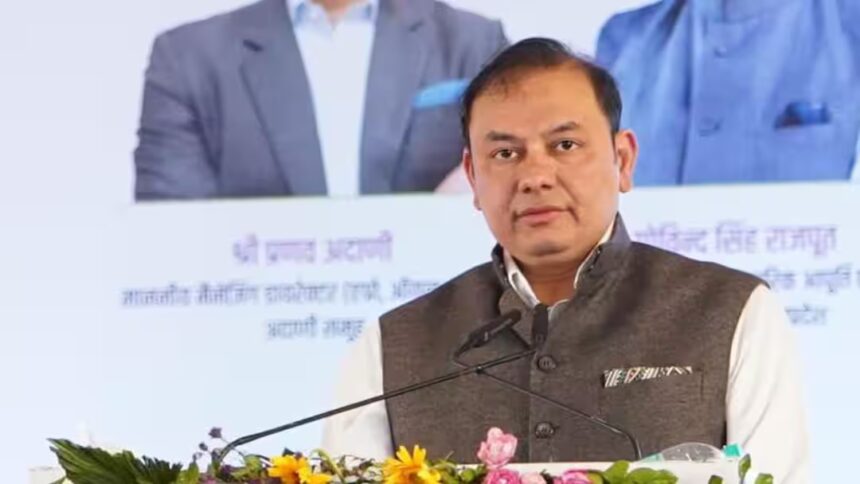
Speaking at the foundation stone ceremony, Pranav Adani praised the Madhya Pradesh government’s approach toward industrial development and investment facilitation.
He stated that under Chief Minister Mohan Yadav’s leadership, the state has gained “new momentum” in infrastructure, industrial growth and employment generation.
Pranav Adani said Madhya Pradesh is increasingly emerging as one of India’s most attractive destinations for industrial investment because of improving infrastructure, supportive governance and policy stability.
He also thanked Union Minister Jyotiraditya Scindia for supporting the industrial initiatives being developed in the region.
According to Pranav Adani, the cement plant project will contribute more than ₹6,000 crore to the state treasury over time through taxes, industrial activity and associated economic growth.
He emphasised that the real strength of industrial projects lies not merely in financial investment figures but in the transformation they bring to people’s lives through employment, business opportunities and regional development.
Industry experts note that the cement sector remains deeply linked to India’s infrastructure growth story.
Rapid urbanisation, expansion of highways, railway modernisation, industrial corridors, housing projects and commercial construction continue driving strong long term demand for cement across the country.
India is already among the world’s largest cement producers, and analysts expect demand to remain strong due to large public infrastructure projects and private real estate expansion.
The Adani Group has rapidly expanded its position in the cement industry over recent years through acquisitions and greenfield investments.
The company’s cement business has become one of the fastest growing segments within the broader Adani industrial ecosystem, which spans ports, logistics, energy, infrastructure, airports, mining and manufacturing.
The Madhya Pradesh investment is expected to further strengthen the group’s cement production network across India.
The project also reflects growing competition among Indian states to attract large private investments.
Madhya Pradesh has increasingly focused on improving industrial infrastructure, simplifying investment procedures and promoting sector specific industrial clusters.
The state government has aggressively marketed Madhya Pradesh as a business friendly destination through investor summits and infrastructure expansion programs.
The latest announcements also reconnect with a much larger commitment made by Gautam Adani during the Global Investors Summit held in Bhopal.
At the summit, Gautam Adani pledged investments worth ₹1.10 lakh crore for Madhya Pradesh across multiple sectors including infrastructure, energy, logistics, manufacturing and industrial development.
Political observers believe these investments indicate growing alignment between state governments seeking industrial expansion and large corporate groups searching for strategic manufacturing hubs.
The industrial push is particularly significant for regions like Guna and Shivpuri, which are expected to witness secondary economic effects beyond the core projects themselves.
Experts believe large industrial plants often trigger development in roads, transport services, warehousing, local markets, housing demand and small business ecosystems surrounding the project area.
Employment opportunities generated directly and indirectly by industrial projects can significantly impact regional economies over long periods.
The projects also arrive at a time when India is attempting to accelerate manufacturing growth and strengthen domestic industrial capacity amid global economic uncertainty and shifting supply chains.
Many economists argue that increasing domestic production capacity in sectors like cement, defence manufacturing and infrastructure equipment is becoming strategically important due to geopolitical tensions and global supply disruptions.
Meanwhile, Gautam Adani also attracted national attention recently for his remarks on artificial intelligence and India’s economic future during the Confederation of Indian Industry Annual Business Summit 2026 held in New Delhi.
During his speech, Adani argued that India’s AI revolution should focus on empowering workers, farmers, nurses and small businesses rather than remaining limited to corporate boardrooms.
He stated that India must avoid viewing artificial intelligence purely as a job replacement technology.
Instead, according to Adani, AI should become a tool for productivity expansion, employment generation and economic inclusion.
He said India has an opportunity to build AI driven industries and employment ecosystems that strengthen small enterprises and allow Indian businesses to compete globally.
Gautam Adani compared the transformative potential of artificial intelligence with India’s successful Unified Payments Interface (UPI) digital payments revolution.
According to him, UPI demonstrated how India can build scalable technological ecosystems that fundamentally transform economic participation at the grassroots level.
He argued that artificial intelligence could similarly create entirely new business models, industrial opportunities and employment systems if developed with inclusion and productivity in mind.
The combination of industrial manufacturing investments and technological discussions reflects how large Indian conglomerates are increasingly positioning themselves across both traditional infrastructure sectors and emerging future technologies.
At the political level, the Madhya Pradesh government is expected to project the Adani investments as evidence of rising investor confidence in the state’s economy.
The announcements may also strengthen the ruling government’s broader narrative focused on infrastructure expansion, industrialisation and employment creation.
For the Adani Group, the projects reinforce its strategy of expanding aggressively across sectors linked to national infrastructure growth and long term economic development.
The coming years will now determine how quickly these announced investments move toward execution and whether the projects achieve their projected economic impact.
If completed on schedule, the Guna cement plant and proposed Shivpuri defence unit could significantly reshape the industrial profile of the region while contributing to Madhya Pradesh’s ambitions of becoming one of India’s leading manufacturing and investment destinations.