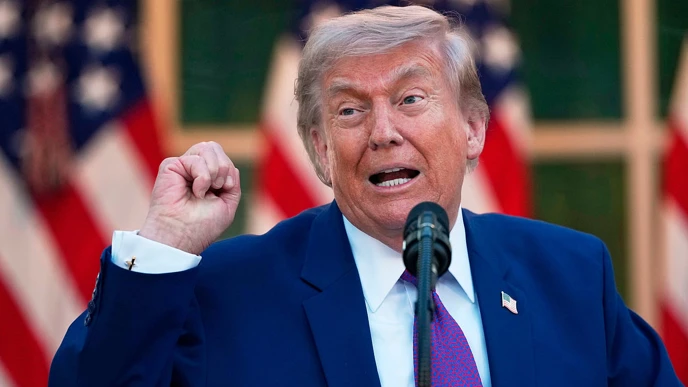
The fragile ceasefire between the United States and Iran has entered a dangerous new phase after US President Donald Trump declared that the ongoing truce is on “massive life support”. His explosive remarks have intensified fears of another major escalation in the Middle East, especially as tensions continue surrounding the Strait of Hormuz, nuclear negotiations, and ongoing Israeli military operations.
Speaking from the Oval Office, Trump described the ceasefire as “unbelievably weak” and compared its condition to a patient with “a one percent chance of survival”. His statement came shortly after Iran submitted a counter-offer to Washington aimed at ending the conflict and reopening critical shipping routes in the Gulf region.
However, Trump sharply rejected Tehran’s proposal, calling it “totally unacceptable” and even describing it as “a piece of garbage”. The comments have once again pushed diplomatic relations between the two nations toward uncertainty, while global markets react nervously to the possibility of renewed war.
The latest confrontation highlights how fragile the geopolitical situation remains in the Middle East, where military pressure, nuclear negotiations, oil supply routes, and regional alliances are all deeply interconnected.
Trump Rejects Iran’s 14-Point Proposal
According to reports from Iranian state-linked media, Tehran submitted a 14-point counter-proposal to the United States on Sunday. The proposal reportedly included demands such as an immediate halt to military action on all fronts, an end to the US naval blockade of Iranian ports, guarantees against future attacks on Iran, and recognition of Iranian sovereignty over the Strait of Hormuz.
Iran also allegedly demanded compensation for war-related damages caused during the recent conflict. Another major point involved the lifting of economic sanctions and restoration of normal trade movement through Gulf waters.
Despite these demands, Trump reacted aggressively. Posting on his social media platform Truth Social, the US president wrote that he had reviewed Iran’s response and found it completely unacceptable.
Later, during a media interaction at the White House, Trump intensified his criticism by accusing Iranian leaders of repeatedly changing their positions during negotiations.
He also claimed Iran had backed away from an earlier understanding related to enriched uranium. According to Trump, Tehran had previously indicated willingness to allow removal of enriched nuclear material, but later reversed its position.
Iranian officials strongly denied that claim. A source close to Tehran’s negotiating team reportedly stated that no such agreement regarding removal of enriched uranium existed in Iran’s proposal.
The disagreement over uranium enrichment remains one of the biggest obstacles in reaching a long-term agreement between Washington and Tehran. The United States continues to insist that Iran must never obtain a nuclear weapon, while Iran maintains that its nuclear programme is for peaceful and civilian purposes.
Strait of Hormuz Crisis Raises Global Oil Market Concerns
One of the most alarming aspects of the ongoing standoff is the continued disruption around the Strait of Hormuz — one of the world’s most strategically important maritime trade routes.
The narrow waterway connects the Persian Gulf with the Arabian Sea and handles nearly 20% of the world’s oil and liquefied natural gas shipments. Any disruption in this region immediately impacts international energy prices and global supply chains.
Iran has reportedly continued restricting normal movement through the Strait of Hormuz despite ceasefire discussions. As a result, oil prices have surged once again amid fears that shipping lanes could remain unstable for an extended period.
The United States, meanwhile, has intensified pressure on Tehran through naval operations and restrictions targeting Iranian ports. Washington believes the economic and military pressure could force Iran into accepting stricter nuclear and regional security conditions.
Iran, however, views these actions as violations of sovereignty and has warned that its armed forces remain fully prepared to respond to any future aggression.
Iranian parliamentary speaker Mohammad Ghalibaf stated on social media that Iran’s military stands ready “to teach a lesson for any aggression”. He further insisted that the rights of the Iranian people must be accepted according to Tehran’s proposed framework.
The growing confrontation has increased fears among international observers that even a small military exchange in the Gulf could spiral into a broader regional conflict involving multiple countries.
Israel’s Role and Rising Regional Pressure
The ceasefire tensions are also closely linked to the broader conflict involving Israel and Iranian-backed groups across the region.
Israeli Prime Minister Benjamin Netanyahu recently stated that Iran’s enriched uranium stockpile must be completely removed before the conflict can truly end. He also stressed that Iran’s enrichment facilities still need to be dismantled.
Israel has maintained a hardline approach against Iran’s nuclear infrastructure and regional influence, particularly concerning Tehran’s support for Hezbollah in Lebanon and other allied groups.
The recent wave of Israeli and US air strikes on Iranian positions earlier this year significantly escalated tensions before the ceasefire temporarily reduced hostilities.
However, analysts believe the ceasefire was always fragile because many of the underlying disputes — including nuclear enrichment, sanctions, regional militias, and maritime control — remain unresolved.
The United States and Israel continue coordinating closely on Iran-related security matters, while Tehran accuses both countries of attempting to weaken Iranian sovereignty and regional power.
At the same time, diplomatic backchannel negotiations are reportedly still continuing through intermediaries. Several reports suggest that Washington’s original proposal included suspension of Iranian nuclear enrichment, phased sanctions relief, and guarantees for free navigation through the Strait of Hormuz.
Yet neither side appears willing to compromise on core strategic issues.
Global Implications of the Iran-US Standoff
The worsening tensions between the United States and Iran carry consequences far beyond the Middle East.
Global financial markets remain highly sensitive to developments involving Gulf oil routes. Continued instability could increase fuel prices worldwide, disrupt supply chains, and place additional pressure on inflation-hit economies.
Security experts also warn that any collapse of the ceasefire may trigger renewed military action involving not only the US and Iran, but also Israel, Hezbollah, and allied regional groups.
For now, the ceasefire technically remains in place. But Trump’s warning that it is on “life support” reflects the growing distrust between both governments.
Diplomatic channels remain open, yet the rhetoric from both Washington and Tehran has become increasingly hostile. Iran insists its demands are “responsible” and “generous”, while Trump continues to accuse Tehran of dishonesty and strategic manipulation.
As uncertainty deepens, the world is closely watching whether negotiations can prevent another major escalation in one of the most volatile regions on Earth.