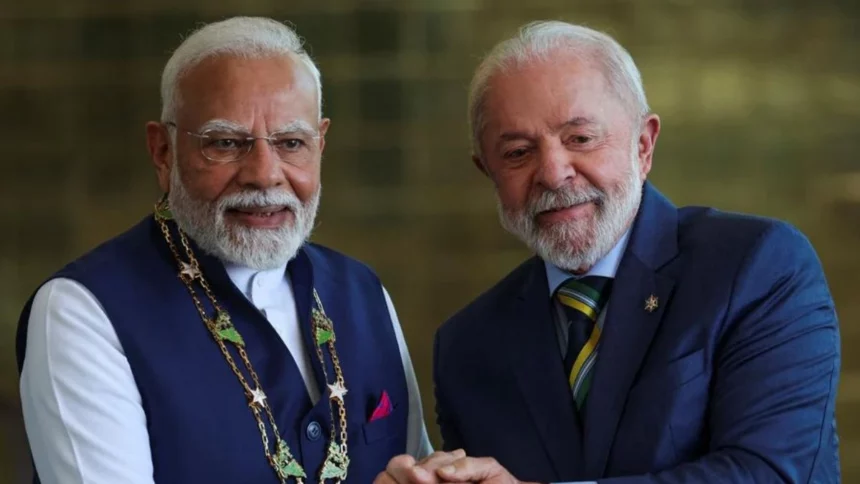
Brazilian President Luiz Inacio Lula da Silva arrived in India on a five-day State visit at a time when global trade equations are undergoing rapid transformation. Scheduled from February 18 to 22, the visit is notable not only for its diplomatic symbolism but also for its scale, as Lula is accompanied by the largest-ever Brazilian delegation to visit India, including Cabinet ministers, senior officials, business leaders, and chief executives. The centerpiece of the visit will be his bilateral meeting with Indian Prime Minister Narendra Modi on February 21, an engagement that is expected to shape the future trajectory of India–Brazil relations across trade, technology, energy, and global governance.
Lula’s visit coincides with the India AI Impact Summit, underscoring how technological transformation and economic resilience are becoming central themes of modern diplomacy. Against the backdrop of renewed protectionism in parts of the world and lingering uncertainties in global supply chains, New Delhi and Brasilia are looking to recalibrate their partnership with a sharper strategic focus. For both countries, the visit represents an opportunity to reinforce South–South cooperation and diversify partnerships beyond traditional economic poles.
Strategic and Diplomatic Significance of Lula’s India Engagement
The timing of President Lula’s visit carries considerable diplomatic weight. India and Brazil are not only large emerging economies but also influential voices within the Global South, multilateral forums, and institutions advocating a more balanced international order. Over the years, both countries have cooperated closely in platforms such as BRICS, the G20, and the United Nations, often aligning on issues related to development, climate change, and reform of global governance structures.
During his visit, Lula is expected to hold wide-ranging discussions with Prime Minister Modi on strengthening political trust and institutional cooperation. Officials from India’s Ministry of External Affairs have indicated that talks will focus on expanding collaboration in defence, pharmaceuticals, digital technology, agriculture, and space. These sectors reflect complementary strengths, with India offering scale, innovation, and manufacturing capabilities, while Brazil brings resource depth, agricultural expertise, and growing technological ambition.
Diplomatically, Lula’s presence in India also reinforces Brazil’s renewed outreach to Asia under his leadership. Since returning to office, the Brazilian President has emphasized rebuilding global partnerships and asserting Brazil’s strategic autonomy. India, with its rapidly expanding economy and growing geopolitical influence, fits naturally into this vision. For New Delhi, closer ties with Brazil strengthen its engagement with Latin America, a region increasingly important for energy security, food supply chains, and political coordination in multilateral forums.
The size and composition of the Brazilian delegation highlight the economic dimension of the visit. Business leaders and CEOs accompanying Lula signal strong interest in deepening commercial engagement with India. Brazilian companies see India as a fast-growing market for commodities, food products, energy resources, and services, while Indian firms view Brazil as a gateway to Latin American markets and a reliable partner in sectors such as biofuels, mining, and clean energy.
Trade, Tariffs, and the Push for Economic Diversification Beyond the US
One of the most critical contexts shaping Lula’s visit is the evolving global trade environment influenced by tariff-driven policies during the administration of former US President Donald Trump. Under Trump’s protectionist approach, both Brazil and India faced steep tariffs on their exports to the United States, disrupting established trade flows and highlighting vulnerabilities in overreliance on a single major market.
In 2025, the United States raised tariffs on several Brazilian goods to around 50 per cent, a move that significantly affected Brazilian exporters. Brazil responded by challenging these measures at the World Trade Organization, underscoring its commitment to multilateral trade rules. India, too, faced similar tariff pressures, with duties reaching as high as 50 per cent on certain products. Although subsequent negotiations led to a reduction of tariffs on Indian exports to approximately 18 per cent following a bilateral trade deal, the episode reinforced the need for diversification of economic partnerships.
Against this backdrop, Lula’s India visit takes on added strategic importance. It reflects a shared recognition in New Delhi and Brasilia that deeper bilateral cooperation can help cushion the impact of external trade shocks. By expanding trade in pharmaceuticals, aviation, minerals, energy, and agricultural products, both countries aim to reduce exposure to protectionist measures elsewhere while strengthening their own economic resilience.
India and Brazil have previously set ambitious targets to nearly double bilateral trade in the coming years. Brazil views India as an increasingly important destination for exports such as crude oil, soybeans, sugar, and meat products, while also exploring opportunities in services and technology. India, on the other hand, sees Brazil as a crucial supplier of energy resources and critical minerals essential for its industrial growth and clean-energy transition. Collaboration in areas like lithium, rare earths, and biofuels aligns closely with India’s long-term sustainability goals.
Lula’s visit also sends a broader geopolitical message. At a time when global trade alliances are being reshaped, closer India–Brazil ties signal that emerging economies are proactively building alternative networks of cooperation rather than passively adapting to policies set by traditional economic powers. This alignment underscores a commitment to multilateralism, open markets, and shared growth, reinforcing the role of the Global South in shaping the future of global trade.
Beyond economics, the visit highlights a convergence of strategic outlooks. Both India and Brazil advocate reform of international institutions to better reflect contemporary realities and the voices of developing nations. Strengthened bilateral ties enhance their collective influence in pushing for a more inclusive global order. Lula’s engagement with India during the AI Impact Summit further emphasizes the importance both countries place on technology, innovation, and ethical governance as drivers of future prosperity.
As discussions unfold during the visit, the emphasis is expected to remain on building long-term frameworks rather than short-term gains. From trade facilitation and investment protection to collaboration in science, technology, and education, the outcomes of Lula’s visit are likely to shape India–Brazil relations for years to come. In an era marked by uncertainty and shifting power balances, the visit underscores how strategic partnerships among emerging economies are becoming central to navigating global challenges.