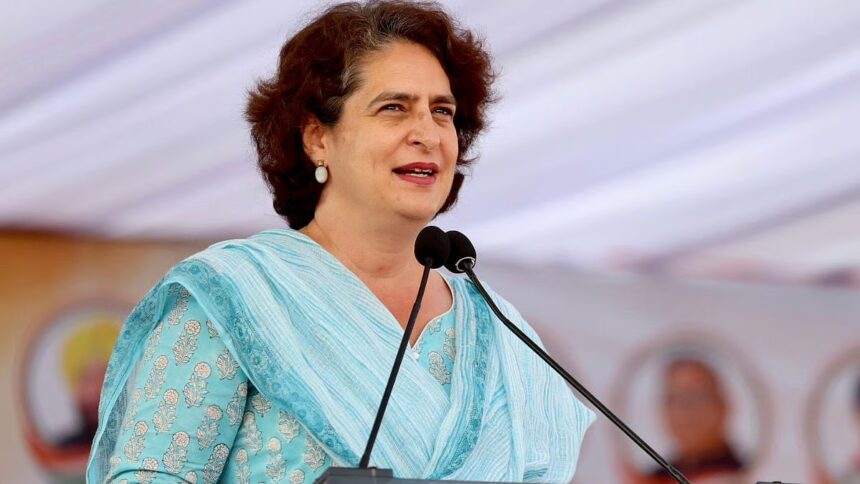
As the Assam Assembly elections approach, the Congress has initiated a significant organisational experiment aimed at reshaping how candidates are selected, signalling a broader effort to reconnect the party with ground realities and local sentiment. At the centre of this exercise is Priyanka Gandhi Vadra, Congress general secretary and Member of Parliament, who is heading the party’s screening committee for the state. Her decision to introduce what party leaders describe as a “new system” for identifying and shortlisting candidates marks a departure from conventional, centrally driven selection mechanisms and reflects the Congress leadership’s growing emphasis on decentralisation, credibility, and feedback-driven decision-making in electoral politics.
With elections drawing closer, Priyanka Gandhi is scheduled to travel to Guwahati for a series of meetings with state leaders and members of the screening committee. Over two days of deliberations, the party aims to assess potential candidates, review district-level feedback, and streamline internal consultations. The initiative comes at a time when the Congress is seeking to revitalise its organisational structure in key states, address long-standing grievances about candidate selection, and improve its electoral performance by fielding candidates with stronger local acceptance and organisational backing.
A Ground-Up Approach to Candidate Selection in Assam
The “new system” introduced by Priyanka Gandhi for Assam’s candidate screening process is rooted in extensive field engagement rather than reliance on second-hand reports or factional lobbying. Under this approach, members of the screening committee have been instructed to travel widely across the state, engage with district and block-level leaders, and gather direct feedback on potential candidates. The objective is to assess not just winnability, but also public perception, organisational commitment, social credibility, and the candidate’s ability to mobilise voters at the grassroots.
The screening committee includes MPs Saptagiri Sankar Ulaka and Imran Masood, along with senior leader Sirivella Prasad, all of whom have been assigned the task of touring various districts of Assam. Their mandate goes beyond compiling names; they are expected to listen to local workers, consult community representatives, and understand constituency-specific dynamics before preparing a shortlist. This method contrasts sharply with earlier practices where candidate names were often finalised through recommendations from state leadership or central observers with limited on-ground exposure.
Party insiders suggest that the emphasis on travel and direct interaction is designed to counter perceptions that the Congress has, in the past, overlooked grassroots opinion while selecting candidates. In many states, local workers have complained that candidates were imposed from above, sometimes leading to resentment, lack of coordination during campaigns, and even internal sabotage. By institutionalising field visits and structured feedback, the party leadership hopes to foster a sense of ownership among workers and ensure that nominees enjoy broader organisational support.
Priyanka Gandhi’s involvement is also seen as a signal to the state unit that the central leadership is closely monitoring the process. Her meetings in Guwahati are expected to include discussions with senior state leaders, district presidents, and members of frontal organisations. These interactions are aimed at balancing local aspirations with the party’s broader electoral strategy, ensuring that caste, community, regional representation, and organisational experience are factored into the final selection.
The Assam exercise is being closely watched within the Congress because of its potential implications beyond the state. A senior party source described the initiative as a “pilot project,” indicating that its outcomes will influence how the party approaches candidate selection in other upcoming state elections. If successful, the model could become a template for decentralised screening processes, reducing the scope for ad hoc decisions and last-minute changes that have historically weakened the party’s electoral preparedness.
Organisational Reform, Electoral Strategy, and National Implications
The introduction of a revised screening mechanism in Assam reflects a broader internal debate within the Congress about organisational reform and electoral strategy. Over the past decade, the party has faced repeated criticism for opaque decision-making, lack of internal democracy, and an over-centralised structure that often alienated state units. Priyanka Gandhi’s initiative appears to be an attempt to address some of these concerns by creating a more consultative and transparent process, at least at the level of candidate selection.
For the Congress, Assam holds both symbolic and strategic importance. The state has witnessed intense political competition, with regional forces and the Bharatiya Janata Party consolidating their presence over recent election cycles. To mount an effective challenge, the Congress needs candidates who are not only electorally viable but also capable of energising the cadre and articulating a coherent alternative narrative. The new screening system is intended to identify such candidates early enough to allow for focused campaigning and constituency-level groundwork.
Party strategists believe that the credibility of candidates plays a crucial role in voter mobilisation, particularly in a politically diverse state like Assam, where ethnic, linguistic, and regional factors heavily influence electoral outcomes. By relying on district-level feedback, the screening committee aims to avoid nominating individuals with weak grassroots connections or controversial reputations, even if they enjoy backing from influential leaders. This approach, while potentially reducing internal friction in the long term, also carries risks, as it may upset established power structures within the state unit.
The involvement of MPs from outside Assam in the screening committee is another notable aspect of the process. Their relative distance from local factional rivalries is seen as an advantage, enabling more objective assessments. At the same time, their extensive tours are meant to familiarise them with the state’s political landscape, ensuring that their recommendations are grounded in lived realities rather than abstract metrics.
Priyanka Gandhi’s leadership of the committee adds political weight to the exercise. As one of the most recognisable faces of the Congress, her direct engagement is expected to reassure workers that their inputs matter. It also reinforces her broader role within the party as a leader focused on organisational revival, mass outreach, and internal cohesion. Over the past few years, she has been associated with efforts to strengthen the party at the grassroots, particularly in states where the Congress has struggled to retain its traditional support base.
Within the party, there is cautious optimism about the Assam experiment. Some leaders view it as a necessary corrective to past practices, while others are waiting to see whether the final list of candidates truly reflects grassroots sentiment. The real test of the new system will lie in its implementation and outcomes—whether it leads to stronger campaigns, reduced internal dissent, and improved electoral performance.
Beyond Assam, the implications of this initiative could be significant. If the Congress decides to replicate the model in other states, it would mark a shift towards more structured and decentralised organisational functioning. Such a move could help rebuild trust between the central leadership and state units, encourage greater participation from local leaders, and present the party as more responsive to internal feedback.
At a time when Indian politics is increasingly shaped by perceptions of leadership credibility and organisational strength, the Congress’s attempt to reform its candidate selection process carries both risks and opportunities. For Priyanka Gandhi, the Assam exercise represents a chance to demonstrate that internal reform can translate into electoral strategy. For the party as a whole, it underscores an acknowledgment that reconnecting with voters begins with listening to those who work closest to them on the ground.