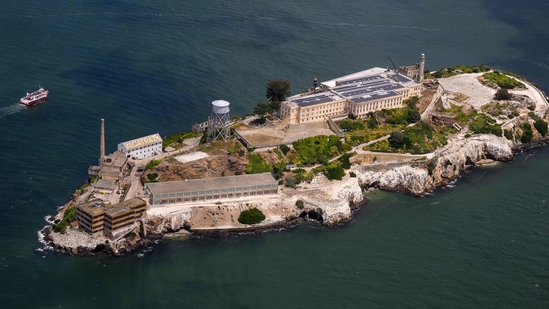
US President Donald Trump has expressed plans to reopen the infamous Alcatraz prison, with a social media post stating: “Rebuild and open Alcatraz.” He further emphasized that in the past, the nation didn’t hesitate to lock up dangerous criminals far away from the public. Trump directed the Bureau of Prisons, in coordination with the Department of Justice, FBI, and Homeland Security, to rebuild and reopen Alcatraz.
But why is Alcatraz regarded as one of America’s most notorious prisons, and why has it earned such a reputation? Let’s delve deeper into its history and why it remains a key part of American prison lore.
What Is Alcatraz Known For?
Alcatraz is situated about two kilometers off the coast of San Francisco, once a military prison and later one of the world’s most secure federal prisons. Today, it is a popular tourist destination managed by the National Park Service, alongside landmarks like the Golden Gate Bridge. However, before becoming a tourist attraction, it had a grim past.
Originally, Alcatraz was just an island named “La Isla de los Alcatraces,” a name given by Spanish explorer Juan Manuel de Ayala y Aranza in 1775, meaning “the island of the pelicans.” Over time, control of the island shifted, with Mexico taking control in 1821 and the US acquiring it in 1848 after the Treaty of Guadalupe Hidalgo.
Recognizing its strategic location, President Millard Fillmore authorized the construction of Fort Alcatraz in 1858. During the US Civil War, it was used to detain Confederate prisoners and civilians suspected of aiding the South.
Transition to a Federal Prison
In the early 20th century, Alcatraz evolved from a military fort to a federal penitentiary. By 1907, the US Army rebranded it as “Pacific Branch, US Military Prison.” It continued to evolve, with a 600-cell complex and various facilities like a mess hall and hospital by 1912. In 1930, the US Bureau of Prisons assumed control, and Alcatraz became a facility for the most difficult prisoners.
The prison was famous for housing the worst criminals, including mobster Al Capone, bank robber George “Machine Gun Kelly” Barnes, and Robert Stroud, known as the Birdman of Alcatraz. During its peak, Alcatraz was thought to be the most secure prison in the world.
Alcatraz witnessed numerous escape attempts, though none were successful. Over a dozen escape attempts were made, but none of the prisoners managed to evade the law for good. The most famous escape occurred in June 1962 when three prisoners – Frank Morris, and John and Clarence Anglin – attempted to escape by chiseling their way into an unguarded corridor and then constructing a makeshift raft. Despite some pieces of the raft being found, the men were never seen again, and their fate remains a mystery.
However, the true reason for Alcatraz’s closure was less dramatic: it was simply too expensive to maintain. The prison was costing taxpayers nearly three times as much as other federal prisons, leading to its closure in 1963.
Life After the Prison
In the years following its closure, Alcatraz gained attention for different reasons. In 1964, it was occupied by Native American activists who argued that the land was rightfully theirs according to the 1868 Fort Laramie Treaty. This occupation, which lasted until 1971, brought global attention to the fight for Native American rights.
Alcatraz became a tourist attraction in 1972 when it was designated as part of the Golden Gate National Recreation Area. Managed by the National Park Service, it began offering tours that highlighted both its role as a prison and its cultural history. Today, Alcatraz attracts over one million visitors each year.
Alcatraz has earned its place in history due to its high-profile inmates, its reputation as an escape-proof prison, and its notorious escape attempts. With figures like Al Capone and Robert Stroud imprisoned there, it became synonymous with tough justice. Though it ceased operations as a prison decades ago, the legacy of Alcatraz as a symbol of confinement and punishment remains etched in the public consciousness.
Trump’s proposal to reopen Alcatraz seems to revisit this troubled past. While his stance emphasizes keeping dangerous criminals isolated, it raises questions about the efficacy of such a facility today, particularly in terms of cost, human rights, and modern criminal justice approaches. However, Alcatraz’s place in American history is undeniable – and its transformation from a feared prison to a prominent tourist site tells a fascinating story of America’s penal system evolution.