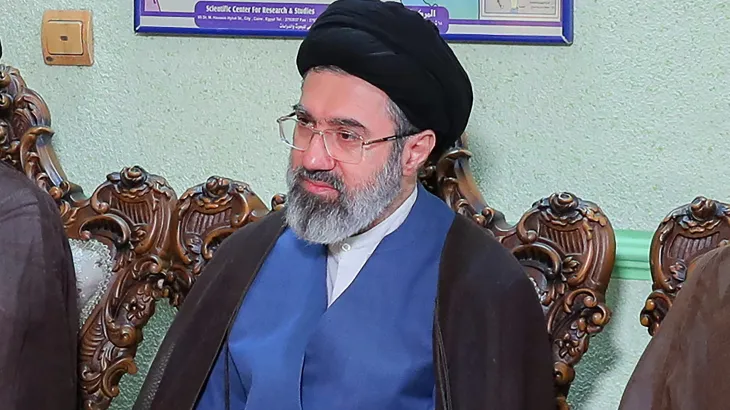
.Iran’s political landscape has entered a historic phase with reports that Mojtaba Khamenei, the son of the late Supreme Leader Ayatollah Ali Khamenei, has been chosen as the country’s next Supreme Leader. The announcement reportedly came from Iran’s powerful Assembly of Experts, the clerical body responsible for selecting the country’s top religious and political authority.
The decision was made just over a week after the death of Ayatollah Ali Khamenei, who was killed on February 28, 2026, during joint airstrikes carried out by Israel and the United States in Tehran. His death triggered intense political speculation and uncertainty about the future leadership of the Islamic Republic.
According to reports from Iranian state media, the Assembly of Experts reached a majority consensus on Mojtaba Khamenei’s selection as the new Supreme Leader. Assembly member Ayatollah Mohsen Heidari Alekasir confirmed that a candidate had been chosen based on guidance previously attributed to the late Ayatollah Khamenei that Iran’s top leader should be someone “hated by the enemy.”
At 56 years old, Mojtaba Khamenei is considered a mid-ranking cleric in Iran’s religious hierarchy. His rise to the country’s most powerful position is significant because Iran’s political establishment has historically rejected the idea of hereditary succession from father to son. His appointment therefore marks a notable departure from the traditional norms that have governed the leadership transition of the Islamic Republic since the 1979 revolution.
Mojtaba Khamenei was born on September 6, 1969, in the northeastern Iranian city of Mashhad, one of the most important centers of Shia religious scholarship. He is the second son of Ayatollah Ali Khamenei and Mansoureh Khojasteh Bagherzadeh. Mojtaba grew up in a politically charged environment during a period when his father was actively involved in resistance against the rule of Shah Mohammad Reza Pahlavi.
During his childhood, the family frequently faced raids and pressure from SAVAK, the Shah’s secret police, as Ali Khamenei was repeatedly arrested for his revolutionary activities. These experiences reportedly shaped Mojtaba’s early political outlook.
Following the Islamic Revolution of 1979, which overthrew the monarchy and established the Islamic Republic of Iran, the Khamenei family moved to Tehran. Mojtaba later attended the well-known Alavi High School before continuing his religious education in the seminaries of Qom, Iran’s most important center for Shiite theological studies.
In Qom, Mojtaba studied under prominent conservative clerics and eventually attained the clerical rank of Hojjatoleslam. Although he is recognized as a religious scholar, he is not widely regarded as a leading theological authority within Iran’s clerical establishment.
In addition to his religious studies, Mojtaba Khamenei also developed close ties with Iran’s military and security institutions. After completing his education, he reportedly joined the Islamic Revolutionary Guard Corps (IRGC), one of the most powerful organizations in Iran’s political and military system.
He served in the Habib Battalion during the final years of the Iran-Iraq war in the late 1980s. This experience reportedly helped him build long-lasting relationships with senior figures within the IRGC, many of whom later rose to prominent positions in the country’s military establishment.
Despite his strong connections within the Iranian power structure, Mojtaba Khamenei has rarely appeared in public or held formal government positions. He has never been elected to political office and has maintained a relatively low public profile compared to other senior figures in Iran’s leadership.
However, analysts and observers have long believed that he exercised considerable influence behind the scenes. Mojtaba is widely thought to have played an important role in managing the Office of the Supreme Leader and coordinating with powerful institutions such as the IRGC and Iran’s intelligence services.
Due to these connections, some critics have described him as a “shadow power” within Iran’s political system. Reports suggest that he acted as a key gatekeeper within his father’s administration, controlling access to the Supreme Leader’s office and influencing decision-making processes.
His political positions have generally aligned with the conservative and hardline factions within Iran’s leadership. Mojtaba has been known to oppose reformist movements that advocate greater engagement with Western countries and negotiations over Iran’s nuclear program.
In 2019, the United States Treasury Department imposed sanctions on Mojtaba Khamenei, accusing him of representing his father in an official capacity despite not holding a formal government position. U.S. authorities also alleged that he had worked closely with the IRGC’s Quds Force and the Basij militia to advance policies linked to Iran’s regional influence.
Mojtaba Khamenei’s name has also surfaced in connection with several key moments in Iran’s political history. He was widely believed to have supported the rise of hardline politician Mahmoud Ahmadinejad, who was elected as Iran’s president in 2005.
He also reportedly backed Ahmadinejad during the controversial 2009 presidential election, which sparked widespread protests across Iran. The demonstrations were eventually suppressed by security forces, including the Basij militia.
His political role has also been criticized by protest movements inside Iran. During the nationwide demonstrations in 2022 following the death of a young woman in police custody over alleged violations of Iran’s dress code laws, protesters frequently chanted slogans against Mojtaba Khamenei, accusing him of exerting behind-the-scenes control over the country’s leadership.
In 2024, Mojtaba announced that he would suspend his Islamic jurisprudence classes in Qom, a decision that fueled speculation about his future role within the country’s leadership.
The decision to appoint Mojtaba Khamenei as Iran’s Supreme Leader carries major implications for the country’s political future. The move suggests that the conservative establishment remains firmly in control of Iran’s political system and that the ideological direction set by Ayatollah Ali Khamenei is likely to continue.
It also marks a historic shift toward a form of leadership succession that resembles hereditary transfer of power, something that Iran’s revolutionary system had previously sought to avoid.
As Iran faces increasing regional tensions and international pressure, the leadership of Mojtaba Khamenei is expected to play a critical role in shaping the country’s domestic policies, foreign relations, and strategic direction in the coming years.