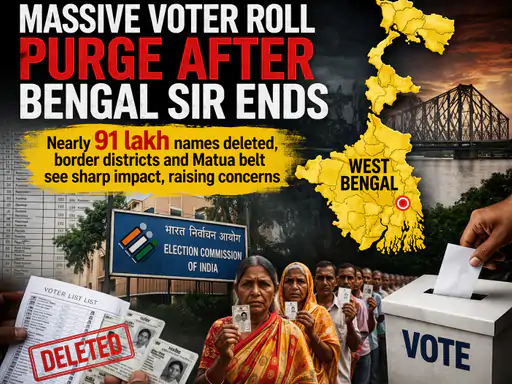
The large-scale deletion of nearly ninety-one lakh names from the electoral rolls in West Bengal ahead of the 2026 assembly elections has triggered one of the most intense political and institutional debates in recent years, placing the spotlight firmly on the processes that govern democratic participation in India. Conducted under the Special Intensive Revision exercise, the voter list update was intended to cleanse the rolls by removing duplicate, deceased, or ineligible entries, yet its scale, timing, and demographic impact have raised serious concerns about transparency, fairness, and potential disenfranchisement. As political parties, civil society, and affected citizens grapple with the implications of this unprecedented revision, the issue has rapidly evolved into a central electoral narrative, shaping campaign strategies and public discourse across the state.
Scale Of Deletions And Regional Impact Across Border Districts And Matua Belt
The magnitude of the voter list revision is striking, with approximately ninety-one lakh names removed through a combination of initial deletions and subsequent judicial scrutiny. This process significantly reduced the voter base, with earlier figures indicating that over sixty-three lakh names had already been excluded before additional adjudications led to further removals. The districts most affected include Murshidabad, North 24 Parganas, and Malda, regions that are not only densely populated but also politically sensitive due to their demographic composition and electoral significance.
Data emerging from the revision process reveals a clear geographical pattern, with higher deletion rates concentrated in border districts and areas with significant minority and Matua populations. These regions have historically played a decisive role in shaping electoral outcomes, making the scale of deletions particularly consequential. The Matua belt, known for its socio-political influence, has reportedly witnessed substantial voter exclusions, raising concerns about how these changes might alter the electoral balance in closely contested constituencies.
Urban constituencies have also seen notable deletions, with certain areas recording exceptionally high rates of removal during the adjudication process. The pattern suggests that economically vulnerable and migrant populations may have been disproportionately affected, further intensifying the debate over whether the revision process adequately accounted for documentation challenges and socio-economic realities.
At the core of this exercise lies the Special Intensive Revision mechanism, a nationwide process designed to ensure that electoral rolls remain accurate and free of ineligible entries. While the objective of maintaining clean voter lists is widely acknowledged as essential for electoral integrity, the implementation in West Bengal has raised questions about the criteria used for deletions, the role of verification mechanisms, and the extent to which due process was followed in each case.
The impact of these deletions extends beyond mere numbers, as they directly influence the composition of the electorate and, by extension, the democratic mandate that emerges from the elections. In a state where political contests are often decided by narrow margins, even minor shifts in voter demographics can have significant consequences, making the scale of the current revision particularly noteworthy.
Political Reactions, Legal Scrutiny, And Concerns Over Democratic Inclusion
The voter list deletion issue has quickly become a flashpoint in West Bengal’s political landscape, with parties across the spectrum voicing sharply divergent views on the legitimacy and implications of the process. The ruling establishment has raised concerns about the alleged targeting of specific communities, arguing that the deletions may have disproportionately affected marginalized groups and could undermine the inclusiveness of the electoral process. Opposition voices, on the other hand, have defended the need for rigorous verification, emphasizing the importance of eliminating duplicate and fraudulent entries to preserve the integrity of elections.
The controversy has also drawn legal attention, with judicial scrutiny playing a significant role in determining the final status of many voters. Over sixty lakh names were placed under adjudication, with judicial officers tasked with evaluating claims and objections before deciding on inclusion or exclusion. Despite this process, a substantial proportion of individuals remained excluded even after review, raising concerns about the accessibility and fairness of the adjudication mechanism.
Individual cases have further highlighted the human impact of the revision process, with reports of long-time voters, including elderly citizens and individuals with valid documentation, finding themselves removed from the rolls. Such instances have amplified public anxiety and contributed to perceptions of opacity and procedural complexity, particularly among vulnerable sections of society.
Beyond individual grievances, the issue has broader implications for electoral trust and institutional credibility. The reliance on documentation and verification processes, while necessary for maintaining accuracy, has also exposed systemic challenges related to record-keeping, data consistency, and access to official documents. In regions where migration, displacement, and socio-economic disparities are prevalent, these challenges become even more pronounced, potentially leading to unintended exclusions.
The timing of the revision, coming just ahead of a crucial assembly election, has further intensified political tensions, with parties incorporating the issue into their campaign narratives. The debate over voter inclusion and exclusion has, in many ways, overshadowed traditional electoral issues, reflecting the growing importance of electoral processes themselves as subjects of political contestation.
At a broader level, the West Bengal voter list deletion controversy underscores the delicate balance between ensuring electoral integrity and safeguarding democratic participation. While the removal of ineligible entries is essential for maintaining the credibility of elections, the process must also ensure that no eligible voter is unjustly excluded. Achieving this balance requires not only robust verification mechanisms but also transparency, accountability, and sensitivity to the diverse realities of the electorate.
As the state moves closer to polling day, the implications of the revised voter list will continue to shape political strategies and voter perceptions. The controversy has already highlighted the need for greater clarity in electoral processes, improved communication with citizens, and stronger safeguards against potential errors or biases. In a democracy as vast and diverse as India, the integrity of voter rolls is not merely an administrative concern but a foundational element of the democratic system, influencing not just electoral outcomes but also public trust in institutions.