The political landscape ahead of the West Bengal Assembly Elections 2026 is rapidly intensifying, with the Bharatiya Janata Party unveiling its fifth list of candidates and gearing up for an aggressive campaign strategy. The announcement marks a significant milestone as the party nears completion of its candidate lineup for almost all constituencies in the state. Simultaneously, high-profile campaign activities, including a major rally by Prime Minister Narendra Modi, underline the importance of West Bengal in the national political arena. With accusations, counter-accusations, and enforcement actions surfacing across different states, the election atmosphere reflects both strategic mobilization and rising political tensions.
BJP’s Strategic Candidate Expansion and Campaign Mobilisation
The Bharatiya Janata Party’s decision to release its fifth list of candidates, comprising five names, signals the party’s near-complete preparation for the electoral battle in West Bengal. With 292 candidates already announced out of the total 294 assembly seats, the BJP has demonstrated a calculated and structured approach to candidate selection. This near-finalization of candidates indicates that the party is prioritizing early groundwork, allowing its nominees more time to connect with voters, establish local networks, and strengthen grassroots outreach.
The inclusion of individuals linked to experienced political families and former Union ministers reflects the BJP’s attempt to balance experience with political legacy. Such selections are often aimed at consolidating voter trust and leveraging established reputations in politically sensitive constituencies. The move also highlights the party’s strategy of combining seasoned leadership with localized appeal, particularly in a state where regional dynamics play a crucial role in electoral outcomes.
At the same time, the BJP’s campaign push is being significantly amplified by the involvement of Prime Minister Narendra Modi. His scheduled visit to Cooch Behar marks the formal launch of the party’s campaign in the state. Cooch Behar, located in northern West Bengal, has been politically significant due to its demographic diversity and strategic electoral importance. By choosing this location for the campaign launch, the BJP aims to send a strong signal about its intent to expand influence across all regions of the state, including areas that have traditionally witnessed intense political competition.
The Prime Minister’s rallies are expected to play a pivotal role in shaping voter perception, as his presence often draws large crowds and media attention. His speeches typically focus on development narratives, governance achievements, and national-level issues, which the party seeks to connect with local concerns. This dual-layered messaging strategy is designed to resonate with both urban and rural voters, thereby strengthening the BJP’s electoral positioning.
Parallel to developments in West Bengal, Union Minister Mansukh Mandaviya launched the BJP’s manifesto in Puducherry alongside party leader V.P. Ramalingam. This indicates that the BJP’s election machinery is operating simultaneously across multiple regions, reflecting a coordinated national strategy. The manifesto launch emphasizes governance commitments, welfare schemes, and policy frameworks aimed at appealing to diverse voter segments.
Political Tensions, Allegations, and Enforcement Actions Shape Election Narrative
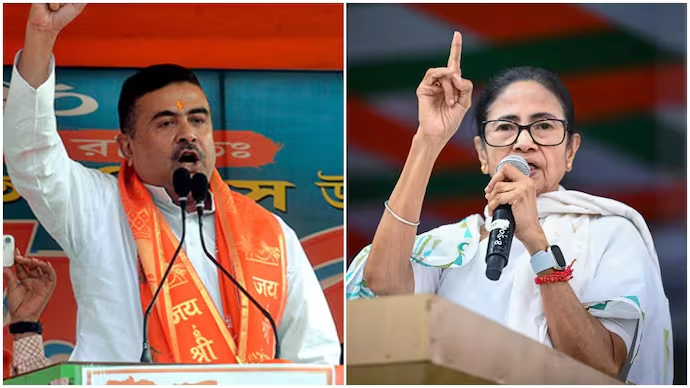
As campaign activities intensify, political tensions have also escalated, with leaders engaging in sharp exchanges over law enforcement and governance issues. West Bengal Chief Minister Mamata Banerjee has raised serious concerns regarding the role of investigative agencies in the state. Addressing a rally in Malda, she alleged that innocent individuals were being targeted while actual perpetrators of violence had managed to evade action. Her remarks specifically referenced incidents in Mothabari, where judicial officers were reportedly gheraoed, triggering widespread debate over law and order.
Such allegations highlight the deep political divide between the ruling state government and central agencies. The narrative around enforcement actions has become a recurring theme in election campaigns, often influencing voter sentiment. While opposition parties claim misuse of power, the ruling establishment maintains that agencies are acting within the legal framework. This ongoing clash adds another layer of complexity to the electoral discourse, shifting focus from purely developmental issues to questions of governance and accountability.
Meanwhile, developments in Tamil Nadu have further underscored the broader electoral climate across the country. In Tiruchirappalli, authorities seized approximately ₹11 lakh in cash from the residence of a functionary associated with the Dravida Munnetra Kazhagam. The seizure followed intelligence inputs suggesting that the money was intended for distribution to voters in the Srirangam Assembly constituency.
The operation, conducted by Income Tax officials along with the election flying squad, reflects the heightened vigilance being maintained during the election period. Such enforcement actions are part of a broader effort to ensure free and fair elections by curbing malpractice and illegal inducements. However, they also contribute to the charged political atmosphere, as parties often interpret these actions through a partisan lens.
The intersection of campaign strategies, political allegations, and enforcement activities illustrates the multifaceted nature of the current electoral environment. While parties focus on mobilizing support and articulating their visions, the parallel narratives of accountability and fairness continue to shape public discourse. The West Bengal Assembly Elections 2026, in particular, stand out as a high-stakes contest, drawing national attention and influencing political dynamics beyond the state itself.