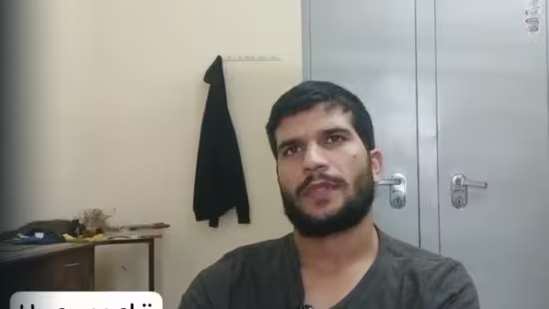
A video believed to have been recorded shortly before the deadly Red Fort blast has surfaced online, showing Umar un Nabi, the man driving the explosive-laden car that killed more than ten people, speaking at length about what he described as the misunderstood nature of suicide bombings. The emergence of the video has added a new dimension to the ongoing investigation, offering investigators a deeper look into Nabi’s mindset, ideological conditioning and possible motivations in the days leading up to the attack.
The Video, Umar’s Ideological Assertions and the New Insight Into His State of Mind
The video shows Umar un Nabi sitting alone in a dimly lit room, speaking calmly and steadily into a camera, explaining what he characterised as the misinterpretation of suicide bombings. His tone is analytical, almost lecture-like, as he attempts to redefine the meaning of such acts. According to investigators, the clip appears to have been filmed before November 10, the day of the blast, making it a potentially important piece of evidence in establishing psychological premeditation.
In the video, Nabi says, “One of the very misunderstood concept is what has been labelled as the concept of suicide bombing. It is a martyrdom operation. There are multiple arguments and contradictions that have been brought against it.”
He continues by describing how, in his interpretation, a so-called martyrdom operation involves a person fully accepting that they will die at a specific place and time. He describes it as an act carried out with the presumption that death is certain, and that the individual moves forward with clarity about that outcome. His words indicate he had been engaged in deep ideological reflection and justification of violence.
Nabi’s language, phrasing and presentation style resemble ideological materials used by extremist groups to rationalise violent acts. Although he does not directly name any organisation or encourage others, his explanations align with well-documented methods through which radicalised individuals attempt to frame self-destructive violence as moral or heroic. For investigators, the video strengthens the belief that the Red Fort attack was carried out not merely as a tactical operation but as an act rooted in ideological commitment.
The Red Fort blast shocked the national security establishment due to its location, scale and deadly impact. The vehicle driven by Nabi exploded near the iconic monument, killing over ten people and injuring several others. Nabi himself died in the explosion. Subsequent investigations revealed that he had been central to the planning, and the network behind the attack was believed to be spread across multiple states.
Before the emergence of the video, agencies already suspected that Nabi had been radicalised and influenced by extremist material. He reportedly consumed content online that glorified violent acts and framed them within ideological narratives. This video appears to confirm the depth of his ideological beliefs, revealing that he had spent considerable time contemplating and articulating the philosophy behind suicide operations.
Investigators say that such videos often serve multiple purposes within extremist networks. They can be attempts by the attacker to justify their actions to family or followers, internal messages to motivate associates, or recorded material meant to circulate after an attack as propaganda. It remains unclear whether Nabi intended the video for personal documentation, for circulation among accomplices or for broader dissemination. Officials are analysing the device used to film the video, metadata, and its transmission history to determine its intended audience.
The video’s calm tone is striking. There is no visible anger, urgency or chaotic emotion. Instead, Nabi seems to be delivering a measured explanation, indicating that he might have internalised the ideological arguments long before the attack took place. This discovery has prompted investigators to revisit earlier digital footprints, including encrypted communication channels and previous recordings, to understand the level of ideological indoctrination that shaped his actions.
The emergence of such a video also raises questions about whether other members of the module were similarly influenced or whether Nabi acted as a guiding ideological voice within the group. His role in the operational planning was already central, but the new clip suggests he may also have shaped the module’s psychological environment, promoting a sense of mission rooted in violent extremist ideology.
The Investigation Deepens as Agencies Explore the Network, Motives and Strategy Behind the Red Fort Blast
With the surfacing of the video, investigative agencies have intensified efforts to map out the broader network that supported or encouraged Nabi’s involvement in the attack. Officials have said that the Red Fort blast was likely not an isolated act but part of a structured and coordinated plot managed by what they describe as a sophisticated “white-collar extremist module.”
Security officials believe that the module combined technical expertise, ideological grooming and operational secrecy. Nabi’s video fits into this assessment, supporting the hypothesis that the group’s members were not merely logistical participants but were steeped in ideological narratives that framed violent acts as purposeful missions.
The car explosion near the Red Fort was carried out with significant precision. The vehicle, rigged with explosives, detonated with devastating force, destroying surrounding vehicles and damaging nearby structures. Agencies have since recovered electronic devices, communication logs and testimony from suspects that point to months of preparation.
According to investigators, the group included individuals with technical backgrounds, access to sophisticated communication systems and the ability to acquire or assemble explosive material. The video implies that Nabi was not only a driver but also a key figure who may have attempted to rationalise and spread extremist views within the module.
Security officials emphasise that the video reflects a pattern often seen in radicalised individuals who record ideological statements before carrying out major attacks. Such recordings can serve as psychological reinforcement, creating a sense of narrative continuity for the attacker. It is also possible that the video was meant to be discovered after his death, providing ideological justification and attempting to shape the legacy of the attack.
Investigators are examining whether the network around Nabi had been exposed to similar forms of ideological conditioning. Several arrested individuals reportedly had been in touch with Nabi for months and had travelled with him between Delhi, Haryana and Jammu and Kashmir. Agencies are now checking whether any of them were present when the video was recorded or had viewed it before the blast.
Digital forensics teams are reconstructing the timeline of the recording. They are analysing the lighting, background noise, and metadata to determine the precise moment the video was made. This can help establish whether it was created as part of the final phase of planning or whether it was recorded earlier as part of ongoing radicalisation.
Officials are also looking into encrypted channels and message groups that Nabi may have used. Many extremist groups rely on such channels to circulate ideological content, operational instructions and motivational material. If Nabi recorded the video with the intention of sharing it within a secure network, it could lead investigators to previously unknown associates or handlers.
Another aspect under scrutiny is the psychological conditioning required to execute such an attack. Experts say that individuals who carry out lethal self-destructive operations typically undergo a long period of indoctrination. The clarity in Nabi’s voice, his structured arguments and his philosophical framing indicate that he had reached a point of ideological certainty. This can shed light on how the module recruited or groomed potential attackers.
Investigators are also working to understand whether the module had planned more attacks. Given Nabi’s rationalisation of suicide bombings, agencies fear that there may have been additional members preparing for similar missions. Recent arrests and interrogations suggest that several suspects were being encouraged toward self-sacrifice, although it remains unclear how many were close to operational readiness.
The Red Fort blast has become a case study for security agencies in understanding how urban radicalisation, digital influence and covert recruitment come together in evolving extremism. Nabi’s newly surfaced video reinforces this concern. It demonstrates how ideological indoctrination can run parallel to technical preparation, each strengthening the other.
Security officials say the video will play an important role in building a timeline of events, establishing motive and identifying ideological handlers. If the video was circulated or intended for circulation, it could reveal the architecture of digital radicalisation within the module.
The Red Fort explosion marked one of the most alarming security breaches in recent years due to its symbolic location. With the video now adding a deeper psychological and ideological dimension, investigators are expanding their inquiry to determine whether the network behind the attack remains active and whether it continues to pose a threat.
As forensic teams, intelligence agencies and counterterror units coordinate their findings, the video has become a key element of the broader puzzle. It offers insight into the internal world of a man who drove a vehicle packed with explosives toward a historic national site, taking more than ten lives and leaving dozens traumatised.