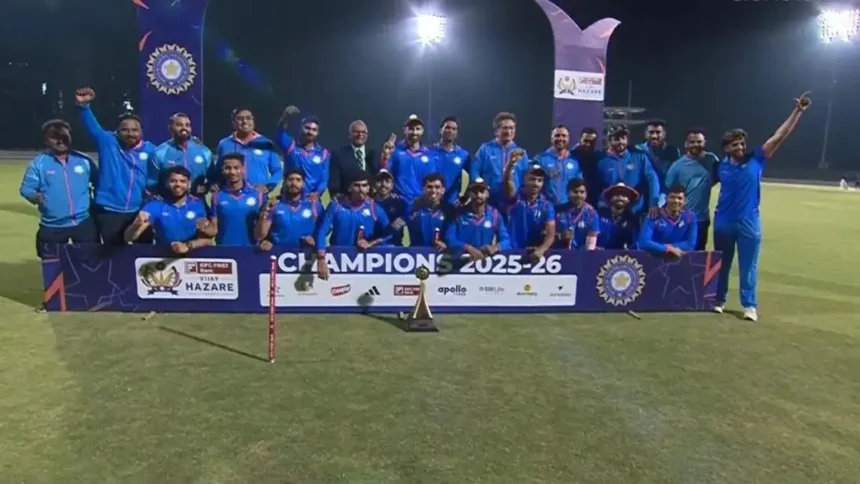
Vidarbha etched their name into Indian domestic cricket history by clinching their maiden Vijay Hazare Trophy title, defeating two-time champions Saurashtra by 38 runs in a high-quality final that showcased composure, depth, and match-winning performances under pressure. In a landmark moment for the team, Vidarbha combined a dominant batting display with disciplined bowling to seal their first-ever domestic white-ball championship, marking a significant milestone in the evolution of a side long admired for its red-ball pedigree.
The final, played at the BCCI’s Centre for Excellence, saw Vidarbha rise to the occasion with clarity of purpose from the outset. A magnificent century from Atharva Taide powered them to a formidable total, while a collective bowling effort, led by Yash Thakur’s four-wicket haul, ensured that Saurashtra never quite gained control of the chase. Under the leadership of Harsh Dubey, Vidarbha delivered a complete performance to cap a memorable tournament run.
Atharva Taide’s commanding century lays foundation for Vidarbha’s imposing total
Asked to bat first after Saurashtra won the toss and elected to field, Vidarbha began with confidence and intent. Openers Atharva Taide and Aman Mokhade set the tone with a solid partnership, combining caution with timely aggression to negate the early movement and build a stable platform. The pair added 78 runs for the opening wicket, frustrating the Saurashtra bowlers and allowing Vidarbha to dictate the tempo in the early overs.
Aman Mokhade’s dismissal, courtesy of Ankur Panwar, brought an end to a productive opening stand, but the foundation had already been laid. Mokhade, who finished the Vijay Hazare Trophy season as the leading run-scorer and the only batter to cross the 800-run mark in the tournament, once again demonstrated his consistency and value at the top of the order. His contribution in the final, though brief, played a key role in ensuring Vidarbha maintained early momentum.
Atharva Taide, however, was the undisputed centerpiece of Vidarbha’s innings. Batting with maturity beyond his years, Taide anchored the innings while steadily increasing the scoring rate. He found an able partner in Yash Rathod, with whom he stitched together a crucial century partnership that shifted the balance decisively in Vidarbha’s favour. The pair rotated the strike efficiently, punished loose deliveries, and ensured that the scoreboard kept moving even as Saurashtra searched for breakthroughs.
Taide brought up his century off just 97 balls, a knock that blended classical strokeplay with modern white-ball aggression. He eventually scored 128 runs off 118 deliveries, an innings studded with 15 boundaries and two sixes. This century was his first in the Vijay Hazare Trophy and the third of his List A career, underlining his growing stature in domestic cricket. Playing his 42nd List A match, Taide also added to a record that already includes nine half-centuries, reflecting both consistency and the ability to convert starts into substantial scores.
Yash Rathod contributed a valuable 54 before being dismissed leg-before wicket, while Samarth and others added useful runs in the middle and lower order. For Saurashtra, Ankur Panwar emerged as the standout bowler, picking up four wickets and shouldering much of the responsibility in an otherwise challenging innings. Chirag Jani also chipped in with key wickets, but Vidarbha’s depth ensured that the scoring rate never dipped significantly.
By the end of their allotted 50 overs, Vidarbha had amassed an imposing 317 for eight, a total that reflected not only individual brilliance but also collective discipline. On a surface that offered something for both batters and bowlers, the target of 318 placed Saurashtra under immediate pressure, especially in a final where scoreboard pressure often plays a decisive role.
Disciplined bowling effort and Yash Thakur’s four wickets seal historic victory
Saurashtra’s chase got off to a shaky start, as Vidarbha’s bowlers struck early to dent their confidence. Both openers were dismissed cheaply, leaving the two-time champions reeling in the powerplay. Harvik Desai managed just 20, while Vishvaraj Jadeja was dismissed for nine, a double blow that tilted the momentum firmly in Vidarbha’s favour.
Despite the early setbacks, Saurashtra attempted to rebuild through Prerak Mankad, who played a determined knock to keep his side in contention. Mankad scored a well-crafted 88 off 92 balls, mixing resilience with calculated aggression and refusing to let the required run rate spiral out of control. His innings provided Saurashtra with hope during the middle overs, as he sought to anchor the chase and set up a late push.
Chirag Jani offered strong support, scoring 64 runs off 63 deliveries in a partnership that briefly threatened to swing the contest back toward Saurashtra. The pair counterattacked effectively, targeting gaps and punishing anything loose, forcing Vidarbha to stay sharp in the field and disciplined with their lines and lengths.
The turning point came when Vidarbha captain Harsh Dubey dismissed Prerak Mankad, breaking the backbone of Saurashtra’s chase. The wicket not only removed their set batter but also exposed the lower middle order to sustained pressure. From that moment, Vidarbha tightened their grip on the match, sensing that the title was within reach.
Yash Thakur led the bowling attack with a superb spell, claiming four wickets and consistently hitting the right areas. His ability to extract movement and maintain control during crucial phases of the innings proved decisive. Nachiket Bhute provided excellent support, picking up three wickets and ensuring that Saurashtra never regained momentum. Darshan Nalkande added two scalps, rounding off a collective bowling effort that exemplified teamwork and tactical awareness.
Despite flashes of resistance, Saurashtra ultimately fell short, being bowled out for 279. The 38-run margin of victory underscored Vidarbha’s dominance on the day and reflected the gap between the two sides in terms of execution under pressure. For Saurashtra, it was a disappointing end to an otherwise strong campaign, but their fighting spirit, particularly through Mankad and Jani, ensured the final remained competitive for long stretches.
Vidarbha’s journey to the title was marked by consistency and composure throughout the tournament. Led by Harsh Dubey, they had earlier overcome defending champions Karnataka in the semifinals, demonstrating their ability to perform against top-quality opposition. Saurashtra, meanwhile, had reached the final after an emphatic semifinal win over Punjab under the leadership of Harvik Desai, making the summit clash a contest between two in-form sides.
The triumph carries added significance for Vidarbha, as it represents their first title in India’s domestic white-ball competitions. Long regarded as a powerhouse in red-ball cricket, Vidarbha’s success in the Vijay Hazare Trophy signals a broader evolution of the team and its ability to adapt to different formats. The blend of experienced performers and emerging talent suggests a promising future for the side in limited-overs cricket.
Atharva Taide’s match-winning century and Yash Thakur’s incisive bowling will be remembered as defining moments of the final, but the victory was ultimately the result of collective effort, clarity in planning, and calm execution. For Vidarbha, the maiden Vijay Hazare Trophy title is not just a trophy but a statement of intent, affirming their place among India’s elite domestic teams and opening a new chapter in their cricketing journey.