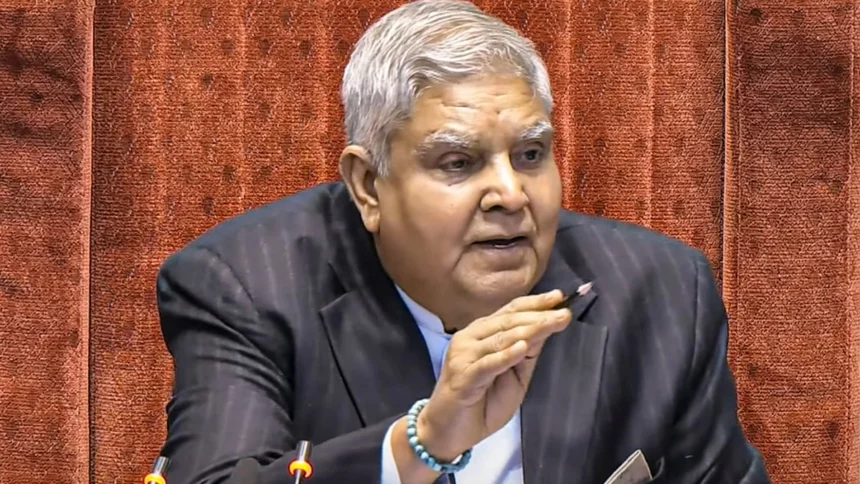
Vice president Jagdeep Dhankhar has sparked a major debate over the principle of separation of powers in India, questioning the role of the chief justice in executive appointments. Speaking at the National Judicial Academy in Bhopal, he expressed deep concerns about what he termed as the judiciary’s encroachment into the executive domain. His remarks come at a critical juncture as the selection process for the new chief election commissioner is about to take place, making his observations even more significant in the current political and judicial landscape.
Jagdeep Dhankhar’s comments were particularly pointed regarding the chief justice of India’s participation in the selection of the Central Bureau of Investigation (CBI) director, stating that such involvement does not align with democratic principles. He questioned whether there was any legal rationale for the chief justice to be part of an executive decision-making process, arguing that this practice arose due to judicial verdicts influencing executive decisions. He called for a reevaluation of such statutory prescriptions, asserting that democracy cannot function effectively if institutions exceed their constitutional boundaries. His concerns were underscored by his assertion that governance by judicial decree creates a constitutional paradox that the world’s largest democracy can no longer afford.
The timing of Jagdeep Dhankhar’s remarks is crucial as the process of selecting the next chief election commissioner is underway. This selection marks the first such appointment since the enactment of the chief election commissioner and other election commissioners (appointment, conditions of service and term of office) act, 2023. The new law was introduced following a Supreme Court verdict in March 2023 that had mandated a three-member panel comprising the prime minister, the leader of the opposition, and the chief justice of India to oversee appointments until Parliament passed a law. The legislation now in effect, however, excludes the chief justice from the panel, a move that critics argue grants excessive power to the executive and undermines the independence of the Election Commission.
Chief election commissioner Rajiv Kumar is set to retire on February 18, and the selection committee, consisting of prime minister Narendra Modi, law minister Arjun Ram Meghwal, and leader of the opposition in the Lok Sabha Rahul Gandhi, is expected to deliberate on the appointment soon. The timing of this meeting is particularly significant as it is scheduled just a day before the Supreme Court is set to hear petitions challenging the new law.
Jagdeep Dhankhar’s remarks further underscored the broader debate on the separation of powers, emphasizing that institutions should function within their defined constitutional limits while maintaining cooperative dialogue in the national interest. He stressed that executive governance is constitutionally sanctified as it reflects the will of the people and is accountable to both the legislature and the electorate. He warned against any form of executive governance being outsourced or interfered with, whether by the legislature or the judiciary, as it would undermine the democratic framework of the country.
Drawing from his past experience as parliamentary affairs minister in 1990, Jagdeep Dhankhar recalled that when the Supreme Court had only eight judges, the interpretation of the Constitution was handled by a five-judge bench under Article 145(3). He argued that while judicial interpretation of the Constitution is necessary, it should not lead to an arrogation of authority beyond what the framers of the Constitution had envisioned. He insisted that the spirit of Article 145(3) must be upheld to prevent the judiciary from assuming powers not intended by the Constitution.
Expanding on the subject of judicial review, Jagdeep Dhankhar reiterated that while Parliament holds supremacy in lawmaking, it remains subject to judicial review to ensure legislative conformity with the Constitution. However, he asserted that the power to amend the Constitution rests solely with Parliament and should not be subject to external intervention. He emphasized that the will of the people is expressed through elected representatives, making Parliament the ultimate authority in constitutional amendments.
Jagdeep Dhankhar also addressed concerns regarding judicial overreach, stating that the judiciary’s presence in public discourse should be reflected primarily through its judgments. He warned against judges expressing their views outside of their official capacity, arguing that such practices risk undermining institutional dignity. He pointed out that in other democracies, judges typically refrain from making public statements on political or administrative matters.
Highlighting the importance of free expression in a democratic society, Jagdeep Dhankhar remarked that democracy weakens if the right to express opinions is curtailed or suppressed. He underscored that voting is one essential aspect of democracy, but the broader right to express views and participate in governance is equally important. He advocated for meaningful dialogue, emphasizing that differing opinions should not lead to confrontation but should instead foster discussions that help build consensus. He stated that dialogue is essential in democracy, as unilateral expression without engagement leads to polarization and stagnation.
Jagdeep Dhankhar’s remarks have ignited a larger debate on the role of the judiciary in executive matters and the extent to which institutional powers should be demarcated. His comments also align with the broader political discourse surrounding the independence of constitutional bodies such as the Election Commission and the CBI. As the legal and political battles over these issues unfold, his statements add to the growing discourse on the need for clarity in the distribution of powers among the executive, legislature, and judiciary. With critical decisions regarding the Election Commission’s future governance set to be made soon, the balance of power between these institutions remains a focal point of national attention.