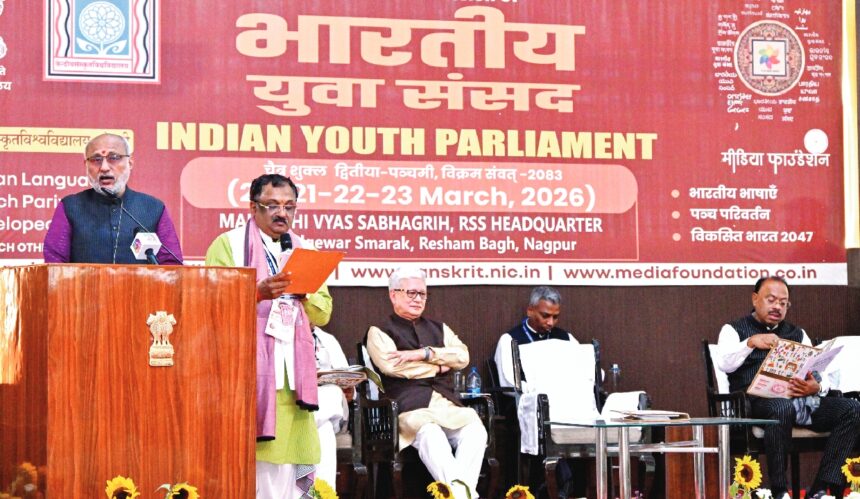
Vice President C.P. Radhakrishnan’s address at the 29th National Youth Parliament in Nagpur was more than a ceremonial speech to students; it was a timely intervention in the national conversation on the future of India. Speaking at the Maharshi Vyas Auditorium in Dr. Hedgewar Smriti Mandir in Reshimbagh, he placed the country’s youth at the centre of the vision for a developed India by 2047.
His message balanced modernity with cultural rootedness, patriotism with responsibility, and ambition with democratic dialogue. At a time when young Indians are being called upon to shape the social, political, and economic future of the nation, his remarks underlined that progress cannot be measured only in material or technological terms. It must also reflect the strength of values, respect for heritage, and a commitment to peaceful discourse in a rapidly changing and conflict-prone world.
Youth at the heart of developed India 2047
The Vice President’s speech strongly connected the aspirations of young Indians with the long-term national goal of building a developed India by the year 2047, when the country will mark 100 years of independence. This vision has increasingly become a central theme in public discourse, and his address gave it moral and civic depth. Rather than presenting development as a distant governmental project, he framed it as a participatory national mission in which students and young citizens must play an active role.
His call to the youth to uphold the dignity and glory of the Tricolour was not merely symbolic. It reflected a broader expectation that the younger generation must protect the values associated with nationhood, unity, and public service. In invoking the image of the national flag, he tied personal responsibility to collective destiny. The message was clear: a developed India cannot be built only through policy, investment, or innovation. It also requires citizens who understand the meaning of democratic responsibility and national integrity.
This appeal gains importance in a time when the language of development is often reduced to infrastructure, markets, and global rankings. C.P. Radhakrishnan’s remarks reminded students that the making of a strong nation depends equally on character, discipline, and commitment to the public good. By placing youth at the forefront of this journey, he recognized that India’s demographic strength will matter only if it is matched by clarity of purpose and civic awareness.
The venue and context of the address added further significance. The National Youth Parliament is not simply an academic exercise but a platform designed to cultivate democratic habits among students. Through discussion, debate, and structured engagement with public issues, it encourages young participants to think beyond examination halls and career anxieties. It prepares them to understand institutions, appreciate disagreement, and engage with public questions in a reasoned manner. In that sense, the Vice President’s emphasis on the role of youth was perfectly aligned with the spirit of the event.
The four-day Indian Youth Parliament in Nagpur, centred on the theme ‘Indian languages & Viksit Bharat@2047’, also reflects a larger shift in the national imagination. It suggests that India’s development journey cannot be separated from its linguistic and cultural identity. The participants are expected to engage with this theme through discussions and paper presentations, bringing together language, democracy, and national growth. This approach broadens the meaning of development and resists the idea that progress must come at the cost of civilizational memory or cultural diversity.
By encouraging students to think in these terms, the Vice President effectively challenged a narrow version of modernity that dismisses tradition as irrelevant. He acknowledged the need for a progressive mindset, but warned against forgetting the country’s rich and diverse cultural heritage. This balance is particularly important in contemporary India, where young people are navigating global influences, digital cultures, and new forms of aspiration. The challenge is not whether they should be modern, but whether they can remain anchored while moving forward. His speech offered that framework.
Cultural heritage, democratic dialogue and the meaning of national responsibility
One of the most notable aspects of the address was its insistence that modern progress must remain connected to India’s civilizational depth. In asking students not to forget the country’s cultural heritage, the Vice President touched upon a recurring tension in public life: how to embrace innovation without losing identity. His words suggested that heritage is not a burden from the past but a source of strength for the future. For a country as diverse as India, cultural memory is not ornamental; it is foundational to social confidence and national continuity.
This message carried added weight in Nagpur, a city that occupies an important place in India’s ideological and organizational history. In his remarks, C.P. Radhakrishnan referred to the historical significance of the city, noting that Keshav Baliram Hedgewar founded the Rashtriya Swayamsevak Sangh there in 1925. Whether viewed politically, historically, or culturally, Nagpur remains a city with symbolic resonance. Mentioning this context situated the event within a broader narrative of national organization, civic thought, and ideological influence. It also reinforced the idea that youth engagement today is part of a larger continuum of institution-building and public mobilization.
The Vice President also drew attention to one of the most urgent questions of the present global moment: the threat of international conflict. His observation that the world is grappling with the spectre of global conflict made the speech outward-looking as well as domestically focused. By stating that dialogue and discourse are the only viable solution, he affirmed the value of democratic engagement not just within India but in international affairs as well. This was a meaningful reminder for students participating in a parliamentary forum. Debate is not a weakness of democracy; it is its strength. Discussion is not delay; it is the civilised alternative to division and violence.
At a time when public discourse is often shaped by polarisation, instant reactions, and ideological rigidity, such a message deserves serious attention. Young people today consume political content at great speed, often through fragmented digital platforms that reward outrage more than understanding. In that environment, a call for dialogue and discourse becomes deeply relevant. The National Youth Parliament, with its emphasis on structured debate and thoughtful participation, offers an antidote to superficial engagement. It teaches that disagreement can be productive and that institutions matter.
The presence of Maharashtra Governor Jishnu Dev Sharma, Nagpur’s Guardian Minister Chandrashekhar Bawankule, and a large gathering of students gave the event both ceremonial stature and broad public visibility. Yet the real importance of the occasion lies in its educational and democratic purpose. Youth forums of this kind can become meaningful only when they move beyond formal speeches and generate genuine intellectual engagement. The chosen theme, linking Indian languages with Viksit Bharat@2047, has the potential to deepen that engagement by foregrounding questions of inclusion, accessibility, and cultural confidence.
Language is a crucial part of democratic participation. A developed India cannot be imagined only through the vocabulary of elite institutions or global business. It must also speak in the many languages of its people. In that sense, the Youth Parliament’s theme is both timely and transformative. It recognizes that India’s future will be stronger if it is articulated through its linguistic diversity rather than despite it. This is especially important for students, who often experience the tension between local identity and national aspiration in immediate ways.
C.P. Radhakrishnan’s speech therefore stood at the intersection of several important ideas: youth participation, cultural rootedness, national development, democratic dialogue, and the urgency of preserving unity in uncertain times. His message was not merely about inspiring students for a single event. It was about defining the moral and civic qualities that India will need from its young citizens if the promise of developed India 2047 is to become meaningful and enduring.