As Venezuelan President Nicolás Maduro prepares for his controversial third-term inauguration, political tensions and repression in the country have reached new heights. Human rights groups and political opponents are expressing growing concern that the inauguration ceremony will mark the escalation of violence and political persecution in Venezuela. The ongoing repressive measures have already forced many activists and opposition figures to flee the country, seeking refuge from the government’s growing crackdown on dissent.
One such individual is Jesus Medina Ezaine, a 43-year-old Venezuelan photojournalist who has been the target of the Maduro government due to his work exposing human rights abuses. Medina was arrested in 2018 on charges of money laundering, criminal association, and inciting hatred, charges he vehemently denies. Instead, Medina maintains that his arrest was retaliation for his journalistic work documenting human rights violations under Maduro’s rule.
Medina was held for months without trial in the infamous Ramo Verde military prison before being released in January 2020. However, after the controversial presidential election in July 2024, Medina found himself once again in danger. As protests erupted in response to allegations of electoral fraud, Medina, who had been documenting the opposition leader María Corina Machado’s campaign, was forced to go into hiding. Medina feared another arrest after reports surfaced that the Venezuelan government was rounding up political dissidents in the wake of the election.
“I knew I had to leave before they could throw me back in prison,” Medina said in an interview. His fear of imprisonment led him to flee to Bogotá, Colombia, where he currently resides. He described his last months in Venezuela as being drenched in fear, as he witnessed firsthand the severe suppression of opposition voices and journalists in the country.
The backdrop to Medina’s escape is the political crisis that has engulfed Venezuela since the May 2024 re-election of Maduro. The election has been marred by allegations of voter fraud, as opposition figures claimed that Maduro’s government manipulated the results to secure his re-election. While the National Electoral Council officially declared Maduro the winner, opposition figures—including Edmundo Gonzalez, who has claimed to have won the election—published documents contradicting the government’s narrative. The ensuing protests and unrest were met with brutal government crackdowns, with state forces detaining thousands of people, including political activists, journalists, and human rights defenders.
Between August and December 2024, at least 56 political activists, 10 journalists, and one human rights defender were arrested, according to reports by the United Nations. The crackdown continued as Maduro’s government sought to silence opposition forces in the lead-up to his inauguration. The Venezuelan government’s actions have drawn widespread international condemnation, with groups like Human Rights Watch warning that Maduro is likely to continue using violence and intimidation to maintain control over the country.
The government’s response to the protests, which included violent repression and mass arrests, has been nothing short of extreme. According to the Inter-American Commission on Human Rights, the Venezuelan government has intentionally suppressed political opposition in an attempt to “sow terror among citizens” and prevent any meaningful political change. As part of this effort, Maduro’s regime has continued to arrest dissenting voices, even as it has released some political prisoners in an attempt to reduce scrutiny from international observers.
Despite these attempts to ease international pressure, the situation in Venezuela remains dire, and more than 1,700 individuals remain incarcerated as of January 2025. Alfredo Romero, the director of Foro Penal, a Venezuelan human rights group, stated that the release of some prisoners does not signify an end to the ongoing repression. “People may be released from prison, but it doesn’t mean that new ones won’t be jailed,” he said.
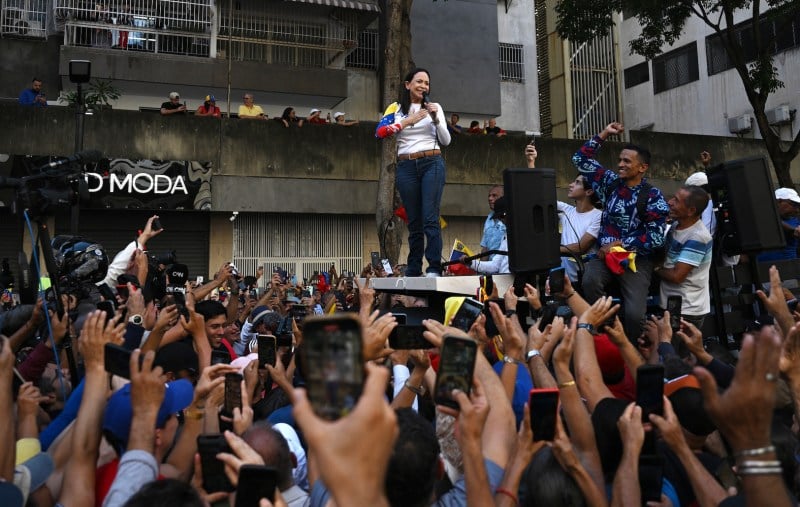
As Maduro prepares for his third-term inauguration on January 12, 2025, it is clear that his grip on power is being reinforced by force and fear. Demonstrations are expected on the day of the inauguration, with opposition leaders like María Corina Machado pledging to return from exile and demand a transition of power. While the details of how Machado will follow through on her pledge remain unclear, her call for a massive protest is a reflection of the growing dissatisfaction with Maduro’s rule.
In response, the government has ramped up security, deploying more than 1,200 military personnel to maintain order on inauguration day. Maduro’s forces have also arrested human rights defenders and opposition figures in recent days, including the son-in-law of presidential candidate Edmundo Gonzalez. Critics view these arrests as attempts to intimidate those who challenge Maduro’s regime, and to silence dissent ahead of his re-inauguration.
The international community has also condemned the ongoing repression, with the United States and the European Union denouncing the recent wave of arrests. The U.S. Embassy in Venezuela has described the detention of Gonzalez’s son-in-law as an act of “intimidation” against the opposition, while Colombian President Gustavo Petro announced that he would not attend the inauguration due to the repressive atmosphere in the country.
As Venezuela approaches the swearing-in of its president for a third term, many fear that the worst is yet to come. Jesus Medina, who has dedicated his life to exposing the abuses of the Maduro government, believes that the situation will only worsen if Maduro continues to hold power. “If we do not achieve freedom, there will be much more persecution,” Medina warned. “They will try to put an end to everything that they consider the opposition, including political leaders and the media.”
For now, Medina remains committed to his mission of exposing the human rights abuses taking place in Venezuela. Although in exile, he vows to continue his work and fight for his country, despite the immense personal risks involved. “I’ll fight for my country, no matter what,” Medina declared, a sentiment shared by many who continue to resist the Maduro government’s authoritarian rule.
As Venezuela grapples with its uncertain future, the world watches closely to see whether international pressure and internal resistance can lead to meaningful change or if the country will continue down the path of authoritarianism under Maduro’s control.