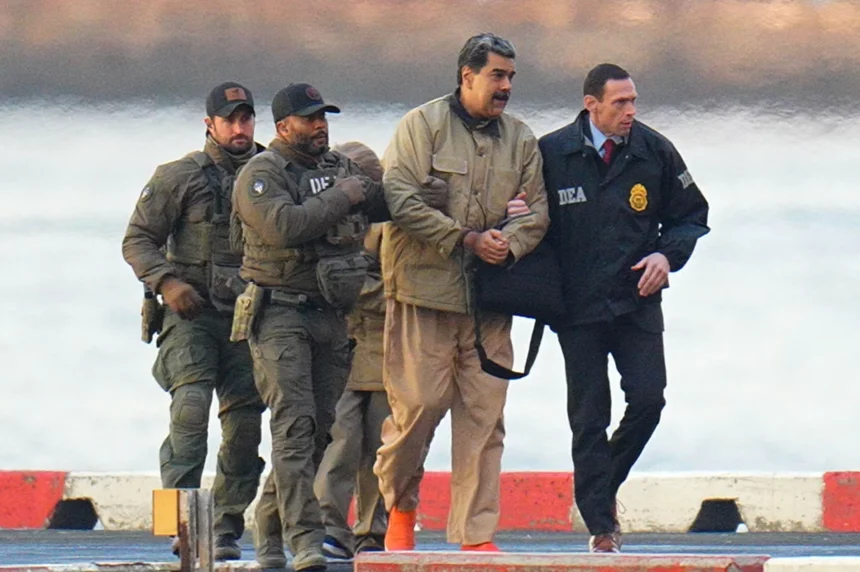
Venezuela has triggered an international controversy after accusing the United States of deploying a sonic or directed-energy weapon during a high-intensity operation, claiming that members of its presidential security detail suffered extreme physical effects including nosebleeds, vomiting blood, and sudden incapacitation, raising serious questions about modern warfare, state sovereignty, and the use of unverified advanced military technologies.
The allegations emerged amid already heightened tensions between Caracas and Washington, with Venezuelan officials asserting that the incident occurred during a covert or semi-covert operation aimed at destabilising the government of Nicolás Maduro. According to accounts circulated by Venezuelan security personnel and officials, the incident unfolded rapidly and with overwhelming technological force, leaving guards disoriented and physically unable to respond. The claims have ignited debate across diplomatic, military, and human rights circles, even as the United States has not officially confirmed the use of any such weapon.
At the heart of the Venezuelan accusation is the assertion that soldiers protecting key state installations were subjected to a powerful, non-conventional weapon that caused immediate and severe physiological reactions. These claims, while unverified by independent investigators, have drawn global attention due to their graphic nature and the implications they carry for international law and future conflict norms. The Venezuelan government has framed the episode as evidence of foreign aggression and technological intimidation, while critics caution against drawing conclusions without concrete proof.
Alleged attack, physical symptoms, and claims of advanced warfare
According to statements attributed to members of Venezuela’s presidential guard, the incident began with a sudden failure of surveillance and radar systems, followed by the appearance of unmanned aerial vehicles and helicopters. Guards described hearing or feeling an intense, invisible force that struck without warning. Within moments, several soldiers reportedly experienced acute pain, dizziness, bleeding from the nose, and vomiting blood, forcing them to collapse and abandon their posts.
One guard claimed that the sensation felt like extreme pressure building inside the skull, accompanied by disorientation and loss of balance. Others described temporary blindness, ringing in the ears, and a sense of paralysis. These symptoms have led Venezuelan authorities to allege the use of a sonic or directed-energy weapon, technologies that are often discussed in military research but rarely acknowledged as operational tools in real-world combat.
Sonic weapons, also referred to as acoustic weapons, are said to use focused sound waves to disorient or incapacitate targets. Directed-energy weapons, a broader category, can include systems that use microwaves, lasers, or other forms of concentrated energy. While some non-lethal versions, such as long-range acoustic devices, have been used for crowd control, the Venezuelan claims suggest something far more powerful and harmful.
Officials in Caracas argue that the rapid incapacitation of multiple trained soldiers, combined with the absence of conventional explosions or gunfire, points to an unconventional weapon. They claim the effects were disproportionate to any known crowd-control or psychological warfare tools and insist that the symptoms align with exposure to high-intensity energy waves. Venezuelan military doctors reportedly examined affected personnel and documented internal bleeding, although no medical records have been released publicly.
The government has also suggested that the alleged weapon was used as part of a broader strategy to demonstrate technological superiority and intimidate Venezuelan forces. According to this narrative, the operation was designed not only to achieve tactical objectives but also to send a political message about the imbalance of power between the two countries.
Sceptics, however, urge caution. Military analysts note that extreme stress, blast pressure from nearby explosions, or even chemical exposure can produce severe physical reactions, including vomiting and bleeding. Without transparent medical data or independent forensic analysis, they argue, it is impossible to conclusively identify the cause of the reported symptoms. Nevertheless, the vivid accounts have ensured that the allegations cannot be easily dismissed.
The role of social media has further complicated the situation. Accounts describing the incident spread rapidly online, amplified by political figures and commentators. Supporters of the Venezuelan government have used the story to reinforce claims of U.S. aggression, while critics argue that the narrative serves domestic political purposes, rallying support around the Maduro administration by portraying it as a victim of foreign hostility.
Geopolitical fallout, legal questions, and information warfare
The accusations come at a time of deep mistrust between Venezuela and the United States, following years of sanctions, diplomatic isolation, and mutual hostility. Caracas has long accused Washington of attempting to overthrow its government through economic pressure, covert operations, and support for opposition figures. The latest claims of sonic weapon use fit into this broader narrative of external interference and regime change efforts.
From a legal standpoint, the alleged deployment of a weapon causing severe physical harm without conventional combat raises serious questions. International humanitarian law places strict limits on the use of weapons that cause unnecessary suffering or cannot be precisely controlled. If proven, the use of a directed-energy or sonic weapon against personnel in an urban environment could prompt calls for international investigation and accountability.
Human rights organisations have expressed concern over the lack of clarity surrounding the incident. While some groups are cautious not to endorse unverified claims, they stress that any military operation resulting in severe injury must be scrutinised. They have called for independent access to medical reports, eyewitnesses, and the alleged site of the attack to determine what occurred.
The United States, for its part, has not issued a detailed response addressing the specific allegations. Past statements from Washington have consistently denied conducting illegal military operations on Venezuelan soil, instead framing its actions as diplomatic and economic measures aimed at restoring democracy. The absence of a direct rebuttal, however, has allowed speculation to flourish.
Experts also point to the increasing role of information warfare in modern conflicts. In an era where narratives can spread globally within minutes, unverified claims can shape public perception long before facts are established. Governments may exploit this dynamic to advance strategic goals, rally domestic support, or discredit adversaries. In this context, the sonic weapon allegation is as much an information battle as it is a military one.
The incident has also revived discussions about so-called “Havana syndrome,” a mysterious set of symptoms reported by diplomats in several countries over the past decade. While no direct link has been established, similarities in reported symptoms have fuelled speculation about directed-energy technologies and their possible covert use. Scientists remain divided on the causes of those incidents, underscoring how limited current understanding remains.
Within Venezuela, the allegations have reinforced the government’s security posture. Officials have vowed to strengthen defences around key installations and to invest in countermeasures against what they describe as new forms of warfare. State media has portrayed the guards as victims of an inhumane attack, praising their loyalty and resilience while condemning foreign aggression.
At the same time, opposition voices inside the country question the timing and framing of the accusations. Some argue that the story conveniently shifts attention away from Venezuela’s economic crisis and internal challenges. Others fear that escalating rhetoric could further isolate the country internationally and justify harsher domestic controls in the name of national security.
International reactions remain cautious. While some countries have called for restraint and transparency, few have taken a definitive position on the allegations. Diplomatic observers note that without independent verification, most governments are reluctant to escalate tensions or endorse claims that could set dangerous precedents.
The controversy highlights the uncertainty surrounding emerging military technologies and the difficulty of regulating them. As warfare evolves beyond traditional weapons, existing legal and ethical frameworks may struggle to keep pace. The Venezuelan accusations, whether ultimately proven or not, have forced these issues into the global spotlight, raising urgent questions about accountability, verification, and the future conduct of conflict.