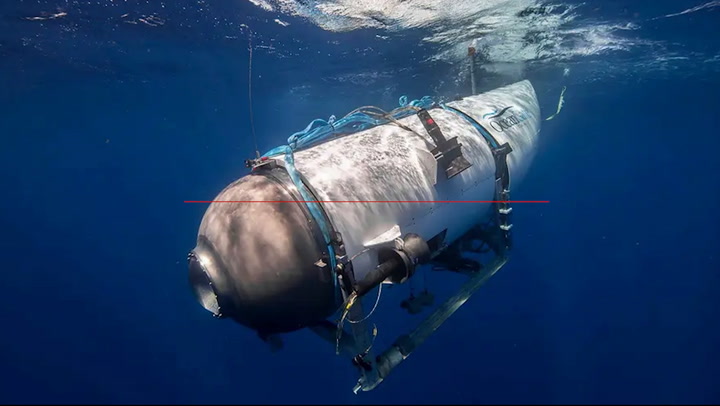
The National Oceanic and Atmospheric Administration (NOAA) has released an audio recording capturing the exact moment the Titan submersible imploded, instantly killing all five passengers as they descended toward the Titanic wreck site in June 2023. The 20-second clip, published by the Defense Visual Information Distribution Service (DVIDS), features a burst of static, followed by a thunderous boom, and then a return to white noise. Officials confirmed that the explosion-like sound captured in the recording was the catastrophic implosion of the submersible, which never reached the Titanic wreck at the bottom of the North Atlantic Ocean.
According to the New York Post, the recording was detected by a moored passive acoustic recorder nearly 900 miles away from the site where the OceanGate vessel succumbed to extreme underwater pressure. The United States Coast Guard confirmed that the clip contains “the suspected acoustic signature of the Titan submersible implosion.” The tragedy claimed the lives of Hamish Harding, a British billionaire and adventurer; Shahzada Dawood, a Pakistani businessman; his 19-year-old son, Suleman Dawood; Paul-Henri Nargeolet, a French deep-sea explorer and Titanic expert; and Stockton Rush, the chief executive officer of OceanGate Expeditions.
The incident led to intense scrutiny of the submersible’s engineering and safety standards. Reports revealed that the vessel had significant design flaws and was never independently certified for deep-sea travel, raising concerns about the safety measures undertaken by OceanGate Expeditions. It was later disclosed that the submersible had encountered several technical and structural issues during previous expeditions. Investigators found that 70 equipment problems had been documented in 2021, with an additional 48 issues reported in 2022. These warnings, however, went largely unheeded before the fatal dive in June 2023.
The Titan’s mothership lost communication with the submersible less than two hours into its descent, triggering an extensive multinational search effort. However, after days of uncertainty, a remotely operated underwater vehicle discovered the debris field four days later on the ocean floor. By October 2023, the United States Coast Guard announced that it had recovered the last remaining pieces of the submersible, further aiding investigations into the disaster.
Subsequent inquiries concluded that the Titan submersible was fraught with safety hazards and lacked proper independent review before embarking on deep-sea exploration. The incident has reignited discussions about the risks of deep-sea tourism and the need for stricter safety regulations in extreme underwater expeditions.