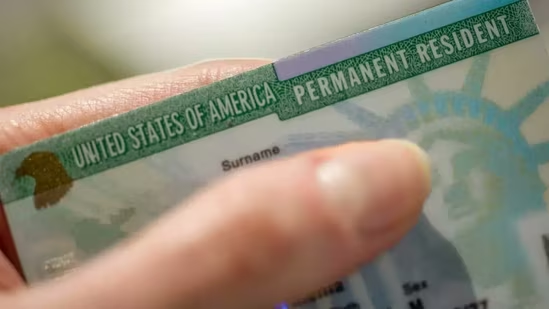
The United States has introduced sweeping new biometric data collection rules for all foreigners, including green card holders and immigrants, as part of the Donald Trump administration’s renewed immigration control measures. The Department of Homeland Security (DHS) announced that from December 26, 2025, all non-citizens entering or leaving the country will be photographed and may also be required to provide additional biometric data such as fingerprints. The new rule, published in the Federal Register on Friday, marks one of the most extensive expansions of surveillance and immigration monitoring in recent years, aiming to address national security concerns, visa overstays, and document fraud.
Comprehensive Biometric Data Collection to Cover All Foreigners
The Department of Homeland Security stated that the data collection program will now apply universally to all foreigners, including immigrants residing legally in the United States. Previously, such measures were limited to specific groups of travelers, visa applicants, and certain non-citizens. The new rule mandates that U.S. Customs and Border Protection (CBP) officials capture photographs of all non-citizens at both entry and exit points. In addition, CBP will have the authority to collect fingerprints and other forms of biometric data whenever deemed necessary for verification purposes.
According to the DHS filing, the expansion of the biometric entry-exit system aims to strengthen border control and streamline immigration enforcement. The data collected will be used to verify the identity of travelers, detect cases of document fraud, and identify individuals who overstay their visas. The agency said that “comprehensive data gathering for entry and exit of non-citizens will help address national security concerns, fraudulent use of travel documentation, and visa overstays.”
CBP officials explained that the system will rely heavily on facial comparison technology, which matches real-time photographs taken at airports or land borders with images already stored in visa applications and passports. This process, they added, allows for more accurate identity verification while reducing dependence on manual documentation checks. The integrated system is designed to compare biometric data collected upon arrival with data obtained upon departure, helping identify individuals who remain in the U.S. beyond their authorized stay or are present without proper admission or parole.
The DHS first began experimenting with biometric entry procedures in 2004, primarily targeting visitors from certain countries. Over time, the program expanded to include a wider range of travelers, particularly those considered high-risk. With this latest move, however, every foreign national entering or leaving the country will now be subject to biometric verification, regardless of nationality or visa type. Officials emphasized that the enhanced surveillance mechanism is crucial for national security and counter-terrorism, especially in light of rising global mobility and increasing attempts at identity fraud.
The Federal Register filing also detailed how biometric data will be stored and used in coordination with other federal agencies, such as Immigration and Customs Enforcement (ICE) and the Federal Bureau of Investigation (FBI). The data will be integrated into existing federal databases to help track immigration compliance and identify individuals flagged for security reasons.
Civil rights organizations, however, have expressed concerns about the privacy implications of such widespread data collection. Advocacy groups argue that the expansion of biometric surveillance raises the risk of data misuse and potential profiling. They have urged the government to ensure robust safeguards to protect individuals’ personal information. DHS officials, on the other hand, have defended the measure as a “necessary and proportionate response to modern security challenges.”
Donald Trump Administration’s Intensified Crackdown on Immigration
The new biometric rule aligns with the Donald Trump administration’s broader push to tighten immigration enforcement and restrict the entry of non-citizens. Since returning to office in January 2025, President Donald Trump has revived many of his earlier policies from his first term, starting with the controversial decision to end birthright citizenship. This move sparked widespread debate across political circles and was viewed by critics as an attack on constitutional protections for children born in the United States to immigrant parents.
The administration has also expanded Immigration and Customs Enforcement (ICE) raids nationwide in an effort to identify and deport what it calls “illegal criminal aliens.” Officials have described these operations as necessary to restore law and order, while immigrant rights groups have accused the government of targeting vulnerable communities and fostering fear among lawful residents.
Under the renewed enforcement strategy, visa applicants and green card holders have faced stricter scrutiny. DHS and the State Department have introduced mandatory social media vetting, requiring applicants to disclose their online accounts and activity history. The measure, intended to detect potential security threats, has reportedly led to increased detentions, visa denials, and deportations. Many applicants have complained that their visa applications were rejected or revoked based on arbitrary interpretations of their online behavior.
In addition, the administration has increased the use of data analytics and artificial intelligence to identify irregular migration patterns and verify compliance with immigration laws. Officials argue that the integration of biometric systems and AI-driven risk assessments will make the immigration process more transparent and efficient. Critics, however, fear that such technologies may reinforce biases and errors, resulting in wrongful detentions or deportations.
Within the context of Donald Trump’s wider immigration agenda, the DHS’s biometric expansion appears to be part of a long-term plan to establish a fully automated tracking system for all non-citizens. This initiative reflects the administration’s emphasis on technological surveillance and data-driven governance as tools of immigration control. The government insists that the collection of biometric information is a critical step toward ensuring that only authorized individuals enter and exit the United States.
The political response to the new rule has been sharply divided. Supporters within the Republican Party have hailed the measure as a landmark step toward strengthening border security and protecting American interests. They argue that the biometric exit-entry system will help close long-standing loopholes in immigration enforcement and prevent individuals from exploiting the system. Democrats and civil liberty advocates, however, have criticized the rule as another example of the administration’s heavy-handed approach toward immigrants and its disregard for privacy rights.
As the December 26, 2025 implementation date approaches, DHS is expected to issue detailed operational guidelines for CBP officers, airports, and land border checkpoints. The rollout will initially focus on major international airports before expanding to seaports and smaller border crossings. DHS has indicated that it will work with airlines and private contractors to install new facial recognition kiosks and data processing infrastructure.
While the government insists that the new technology will make travel safer and more efficient, privacy advocates remain skeptical. Organizations such as the American Civil Liberties Union (ACLU) have warned that the storage of vast amounts of biometric data could expose millions of travelers to identity theft or unauthorized surveillance. They have called for greater transparency on how long the data will be retained and who will have access to it.
Meanwhile, immigration lawyers have reported a surge in inquiries from clients concerned about how the new rule might affect their travel plans. Many green card holders, particularly those with pending naturalization applications, worry that the additional screening could delay their re-entry into the country or flag them for secondary inspection.
Officials from DHS have reassured the public that the rule is not intended to target any specific group but to ensure a consistent and secure border control process. They also claim that travelers will experience minimal inconvenience, as most biometric verification will be conducted within seconds through automated systems.
The Donald Trump administration’s immigration policy, since its first term, has consistently emphasized enforcement, border control, and surveillance. From the construction of physical barriers to the digitization of entry systems, the overarching objective has been to reduce illegal immigration while tightening oversight of lawful entrants. The new biometric entry-exit expansion marks yet another step in that direction — one that could permanently reshape how foreigners interact with the U.S. immigration system.
For now, the rule stands as a defining example of the administration’s belief that security and control should take precedence over privacy and openness. Whether this approach will succeed in preventing visa overstays or deterring illegal entry remains to be seen, but the broader impact on the immigrant community and civil liberties will likely continue to spark debate well into 2026.