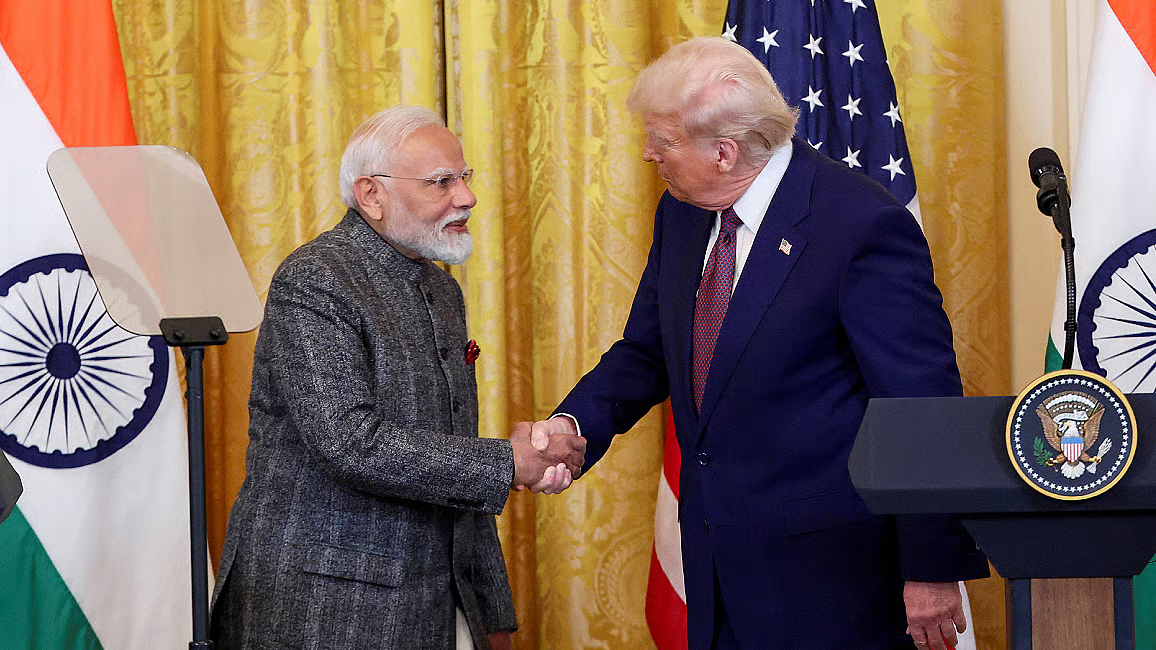
The United States has, for the first time, responded to queries regarding the June phone conversation between Indian Prime Minister Narendra Modi and US President Donald Trump, a discussion that has attracted considerable media attention in India. During this 35-minute call, which took place while PM Modi was in Canada for the G7 Summit, Modi reportedly conveyed in direct terms that the US had no role in mediating between India and Pakistan during Operation Sindoor. The US State Department, however, declined to comment on this private diplomatic interaction, reiterating that it does not disclose or provide interpretations of confidential bilateral conversations. This response highlights a subtle but important distinction in US diplomatic communication, where public statements emphasize broader regional and bilateral cooperation, yet sidestep specifics of private engagements that may carry sensitive political or strategic implications.
The US spokesperson, while avoiding a direct comment on the Modi-Trump exchange, expressed pride in the ceasefire achieved between India and Pakistan, which the US claims it played a role in facilitating. This statement underscores Washington’s desire to portray itself as a key international actor promoting peace in South Asia, even as India has consistently maintained that such ceasefires and dialogue must not be associated with, or substitute for, decisive action against cross-border terrorism. The apparent divergence in narratives between India and the US reflects a broader diplomatic balancing act, where both countries seek to maintain strong bilateral ties, while navigating differing approaches to regional security and conflict resolution.
The State Department also reiterated its position that India and Pakistan should engage directly to prevent future conflict. By encouraging bilateral communication, the US aims to emphasize responsibility on the part of the regional actors themselves, while maintaining its image as a facilitator of dialogue. However, India has consistently argued that terrorism cannot be negotiated through dialogue, particularly in contexts where security operations like Operation Sindoor are aimed at neutralizing threats that have persisted across borders. This tension between the US position and India’s firm stance on counterterrorism demonstrates the complexity of diplomatic messaging, where statements of support for peace must coexist with acknowledgment of sovereign security priorities.
Operation Sindoor, Modi-Trump Call, and US Response
The June call between PM Modi and President Trump occurred against a backdrop of heightened security concerns and ongoing military operations targeting terrorist networks in the region. During the conversation, Modi reportedly conveyed to Trump that India had conducted Operation Sindoor independently, and that the US had not mediated in the process. The operation, which targeted specific terror infrastructures, was part of India’s broader counterterrorism strategy, and Modi’s directness in the call signaled India’s desire to assert autonomy in security matters, while also maintaining strategic coordination with allies.
Despite repeated inquiries from Indian media, the US has maintained a cautious stance, emphasizing that it does not comment on private diplomatic conversations. A US State Department spokesperson told reporters that the agency does not provide interpretations of phone calls or exchanges between heads of state, reaffirming a long-standing principle in international diplomacy that private bilateral discussions are to remain confidential. This position avoids the potential politicization of private remarks, ensuring that any public statement focuses on verifiable actions, agreements, and publicly declared intentions rather than personal exchanges that may be subject to misrepresentation.
At the same time, the US did commend the ceasefire achieved between India and Pakistan, praising both Prime Minister Modi and Prime Minister Imran Khan for choosing “the path of peace.” The spokesperson emphasized that both leaders demonstrated “strength, wisdom, and fortitude” in addressing cross-border tensions. This careful wording underscores the US desire to frame the ceasefire as a cooperative achievement, without acknowledging Modi’s explicit statements that the US had no mediating role. For Indian observers, this illustrates the nuanced approach the US takes in presenting its diplomatic interventions, highlighting its involvement in regional peace efforts while not contradicting official Indian narratives outright.
The State Department also reinforced the importance of maintaining open communication channels between India and Pakistan, stressing that ongoing dialogue is critical to preventing future conflict. While India continues to prioritize counterterrorism operations, the US statement implicitly positions itself as an advocate of dialogue and conflict avoidance, reflecting Washington’s long-standing regional policy goals. This juxtaposition of India’s operational stance and the US’s advocacy for communication exemplifies the often delicate balance in international relations, where allies may share overarching goals yet differ in their approaches or public messaging.
Trade Negotiations and US-India Economic Relations
In addition to regional security issues, the US spokesperson addressed the state of trade negotiations with India, which have become a focal point amid recent tariff disputes. Earlier this month, the US imposed 25 percent tariffs on select Indian goods, citing imbalances in bilateral trade and concerns over India’s purchase of Russian oil. The US also threatened secondary tariffs from August 27, a move that raised concerns over potential impacts on the broader strategic relationship. In response, the State Department emphasized that trade talks with India remain ongoing and that both countries are committed to advancing a “productive and balanced” trade agreement.
The US narrative stresses continuity in engagement and a willingness to negotiate mutually beneficial solutions, highlighting the importance of economic ties alongside strategic and security cooperation. For India, maintaining sovereignty over trade policy while protecting domestic interests—particularly those of farmers and fishermen—remains a priority. Indian officials have indicated that any trade deal must respect these interests, signaling a measured approach that balances openness to negotiation with protection of national economic priorities. The State Department’s statements reflect an acknowledgment of these dynamics, reinforcing Washington’s interest in concluding a trade agreement without undermining India’s internal economic considerations.
This dual focus on trade and security encapsulates the broader US approach to India: promoting regional stability through diplomatic encouragement, while simultaneously fostering economic integration and bilateral cooperation. The emphasis on fair trade practices, compliance with global trade norms, and the pursuit of a balanced agreement indicates that the US sees India as both a strategic partner and a vital market, whose economic policies directly influence bilateral engagement. Observers note that while the US publicly projects progress in trade negotiations, underlying tensions over tariffs and regulatory measures continue to require careful management to avoid undermining strategic partnerships.
The ongoing trade discussions, postponed visits by US trade teams, and public statements by the State Department are part of a coordinated effort to maintain momentum in negotiations. By publicly affirming commitment to dialogue and progress, the US seeks to reassure both domestic and international audiences that its relationship with India is robust, even amidst disagreements or contentious decisions. For India, these engagements offer an opportunity to secure concessions or clarifications that align with national priorities while demonstrating continued collaboration on economic and strategic fronts.
Implications for Bilateral Relations and Strategic Engagement
The Modi-Trump phone call and the subsequent US response exemplify the intricate interplay of diplomacy, public perception, and strategic communication. India’s insistence that the US played no role in Operation Sindoor underscores the country’s emphasis on sovereign decision-making in security matters, while the US emphasis on a brokered ceasefire and ongoing trade negotiations reflects its interest in highlighting continued collaboration and regional influence.
This duality—balancing public affirmation of cooperation with private differences in interpretation—demonstrates the subtlety of modern diplomacy. For policymakers in both countries, managing these narratives is essential to sustaining trust, advancing shared objectives, and avoiding misunderstandings that could disrupt broader bilateral or regional agendas. In particular, the careful wording of US statements illustrates the challenge of maintaining credibility, respecting confidential discussions, and projecting influence, all while avoiding contradictions with Indian official positions.
The discussion of trade issues alongside security matters highlights the increasingly intertwined nature of modern diplomacy, where economic and strategic considerations are addressed concurrently. For India, protecting domestic interests while maintaining international cooperation is a delicate act that requires transparent communication, strategic foresight, and negotiation skill. For the US, projecting an image of continued engagement, fairness, and influence reinforces its role as a key global actor, while demonstrating responsiveness to partner nations’ concerns.
The US State Department’s public comments, while limited in scope regarding the Modi-Trump call, have effectively reinforced two central messages: that it is proud of the ceasefire and that India and Pakistan should continue direct communication, and that trade negotiations with India are ongoing, aiming for balance and mutual benefit. These statements reflect a calibrated diplomatic approach, designed to maintain partnership credibility, minimize controversy, and signal ongoing commitment to both regional stability and economic cooperation.
India’s consistent position, emphasizing that dialogue cannot substitute for counterterrorism and that trade deals must protect domestic priorities, serves as a counterbalance to the US messaging. This interplay of communication, strategy, and national interest highlights the complexity of the bilateral relationship, illustrating how public statements, private conversations, and policy decisions interact to shape the trajectory of one of the most important partnerships in Asia.
In the context of Operation Sindoor, the US decision not to comment directly on the Modi-Trump call reinforces India’s narrative of sovereign decision-making, while still allowing Washington to claim a role in promoting regional peace through ceasefire facilitation. Similarly, in the trade arena, the US commitment to ongoing negotiations provides reassurance of economic collaboration, while leaving India room to protect domestic priorities and negotiate terms favorable to its strategic and economic interests.
The overall interaction demonstrates a nuanced approach to international diplomacy, where messaging, public perception, strategic interests, and national sovereignty must all be balanced. By emphasizing ceasefire achievements, encouraging direct dialogue between India and Pakistan, and affirming ongoing trade talks, the US manages to maintain influence and visibility while respecting India’s position on both security and trade matters. For India, the episode reinforces the importance of clear communication, strategic negotiation, and careful management of bilateral relationships to protect national interests and sustain a productive partnership with the US.
The Modi-Trump conversation, subsequent US statements, and ongoing trade engagements collectively highlight the evolving nature of US-India relations, where security, diplomacy, and economics intersect. They illustrate how nations navigate complex challenges, assert sovereignty, and pursue mutually beneficial outcomes within a framework of strategic cooperation, all while managing domestic and international expectations.
The events also underscore the role of media scrutiny, public inquiry, and transparency in shaping diplomatic narratives. By responding selectively, emphasizing certain outcomes, and deferring commentary on sensitive interactions, the US demonstrates an approach that seeks to maintain strategic credibility, support regional stability, and uphold a constructive relationship with India. For policymakers and observers, these developments provide insight into the mechanics of modern diplomacy, the balancing of multiple priorities, and the careful calibration required to sustain long-term partnerships between nations with shared strategic and economic interests.