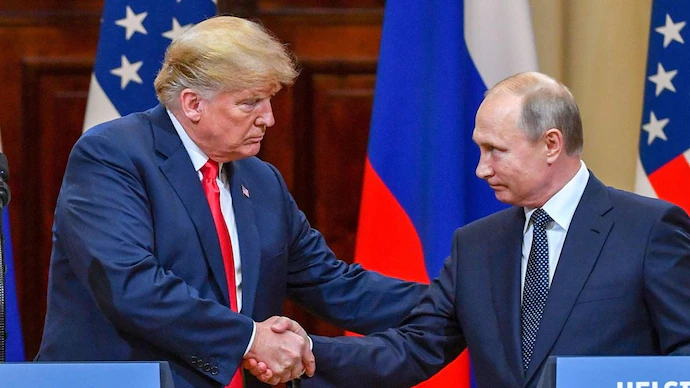
In a significant shift in US foreign policy, Washington sided with Moscow at the United Nations General Assembly on a resolution concerning Ukraine’s territorial integrity, marking a dramatic departure from its previous stance under former President Joe Biden. The United States, along with Russia and 16 other countries, voted against a resolution supporting Ukraine, while India chose to abstain.
The resolution, drafted by Ukraine and European nations, secured 93 votes in favor, 18 against, and 65 abstentions, reaffirming the UN General Assembly’s commitment to Ukraine’s sovereignty, independence, unity, and territorial integrity. However, the level of support for Ukraine saw a decline compared to previous resolutions, highlighting shifting geopolitical dynamics. India, which has consistently maintained a neutral position on the Russia-Ukraine war, once again abstained from voting on the draft resolution titled ‘Advancing a Comprehensive, Just, and Lasting Peace in Ukraine.’ The resolution called for a de-escalation of the conflict, an early cessation of hostilities, and a peaceful resolution to the war.
The US decision to vote against the resolution marks a stark policy change, given that Washington had previously been one of Ukraine’s strongest allies at the UN under Biden’s administration. During Biden’s tenure, the US had played a crucial role in supporting Ukraine’s battlefield efforts, ensuring a steady supply of arms and ammunition. However, the US, now under President Donald Trump, opted to introduce its own resolution, which sought a “swift end” to the conflict but notably omitted any mention of Ukraine’s territorial integrity. This omission led to widespread criticism and a lack of support from UN General Assembly members. The assembly introduced significant amendments to the US-drafted resolution, leading Washington to abstain when the revised text was put to vote. The amended resolution still managed to secure 93 votes in favor, while 73 countries abstained, and eight voted against it.
Russia, which has consistently rejected resolutions condemning its invasion of Ukraine, welcomed the shift in the US stance. Russian Ambassador to the UN, Vassily Nebenzia, described the original US draft as “a step in the right direction,” signaling a thaw in relations between Moscow and Washington under Trump. He went on to praise Trump for recognizing that Ukrainian President Volodymyr Zelenskyy was “not at all interested in having peace in his country because he’s clinging to power.” Nebenzia further stated that Russia’s amendment to the resolution was designed to align with understandings reached in recent high-level diplomatic engagements between Moscow and Washington. He pointed out that Trump himself had spoken about the need to address the root causes of the Ukraine crisis.
Trump’s return to the White House last month has reshuffled global diplomatic alignments, with the US demonstrating a clear rapprochement with Russia while adopting a more dismissive stance toward Ukraine. The former president has openly criticized Zelenskyy, referring to him as a “dictator,” further fueling concerns about a shift in US support for Kyiv. As part of these changing dynamics, France and several European countries, along with Britain, sought to modify the US-drafted resolution, arguing that it failed to address Russia’s role in the conflict. Paris made it clear that it would not support the resolution in its original form, instead advocating for stronger language condemning Russia’s “full-scale invasion of Ukraine” and reaffirming Ukraine’s territorial integrity. These elements had been conspicuously absent from the US text.
The 15-member UN Security Council was also expected to vote on the US-backed resolution, with at least nine votes required for adoption, along with no vetoes from any of the five permanent members— the US, Russia, China, Britain, or France. However, France introduced a series of amendments to the US text, reinforcing its opposition to the document in its initial state.
The inviolability of Ukraine’s territorial integrity has been a key principle in previous UN resolutions, with the US being among its strongest proponents under Biden. However, under Trump’s leadership, Washington’s stance appears to be shifting toward a more conciliatory approach toward Russia, raising concerns among Ukraine’s European allies. The apparent US-Russia alignment on this issue represents a major foreign policy shift, potentially altering the dynamics of the ongoing conflict and international diplomatic efforts to resolve it.