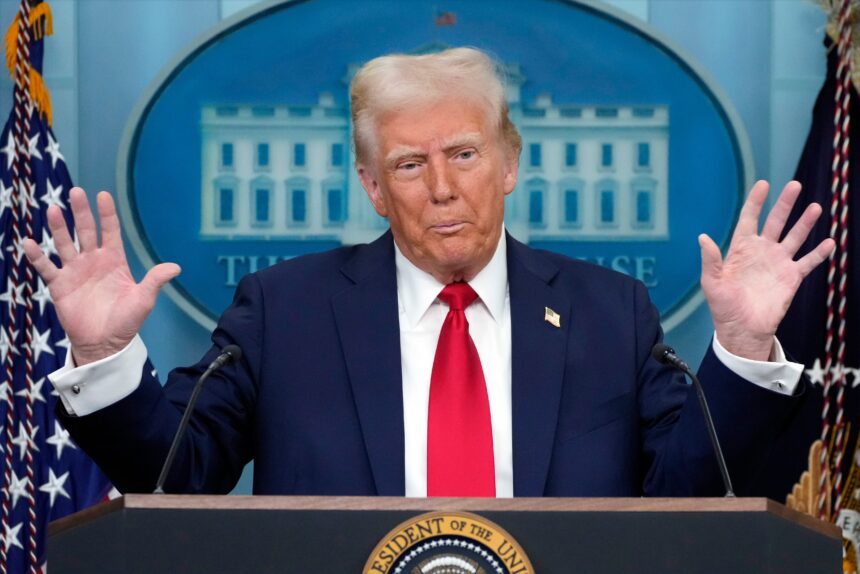
US President Donald Trump issued a stark warning on Tuesday, declaring that Iran would be “obliterated” if it attempted to assassinate him. Speaking while signing an executive order aimed at imposing maximum pressure on Tehran, Donald Trump stated unequivocally that any such action would leave Iran in ruins. “If they did that, they would be obliterated… there won’t be anything left,” he declared, emphasizing the severity of the consequences.
Donald Trump’s comments come amid longstanding concerns over Iranian threats against him and other American officials. Federal authorities have been monitoring such threats for years, particularly since the administration’s controversial 2020 strike that resulted in the death of Qassem Soleimani, the leader of the Islamic Revolutionary Guard Corps’ Quds Force. That strike, ordered by Donald Trump, marked a significant escalation in tensions between the United States and Iran.
The warning also highlighted the constitutional provision regarding presidential succession. Donald Trump noted that if he were assassinated, Vice President JD Vance would assume the presidency and would not be obligated to carry out any of Donald Trump’s directives. This succession plan underscores the high stakes of the threat and the potential for rapid shifts in policy should the unthinkable occur.
Additional context was provided by accounts of earlier incidents. Prior to a July campaign rally in Pennsylvania, heightened security measures were implemented following an incident in which Donald Trump was shot in the ear. Although US officials maintained that there was no evidence of Iranian involvement at that time, the incident contributed to an atmosphere of intense scrutiny and concern over potential Iranian plots.
In November, the US Department of Justice announced that it had thwarted an alleged Iranian plot to assassinate Donald Trump before the presidential election. According to the department, Iranian officials had directed Farhad Shakeri, a 51-year-old suspected to be an asset of the Iranian government, to conduct surveillance and plan an assassination. Shakeri, an Afghan national residing in Iran and previously imprisoned in the United States for robbery, remains at large. Iranian authorities have dismissed these allegations, with a foreign ministry spokesman attributing the plot to Israel-linked groups aiming to complicate relations between Iran and the United States.
Investigations into the plot revealed that Shakeri was instructed by a contact in Iran’s paramilitary Revolutionary Guard to halt his other activities and, within a seven-day window, develop a detailed plan to surveil and ultimately assassinate Trump. This development, unsealed in a criminal complaint in Manhattan’s federal court, further fueled concerns over the extent of Iranian involvement in covert operations against American political figures.
In related security measures, Donald Trump recently revoked government protection for several high-profile figures including former Secretary of State Mike Pompeo, his top aide Brian Hook, and former National Security Adviser John Bolton. All three had previously been targets of Iranian threats due to their firm stances against the Islamic Republic during Donald Trump’s first term in office.
With tensions at a boiling point, Donald Trump’s warning serves as a stark reminder of the dangerous implications of any attempt on his life. As the situation continues to evolve, both US and Iranian officials are under increased pressure to manage the high-stakes geopolitical landscape, where any misstep could trigger further escalation.