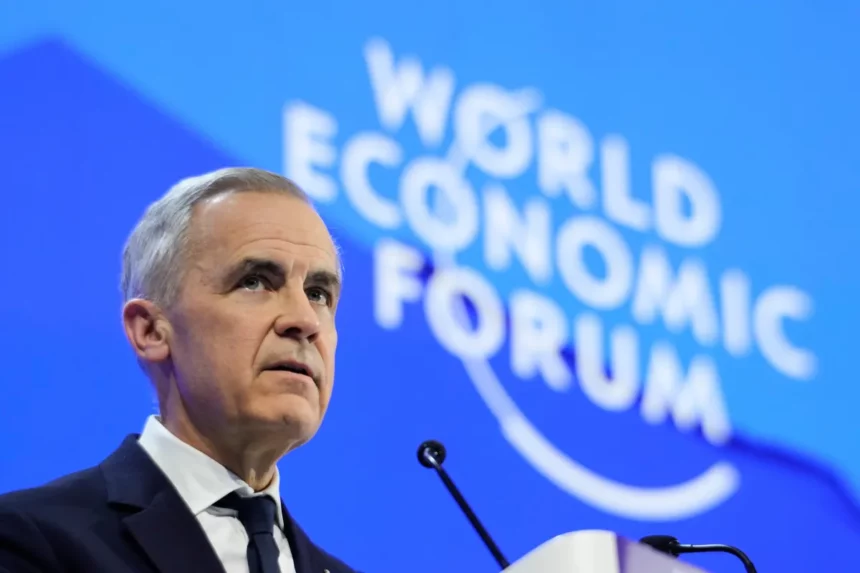
At the World Economic Forum in Davos, Canadian Prime Minister Mark Carney delivered a stark warning to world leaders, policymakers, and business executives, asserting that the era of a US-led global order has ended and the previous international system that guided decades of trade, diplomacy, and security is unlikely to return. Carney emphasized that the world is no longer transitioning gradually but is entering a period of fundamental breakdown, where reliance on old alliances and traditional rules-based mechanisms is no longer sufficient. Speaking amid a climate of rising protectionism, geopolitical tension, and economic disruption, Carney argued that nations must recalibrate their strategies, strengthen domestic capacities, and prepare for a world where multilateral institutions have diminished influence and economic interdependence is increasingly weaponized. His remarks highlighted growing global concerns that the post-Cold War order, characterized by stability and predictability, is undergoing a transformative and possibly irreversible shift.
The End of the US-Dominated Global Order and Rising Geopolitical Fragmentation
Carney’s address painted a detailed picture of a world where the assumptions underpinning decades of international cooperation no longer hold true. He argued that the concept of a rules-based global order—governed by treaties, international law, and institutional frameworks such as the United Nations and the World Trade Organization—was “never entirely true” and has now become increasingly untenable. The Canadian prime minister noted that while countries like Canada benefitted from this system in the past, the dynamics of contemporary geopolitics and global economics have fundamentally changed. Rising powers, shifting alliances, and domestic political pressures have challenged the authority and effectiveness of multilateral institutions, leaving countries more exposed during crises.
Carney highlighted the ways in which major powers have begun to leverage economic tools as instruments of coercion rather than collaboration. Tariffs, he explained, are no longer merely protective measures but are increasingly used to advance strategic national interests. Access to global financial systems is manipulated to exert political pressure, while supply chains are targeted as points of vulnerability to gain leverage in disputes. These developments, coupled with recent shocks such as global financial crises, the Covid-19 pandemic, energy disruptions, and regional conflicts, have revealed the fragility of a system once considered stable and mutually beneficial. Carney emphasized that the assumption that economic interdependence naturally ensures shared prosperity has been decisively disproven. Countries are now confronted with the reality that reliance on foreign partners can be weaponized, leaving domestic economies vulnerable to external pressures and strategic manipulation.
The Canadian prime minister underscored that nations cannot depend solely on old alliances for prosperity or security. Traditional mechanisms, he argued, are no longer adequate in an era defined by shifting power balances and heightened strategic competition. Instead, governments must focus on enhancing domestic resilience by investing in critical industries, developing independent energy and food security capabilities, and diversifying trade relationships to reduce overreliance on any single country or bloc. Such measures, Carney suggested, are essential to preserving national sovereignty and mitigating risks associated with global volatility.
Carney’s concerns were echoed by French President Emmanuel Macron, who warned that the world is increasingly drifting toward “a world without rules,” where raw power often outweighs international law. Macron criticized aggressive US trade policies, particularly the strategic use of tariffs, which he said undermines Europe’s economic sovereignty and weakens the framework of multilateral cooperation. Both leaders highlighted the growing perception that established norms and rules governing trade, security, and diplomacy are being replaced by power-driven, transactional approaches. This, they suggested, poses challenges not only for global economic stability but also for the ability of nations to protect their citizens and maintain strategic autonomy in an increasingly competitive environment.
Economic Weaponization, Institutional Weakness, and the Need for National Preparedness
In addition to highlighting the broader geopolitical shifts, Carney focused on the practical implications for countries navigating this new global landscape. He pointed out that multilateral institutions such as the World Trade Organization and the United Nations have experienced declining influence, reducing their capacity to mediate disputes, enforce international agreements, or provide stability in times of crisis. The weakening of these institutions, combined with the increasing use of economic tools for coercion, has created a world where nations must take direct responsibility for securing their own essential needs. Carney stressed that countries unable to produce sufficient food, generate energy independently, or defend their territories face severely constrained options in a world shaped by power competition rather than collaborative rules.
The Canadian prime minister warned that the combination of economic interdependence and weakened institutions exposes countries to new vulnerabilities. Trade networks, once viewed as sources of stability and mutual benefit, can now be manipulated as instruments of pressure. Critical supply chains—covering energy, semiconductors, pharmaceuticals, and other essential goods—have become strategic battlegrounds, where disruptions can have cascading effects on national economies and security. Carney’s analysis highlighted that these risks are systemic and persistent, requiring governments to invest in both preventive measures and domestic capabilities to mitigate potential shocks.
Carney also emphasized the importance of strategic foresight and proactive planning. He urged Ottawa and other nations to anticipate disruptions, reassess dependency on foreign partners, and strengthen domestic industrial and technological capacities. Countries must diversify their trade portfolios, cultivate alternative supply sources, and invest in critical sectors such as energy, agriculture, and technology to reduce vulnerabilities. These steps, he argued, are critical not just for economic resilience but also for safeguarding national security and maintaining leverage in an increasingly unpredictable global environment.
The address underscored that geopolitical and economic challenges are intertwined. While traditional alliances remain important, they are insufficient in isolation. Nations must develop capabilities to withstand pressures from economic coercion, political maneuvering, and strategic manipulation. In Carney’s view, a combination of self-reliance, diversification, and investment in critical infrastructure provides the foundation for sustainable security and prosperity. This, he suggested, is essential for navigating a world where reliance on any single actor or alliance is increasingly risky.
Carney’s comments at Davos also reflected concerns about broader global dynamics, including rising protectionism, trade disputes, and the erosion of trust between traditional allies. The post-Cold War global order, based on predictable rules, open markets, and cooperative institutions, has been challenged by growing nationalism, bilateral tensions, and competing spheres of influence. This environment, Carney warned, demands that governments recalibrate strategies to account for both immediate and long-term risks. Countries must adopt flexible policies capable of responding to economic coercion, geopolitical tensions, and disruptions to trade or energy supplies.
Both Carney and Macron highlighted the importance of safeguarding sovereignty and operational autonomy in an interconnected yet unpredictable world. While multilateral frameworks provide potential benefits, they can no longer be relied upon as fail-safe mechanisms. Nations must therefore prepare for a system in which strategic competition, rather than cooperative norms, often dictates outcomes. Carney’s insistence on strengthening domestic capacities, securing essential resources, and diversifying partnerships reflects a pragmatic recognition of these evolving global realities.
Carney further noted that modern shocks—including pandemics, energy crises, and regional conflicts—demonstrate how quickly interdependence can be weaponized to create economic and political pressure. He argued that historical assumptions about the benefits of integration, collective problem-solving, and reliance on international institutions need urgent reevaluation. Nations that fail to adapt risk being caught off-guard by sudden disruptions in trade, finance, or energy supply, leaving them vulnerable to coercion and strategic disadvantage.
The Canadian prime minister stressed that recalibrating national strategies is not solely a defensive measure but also a pathway to strategic empowerment. By investing in domestic industries, ensuring food and energy security, and maintaining flexible alliances, countries can strengthen bargaining power and resilience in global negotiations. This proactive approach, he argued, is crucial for sustaining economic stability, protecting citizens’ well-being, and preserving geopolitical relevance in a world defined by uncertainty and strategic competition.
Carney’s address at Davos captured a broad consensus among global leaders that the post-Cold War order is undergoing a fundamental shift. Economic weaponization, weakening multilateral institutions, and the increasing prioritization of power over law are converging to create a new international environment. Governments must therefore adopt adaptive strategies that balance domestic development with strategic engagement, ensuring that nations are prepared for both cooperation and confrontation.
The Canadian prime minister concluded that nations can no longer afford to take global stability for granted. The lessons of recent crises, combined with rising geopolitical tension, underscore the need for independent capabilities, diversified partnerships, and resilient domestic infrastructures. In this emerging order, preparation and foresight are as important as alliances, diplomacy, and international cooperation, requiring a comprehensive reassessment of how countries pursue prosperity, security, and influence in a multipolar and rapidly changing world.