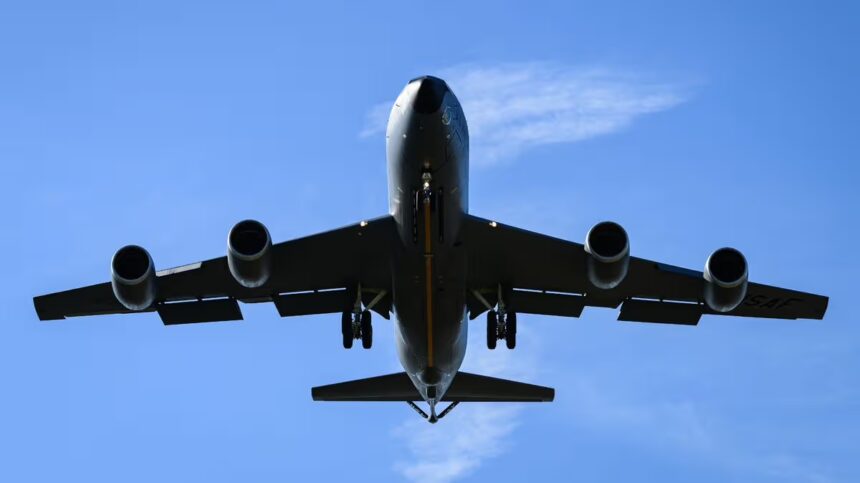
A US Air Force KC-135 Stratotanker triggered a 7700 emergency alert over the Persian Gulf near Iran, raising concerns amid escalating geopolitical tensions in the Middle East.
A major aviation alert involving a United States military aircraft triggered international attention after a Boeing KC-135 Stratotanker reportedly declared an in-flight emergency while operating over the highly sensitive Persian Gulf region near Iran. The aircraft transmitted a “7700” emergency squawk code during flight operations, sparking intense speculation and concern across military and aviation monitoring communities worldwide.
According to flight tracking data available through aviation monitoring platforms, the US military aircraft had departed from Al Dhafra Air Base before the emergency signal was transmitted over the Persian Gulf. The incident occurred at a time when tensions across the Middle East remain exceptionally fragile, increasing global attention on the situation.
The “7700” transponder code is internationally recognised in aviation as a universal emergency signal. Pilots use this code when facing serious onboard issues requiring immediate attention from air traffic controllers and emergency response agencies. Such alerts may involve mechanical failures, engine trouble, medical emergencies, navigation issues, pressurisation failures, fuel concerns, or other significant operational threats.
The sudden appearance of the emergency code immediately attracted scrutiny from aviation trackers and defence analysts because the aircraft was flying near one of the world’s most strategically volatile regions.
At the time of the emergency declaration, the KC-135 Stratotanker was reportedly operating over the Persian Gulf close to Iranian airspace. Although no official confirmation has emerged regarding the precise nature of the emergency, the incident generated heightened concern due to ongoing geopolitical tensions involving the United States, Iran, Gulf states, and broader military activity across the region.
The KC-135 Stratotanker plays a critical role within the United States Air Force’s global operations network. Primarily designed for aerial refuelling missions, the aircraft enables long-range combat and surveillance operations by refuelling fighter jets, bombers, reconnaissance aircraft, and allied military planes during flight.
The aircraft has served as one of the backbone assets of American strategic air mobility for decades. Its operations are particularly important in regions such as the Middle East, where US forces maintain extensive air presence, surveillance operations, and strategic partnerships with Gulf allies.
The emergency declaration therefore immediately prompted speculation regarding whether the incident involved technical malfunction, operational complications, or potential external security concerns.
Flight monitoring data suggested that the aircraft’s signal later disappeared temporarily from public tracking systems after the emergency alert was transmitted. This development fueled further online speculation, although such tracking interruptions are not uncommon for military aircraft operating in sensitive regions.
As of now, neither the United States Air Force nor the Pentagon has released an official statement detailing the exact cause of the emergency. Authorities have also not confirmed whether the aircraft landed safely, diverted to another air base, or required emergency intervention.
The lack of immediate official clarification has intensified discussions among military observers and geopolitical analysts.
The Persian Gulf remains one of the most militarily sensitive airspaces in the world. The region regularly witnesses operations involving American military aircraft, naval assets, surveillance drones, and coalition forces alongside Iranian military activity.
Tensions between the United States and Iran have remained elevated for years due to disputes involving nuclear negotiations, sanctions, maritime security, military deployments, and regional proxy conflicts.
Recent geopolitical developments have further heightened instability in the region. Concerns surrounding naval blockades, threats involving the Strait of Hormuz, and military posturing by various regional actors have increased the strategic sensitivity of any unusual military incident occurring in Gulf airspace.
The Strait of Hormuz itself remains among the world’s most critical maritime chokepoints, through which a substantial portion of global oil and gas shipments pass daily. Any disruption involving military aircraft or naval assets near the region immediately draws international attention due to its potential implications for energy markets and regional stability.
The KC-135 emergency therefore quickly became a major discussion point across global defence forums and aviation tracking communities.
Military aviation emergencies involving large aerial refuelling aircraft are relatively uncommon but not unprecedented. Due to their operational roles, such aircraft often undertake long-duration missions under demanding conditions. Technical issues involving fuel systems, navigation equipment, communication systems, or engine performance can occasionally trigger emergency declarations.
However, because the aircraft was operating near Iranian airspace during a period of heightened geopolitical sensitivity, analysts are carefully examining all available information before drawing conclusions.
Several defence experts cautioned against immediate speculation regarding hostile involvement or military confrontation. Aviation specialists noted that a 7700 code alone does not automatically indicate an attack or combat-related incident. In many cases, emergency squawks are precautionary measures designed to prioritise aircraft handling and ensure rapid coordination with air traffic controllers.
Nevertheless, the geopolitical context surrounding the incident has inevitably amplified international concern.
The United States maintains significant military infrastructure across the Gulf region, including bases in the United Arab Emirates, Qatar, Bahrain, Kuwait, and Saudi Arabia. Al Dhafra Air Base specifically serves as an important operational hub for American aerial operations in the Middle East.
The base supports fighter aircraft, intelligence missions, aerial refuelling operations, and coalition military coordination. KC-135 Stratotankers operating from Al Dhafra frequently participate in missions extending across the Gulf, Iraq, Syria, and surrounding regions.
The incident also arrives amid increasing global scrutiny regarding military activity in the Middle East following recent escalations involving Iran, Gulf allies, and Western powers.
Over recent months, geopolitical tensions have intensified due to maritime confrontations, military exercises, sanctions disputes, and concerns surrounding Iran’s regional influence. International attention has especially focused on the Persian Gulf and the Strait of Hormuz because of their importance to global trade and energy supply chains.
The aviation emergency involving the KC-135 therefore intersects with broader strategic anxieties affecting global security calculations.
Online aviation tracking platforms played a major role in spreading awareness of the incident. Services such as Flightradar24 and independent defence monitoring communities closely monitor military aircraft movements worldwide, often identifying unusual flight patterns or emergency signals in real time.
The rapid circulation of screenshots and flight path data across social media platforms significantly amplified public attention surrounding the aircraft’s distress signal.
However, experts also warned against relying entirely on incomplete flight-tracking data when interpreting military aviation events. Many military aircraft operate with intermittent transponder signals or intentionally limit publicly visible flight information during sensitive missions.
At present, there remains no verified evidence indicating hostile engagement, combat activity, or direct military confrontation involving the aircraft.
Aviation analysts explained that the “7700” emergency code simply instructs all radar and air traffic systems that an aircraft requires immediate priority handling. Once transmitted, controllers typically coordinate emergency landing support, route clearance, and communication assistance.
The aircraft’s crew would also have followed strict emergency protocols designed to manage operational risks while maintaining flight safety.
Given the strategic significance of US military operations in the Gulf region, officials are expected to eventually clarify the incident once operational security considerations permit public disclosure.
Until then, speculation surrounding the cause of the emergency is likely to continue across defence and geopolitical circles.
The incident highlights how even routine military aviation emergencies can rapidly escalate into international concerns when occurring in politically sensitive regions. In today’s hyper-connected information environment, real-time flight data and social media discussions can transform isolated operational events into major global stories within minutes.
For the United States military, maintaining operational readiness and safety across complex overseas deployments remains a constant challenge, particularly in regions involving heightened geopolitical risk.
The KC-135 Stratotanker emergency over the Persian Gulf now joins a growing list of military incidents that underscore the fragile security environment surrounding the Middle East and the continuing strategic rivalry shaping the region.
As global observers await official clarification, the episode serves as another reminder of how closely military operations, aviation safety, and international geopolitics remain interconnected in one of the world’s most volatile strategic theatres.