The United States has entered its first government shutdown in nearly seven years, a political deadlock that has left hundreds of thousands of federal workers facing uncertainty about their jobs and pay. Triggered by a fierce standoff over enhanced Obamacare subsidies, the shutdown has exposed both the fragility of bipartisan negotiation in Washington and the vulnerability of federal agencies to political gridlock. President Donald Trump’s administration and Senate Democrats remain locked in a stalemate, and without a deal, wide segments of the federal government are grinding to a halt. While emergency services such as border patrol, air traffic control, and military operations continue, much of the civilian bureaucracy has been shuttered. Workers are facing furloughs, programs are stalled, and millions of Americans dependent on government services are confronting delays and disruption. The question now is not just when the shutdown will end, but who is paying the steepest price while political leaders continue their battle.
Furloughs, Job Insecurity, and the Scope of Federal Disruption
In practical terms, a government shutdown immediately divides the federal workforce into two categories: those deemed essential, who must continue working often without pay until Congress resolves the crisis, and those placed on furlough, effectively an enforced leave without pay. A furlough does not mean termination—workers remain on government rolls and are generally restored to their positions once funding is approved. However, the financial strain of missing paychecks, even temporarily, is deeply disruptive, particularly for employees living paycheck-to-paycheck or supporting families.
Historically, furloughed employees have received back pay once shutdowns are resolved, but this requires specific Congressional approval, which is never guaranteed in a climate of heightened partisanship. For many federal workers, memories of the record-breaking 35-day shutdown of 2018–2019 remain fresh, when thousands were forced to rely on food banks and temporary work to survive. With the current impasse showing no signs of resolution, similar fears are rising again.
Agency contingency plans reveal the potential magnitude of this shutdown. The Environmental Protection Agency (EPA) could furlough nearly 13,500 of its 15,000 employees—almost 89 percent of its workforce—halting critical environmental monitoring and regulatory enforcement. The Department of Education faces an 87 percent furlough rate, which could delay student aid services, policy enforcement, and grant approvals. The Department of Commerce projects over 34,000 employees on leave, paralyzing statistical programs, trade promotion, and technology oversight. Even the Department of Labor anticipates losing three-quarters of its workforce temporarily, stalling workplace inspections, unemployment insurance oversight, and labor law enforcement.
Perhaps most striking is the potential hit to the Department of Defense’s civilian workforce, where over 330,000 employees may be furloughed. Although uniformed personnel remain active, civilian roles—from logistics and research to administrative coordination—are indispensable to overall military readiness. These numbers, drawn from contingency plans, underscore the far-reaching impact of the shutdown not only on workers but on national capacity to perform critical functions.
Healthcare agencies face a mixed impact. The Department of Health and Human Services may furlough around 32,000 employees, limiting research, grant administration, and even certain regulatory functions at the Centers for Disease Control and Prevention and the Food and Drug Administration. By contrast, the Social Security Administration is projecting a relatively smaller cut, with about 12 percent of its staff affected, allowing the majority of retirement and disability benefits to continue. Yet even partial slowdowns in processing or helpline services create anxiety for millions who rely on these programs.
Meanwhile, agencies classified under national security and public safety functions are expected to remain largely intact. The Department of Homeland Security will furlough only around five percent of its staff, ensuring continuity in border protection, the Coast Guard, and emergency response. The Department of Justice will continue prosecutorial and investigative work, though around 12,000 employees may be sidelined. The Department of Veterans Affairs will see minimal disruption, with over 97 percent of its 460,000-strong workforce remaining active to deliver healthcare and support services to former military personnel. These exceptions illustrate the government’s prioritization of essential functions, yet they also highlight the unevenness of disruption, with some departments crippled while others continue almost seamlessly.
Smaller agencies like the Small Business Administration (SBA) and the Office of Personnel Management (OPM) will also face setbacks. The SBA, vital for providing loans and assistance to entrepreneurs, may furlough nearly a quarter of its staff, delaying small business support programs. OPM, which manages human resources across the federal system, could lose 10 percent of its workforce temporarily, hampering recruitment, payroll, and retirement processes across the government. For agencies with lean operations, even modest furloughs can magnify inefficiencies and delays.
The cumulative effect of these furloughs reaches far beyond Washington. Communities across the United States that depend on government grants, contracts, or services feel the immediate strain. From schools awaiting federal aid to scientists working under federal grants, the shutdown extends its impact into classrooms, laboratories, hospitals, and local businesses. Economists warn that prolonged shutdowns also carry macroeconomic consequences, slowing GDP growth, shaking investor confidence, and deepening financial hardship for households directly dependent on federal salaries.
Political Stalemate, Economic Fallout, and the Path Ahead
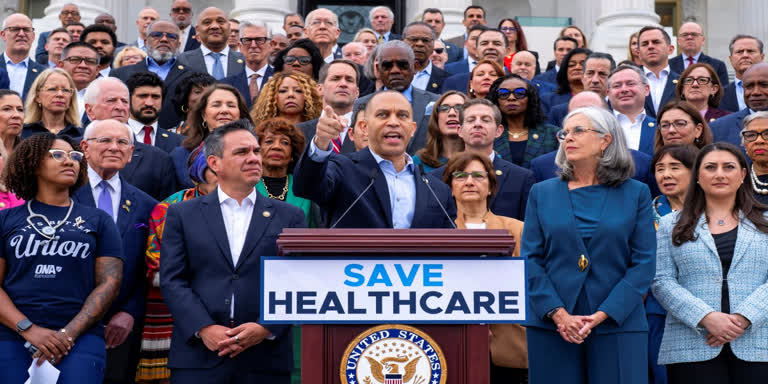
The underlying trigger of this shutdown lies in a budget battle over enhanced Obamacare subsidies, emblematic of the entrenched divisions between the Trump administration and Senate Democrats. For Republicans, the demand to cut or restructure these subsidies reflects broader goals of curtailing government spending and reshaping healthcare. For Democrats, preserving and expanding the Affordable Care Act represents a core policy priority and a defense of healthcare access for millions of Americans. The failure to reconcile these positions has left Congress paralyzed, forcing the government into shutdown.
As of now, negotiations remain frozen. Senate Democrats are expected to block a GOP-backed stopgap funding bill, while no alternative compromise is yet in sight. The Senate has adjourned for the weekend, suggesting that the shutdown may extend further into the week, if not longer. This deepens uncertainty for federal workers and escalates political risk for leaders on both sides.
The politics of shutdowns are complicated. While both parties seek to blame the other for the impasse, public opinion often judges incumbents most harshly, particularly the president and his party. For Donald Trump, already facing scrutiny on multiple policy fronts, the shutdown threatens to erode political capital and frame his administration as unstable or unwilling to compromise. For Democrats, resisting GOP proposals carries risks of appearing obstructionist, yet also provides an opportunity to consolidate their base around protecting healthcare. In the meantime, federal workers and ordinary citizens become collateral damage in a political confrontation that shows little regard for immediate human consequences.
The economic impact of shutdowns has historically been significant. During the 2018–2019 shutdown, the Congressional Budget Office estimated a loss of $11 billion in GDP, $3 billion of which was never recovered. While some lost productivity is restored once operations resume, the disruption to contracts, delayed payments, and shaken confidence leaves lasting scars. For workers, the strain is not just financial but psychological, as uncertainty about paychecks and job security creates stress and instability. For businesses dependent on federal operations—whether a farmer awaiting Department of Agriculture support, a contractor dependent on government projects, or a small business seeking an SBA loan—the shutdown translates directly into economic harm.
Internationally, shutdowns project an image of dysfunction in American governance, weakening the credibility of the United States as a reliable partner. Allies and adversaries alike view these episodes as evidence of partisan paralysis undermining the government’s capacity to act. In an era of global competition, where the US is contending with challenges from China, Russia, and shifting alliances, such displays of domestic gridlock weaken strategic influence.
The question of when this shutdown will end remains unanswered. With both sides entrenched, there is little optimism for a rapid resolution. Federal workers are already bracing for missed paychecks, and the ripple effects across society are growing. If history is any guide, the shutdown could extend for weeks, inflicting damage that far exceeds the immediate savings sought in budget negotiations. Ultimately, while lawmakers continue their political duel, the cost is borne by the very people they were elected to serve—civil servants, families, communities, and the broader economy.