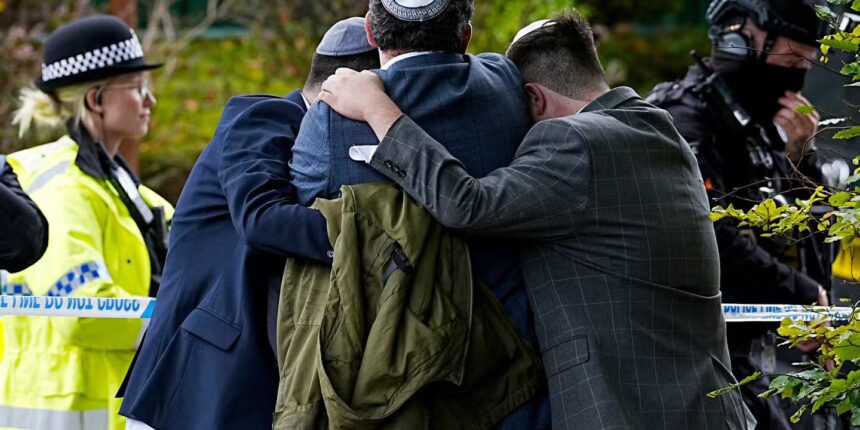
The deadly assault on worshippers outside a Manchester synagogue during Yom Kippur has not only left the Jewish community in shock but has also triggered a diplomatic flashpoint between Israel and the United Kingdom. Israel’s foreign minister Gideon Sa’ar strongly condemned the attack, describing it as the outcome of Britain’s failure to tackle the alarming rise of antisemitism and violent extremism in recent years. The assault, which British police quickly classified as a terrorist incident, claimed the lives of two Jewish community members and left four others seriously injured. Armed officers neutralized the assailant within minutes, yet the event has reignited concerns about extremist violence targeting religious minorities in Europe, as well as the political will of Western governments to address hate-fueled crimes.
Israel’s Outrage and Mounting Concerns Over Antisemitism in Britain
The attack outside the Heaton Park Hebrew Congregation Synagogue occurred on the morning of Yom Kippur, the holiest day in the Jewish calendar, when congregations across the world gather for prayer, reflection, and fasting. Witness accounts and police statements revealed that a man rammed his vehicle into worshippers before launching a stabbing spree. According to Greater Manchester Police, the suspect wore a vest designed to resemble an explosive device, creating chaos and fear before being shot dead by armed officers within seven minutes of the first distress call. Officials have confirmed that while the attacker’s identity is believed to be known, it has not yet been released publicly. Two further arrests have been made as investigations continue into possible accomplices or ideological networks behind the assault.
The swift police action prevented a larger catastrophe, as worshippers reportedly blocked the attacker from entering the synagogue itself, potentially saving dozens of lives. However, the loss of two lives and the critical condition of others has left the community devastated. Israeli leaders swiftly responded, accusing the UK of complacency in the face of rising antisemitic sentiment. Foreign minister Gideon Sa’ar’s statement on X expressed both grief and anger, calling the incident a manifestation of “blatant and rampant antisemitic and anti-Israeli incitement” that, according to him, has been left unchecked across London, Britain’s cities, and its academic institutions. Sa’ar stressed that such toxic rhetoric is not limited to fringe groups but has become a widespread phenomenon influencing public spaces and discourse.
The Israeli government has emphasized that words of condemnation are not enough and has demanded stronger action from the administration of Prime Minister Keir Starmer. For Israel, the attack in Manchester underscores the vulnerability of Jewish communities in Europe at a time when tensions surrounding the Middle East conflict, migration, and radicalization are spilling into Western societies. Diplomatic insiders note that Israel’s harsh rhetoric towards London is rare in tone, reflecting the gravity with which it perceives both the attack and the broader climate of antisemitism.
The UK’s Jewish community, numbering nearly 300,000, has long raised alarm over antisemitic threats. Reports from the Community Security Trust (CST), which monitors antisemitism in Britain, consistently show a spike in antisemitic incidents after flare-ups in the Israeli-Palestinian conflict or during global surges in extremist propaganda. From graffiti and verbal harassment to violent assaults, Jewish institutions across the UK have experienced mounting security threats, leading many synagogues and schools to adopt heightened protection measures. Despite these steps, the Manchester incident highlights the continuing risks faced by Jewish communities.
British Prime Minister Keir Starmer, who cut short his trip to a European summit in Copenhagen to return to London, chaired an emergency COBRA meeting to address the situation. He condemned the attack as “an act of pure evil” and vowed to support the Jewish community. However, Israel’s expectation of more decisive action reflects a deep skepticism about whether Britain’s measures will be sufficient to dismantle the root causes of antisemitic violence. This diplomatic exchange between allies exposes tensions about how democracies balance counterterrorism policies, hate speech regulation, and free expression in the digital and public sphere.
Security Failures, Political Repercussions, and the Global Context of Religious Extremism
Beyond the immediate shock of the Manchester synagogue attack, the incident raises broader questions about Europe’s security environment and the resilience of democratic societies against religious extremism. Analysts argue that the attacker’s tactics—using a vehicle as a weapon, followed by a stabbing assault while wearing a fake explosive vest—mirror patterns seen in previous terrorist incidents in Europe, from the London Bridge attack to the Berlin Christmas market tragedy. Such methods are designed not only to cause mass casualties but also to generate widespread fear, disrupt communal life, and send symbolic messages of defiance.
In the case of Manchester, the choice of Yom Kippur as the day of attack underscored the assailant’s intent to target Jewish worship at its most sacred moment. This timing aligns with extremist groups’ use of religious symbolism to amplify the impact of their violence. Security experts have noted that synagogues and Jewish institutions remain prime targets for radicalized individuals and terror networks due to their symbolic value and perceived connection to broader geopolitical conflicts.
The UK government has pledged to increase surveillance and security at places of worship following the attack. However, the perception that antisemitism is escalating unchecked in Britain is gaining traction internationally. Israel’s criticisms feed into this narrative, suggesting that Britain’s liberal democratic framework may be struggling to contain hate-driven extremism. Domestic critics within the UK have also pointed out that antisemitism has been a persistent problem on university campuses, within political rhetoric, and in online spaces, where incitement often goes unchallenged until it spills into real-world violence.
This attack is also a reminder of the interconnectedness of extremist ideologies across borders. In recent years, Europe has witnessed both Islamist-inspired and far-right extremist violence, often targeting religious minorities. The Jewish community in particular has been caught in the crossfire of these movements, facing threats from multiple ideological sources. The killing of a teacher in France, the hostage situation in a Texas synagogue, and other international incidents illustrate how globalized extremist narratives can inspire local attacks. Britain, with its diverse population and open society, remains particularly vulnerable to such transnational influences.
Political repercussions are already visible in the wake of the Manchester attack. Prime Minister Starmer’s government faces mounting pressure not only from Israel but also from domestic groups demanding stronger protections for minority communities. While the government has increased funding for synagogue security in the past, critics argue that addressing antisemitism requires more systemic interventions, including stricter regulation of online incitement, educational reforms to combat prejudice, and a zero-tolerance stance on hate speech in public life.
The balance between civil liberties and security remains contentious. Advocates for stronger hate speech laws argue that unchecked incitement creates fertile ground for violence, while free speech defenders caution against overly broad restrictions. This debate is not unique to Britain; across Europe and North America, governments grapple with the challenge of preventing extremist violence without eroding democratic freedoms. The Manchester incident may intensify this debate, with policymakers under pressure to act swiftly and decisively.
Israel, meanwhile, is likely to continue pressing the UK and other Western allies to adopt stronger safeguards for Jewish communities and to confront antisemitism as a priority within their counterterrorism frameworks. For Israel, antisemitism abroad is not only a matter of diaspora security but also tied to its own geopolitical legitimacy, as anti-Israeli sentiment often overlaps with antisemitic rhetoric. The forceful tone of Gideon Sa’ar’s remarks reflects Israel’s strategic intent to frame the Manchester tragedy not merely as a local attack but as part of a broader failure to confront hatred against Jews worldwide.