In an unprecedented show of military strategy and aerial precision, the United States carried out a massive, covert operation against Iran’s key nuclear facilities over the weekend. Nicknamed “Operation Midnight Hammer,” this mission marked the largest deployment of B-2 stealth bombers in US history. Pentagon officials disclosed that the operation was executed under intense secrecy, using a decoy to mislead observers and maintain the element of surprise. The strike, targeting Iran’s Fordow, Natanz, and Isfahan sites, has reportedly caused severe damage to Iran’s nuclear infrastructure.
Decoy Takeoff and 18-Hour Stealth Mission
The operation began late Saturday evening when a highly visible group of B-2 bombers took off from Whiteman Air Force Base in Missouri. This move, according to US officials, was intentional and designed to act as a diversion. Military analysts and foreign intelligence watchers initially assumed these aircraft were en route to Iran. However, they were never intended to reach the target.
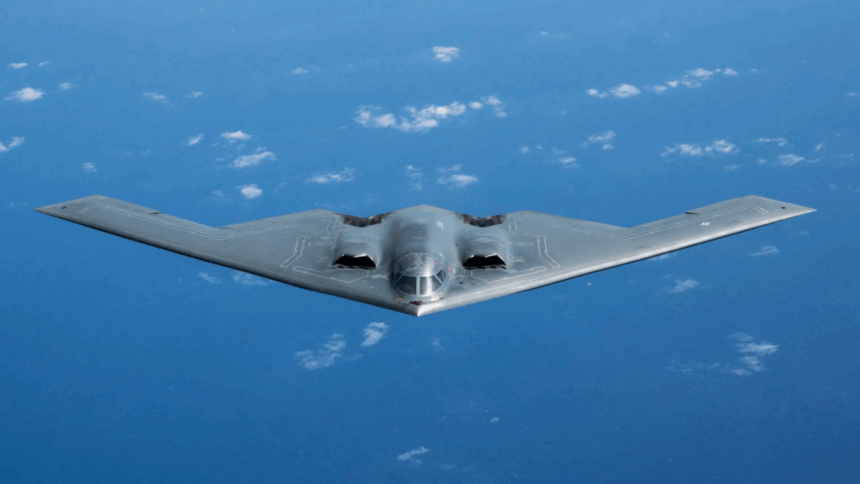
The real strike group—seven bat-winged B-2 stealth bombers—departed discreetly on an 18-hour mission heading east. These aircraft maintained strict radio silence and conducted in-air refueling, enabling them to cross international airspace undetected. Their approach to Iranian airspace was coordinated with a barrage of Tomahawk cruise missiles launched from a submerged US submarine. Simultaneously, American fighter jets swept the skies ahead, posing as decoys and monitoring for any Iranian aerial or missile response.
As the B-2s neared their targets, they dropped 14 GBU-57 Massive Ordnance Penetrators—each weighing 30,000 pounds—on Iran’s most fortified nuclear facilities. Pentagon sources confirmed that over 125 aircraft were involved in the operation, including support planes, refueling tankers, and surveillance crafts, making this one of the most complex and expansive airstrike missions in recent memory.
High-Level Confirmation and Damage Assessment
At a press briefing on Sunday, General Dan Caine, Chairman of the Joint Chiefs of Staff, emphasized the unprecedented scale and stealth of the mission. “This was the second-longest B-2 mission ever flown, surpassed only by the one following 9/11,” he said. “Iran’s fighters never took off. Their missile systems never saw us. We retained complete surprise.”
Initial damage assessments by the Pentagon indicate severe and possibly irreversible destruction at all three nuclear locations. While General Caine refrained from stating whether Iran’s nuclear capabilities had been completely neutralized, he noted that the operation achieved its primary objectives.
US Secretary of Defense Pete Hegseth was more direct in his remarks. “It was clear we devastated the Iranian nuclear program,” he said, underscoring the operation’s tactical success.
Satellite imagery released after the strike confirmed significant structural damage to the targeted facilities. However, some intelligence analysts have cautioned that Iran may have relocated sensitive nuclear materials in anticipation of an attack, potentially limiting the operational impact.
The success of Operation Midnight Hammer rests not just on the military execution but also on its psychological and strategic elements. By employing a visible decoy and maintaining strict radio silence, the US achieved full tactical surprise. Iran’s air defenses did not engage, and no fighter jets were scrambled, indicating that Tehran was caught completely off guard.
As global attention now turns to Iran’s possible retaliation and the broader geopolitical implications of this strike, the Pentagon’s confidence in the mission’s impact signals a turning point in the escalating conflict between Washington and Tehran.