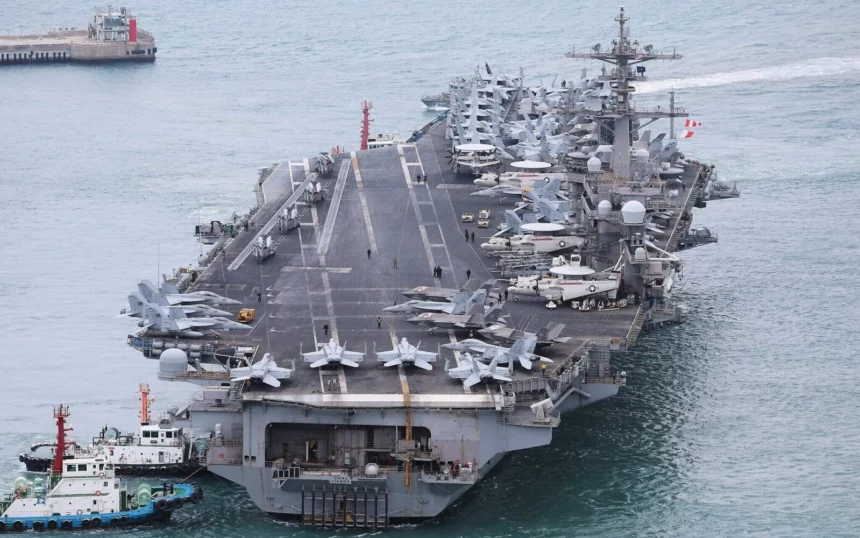
Amid rising tensions over Iran’s nuclear ambitions, the United States has deployed a second aircraft carrier strike group to Middle Eastern waters, signaling a show of force ahead of upcoming diplomatic talks. Satellite images reveal the USS Carl Vinson and its support vessels operating in the Arabian Sea, while speculation continues over the location and outcome of renewed US-Iran negotiations.
The deployment comes at a critical time, with the US intensifying airstrikes on Yemen’s Houthi-controlled regions, a move widely viewed as pressure on Iran, which supports the rebel group. Meanwhile, both countries prepare for another round of talks—originally slated for Rome but possibly shifting to Oman—focused on curbing Tehran’s rapidly advancing nuclear programme.
Heightened Military Presence and Ongoing Strikes
Satellite imagery from the EU’s Copernicus programme confirmed the presence of the USS Carl Vinson northeast of Socotra Island near the Gulf of Aden. The carrier is flanked by the USS Princeton and two guided missile destroyers, USS Sterett and USS William P. Lawrence. The group joins the USS Harry S. Truman, already active in the region since mid-March, conducting airstrikes on Houthi positions.
Recent footage released by the US Navy showed the Vinson launching F-35 and F/A-18 jets, preparing munitions on deck. While the Navy’s Fifth Fleet, headquartered in Bahrain, declined to comment on operational specifics, the military buildup appears closely tied to upcoming diplomatic efforts.
Talks on Nuclear Limits and Missile Programmes
US envoy Steve Witkoff described last weekend’s preliminary talks in Oman as “positive, constructive, compelling.” He emphasized that the upcoming negotiations will focus on verifying both Iran’s uranium enrichment levels and its weaponisation capabilities, including missile stockpiles.
Currently, Iran enriches uranium up to 60%, nearing the weapons-grade threshold of 90%. Witkoff stressed that Iran has no civilian need to go beyond the 3.67% limit set in the 2015 nuclear agreement, from which the US unilaterally withdrew in 2018. He noted that any new deal would need to address not only enrichment but also Iran’s missile arsenal—one of the main reasons for the US exit from the previous accord.
Iran’s state-aligned Javan newspaper hinted at Tehran’s willingness to reconsider its enrichment levels, stating that if such concessions were made before, they could be made again. However, persuading Iran to scale back its missile programme—viewed as a strategic deterrent—may prove a tougher challenge in the delicate negotiation process.