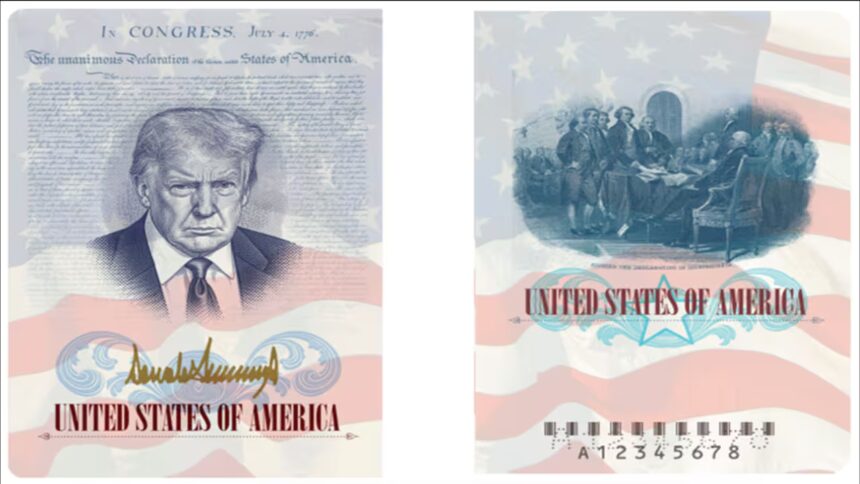
The United States government has announced plans to release a limited number of commemorative passports featuring President Donald Trump’s image as part of celebrations marking the 250th anniversary of the Declaration of Independence in July 2026. The move, confirmed by the U.S. State Department, represents one of the most symbolically significant examples of the Trump administration incorporating the president’s likeness into official government materials, raising major political, legal, and historical questions.
According to State Department officials, these special edition passports will include customized artwork while maintaining all existing security features. Renderings reportedly show Trump’s portrait on an internal passport page opposite imagery depicting the signing of the Declaration of Independence in 1776. While the administration presents the initiative as a commemorative patriotic gesture, critics argue it reflects an unprecedented personalization of national institutions.
The commemorative passports are expected to be available only through the Washington Passport Agency and will reportedly be issued without additional fees. Standard passport functionality and security protocols will remain unchanged. However, the symbolic implications of placing a sitting president’s portrait within such an essential citizenship document have fueled intense public discussion.
Historically, U.S. passports have served primarily as secure legal identification and travel authorization documents, not political branding tools. While commemorative currency, stamps, and official memorabilia have previously honored presidents and historical figures, critics note that embedding the likeness of a current officeholder into passports may blur lines between national symbolism and political self-promotion.
The passport initiative follows several other actions by the Trump administration that have attached Trump’s name or image to federal programs, public infrastructure, and government-issued items. These include commemorative coins, proposed federal savings accounts, visa initiatives, and even the naming of certain national projects. Supporters argue such actions celebrate Trump’s leadership during a pivotal historical milestone, while opponents warn of growing executive personalization of state institutions.
Legal scholars are divided on whether the move raises constitutional concerns. Although there is no explicit prohibition against commemorative government designs, critics argue that official state documentation should remain politically neutral to preserve institutional integrity. Some constitutional analysts suggest the measure could intensify debates over executive power, symbolic nationalism, and the role of public office in democratic governance.
Supporters of the commemorative passport argue that previous administrations have also used national anniversaries and commemorations to highlight sitting leadership. They view Trump’s inclusion as reflective of his presidency during America’s semiquincentennial celebrations. For many of his political base, the move reinforces Trump’s branding as a transformative national figure.
However, opposition voices characterize the decision as part of a broader pattern of personalizing government structures in ways more commonly associated with populist or authoritarian political systems. Critics from both Democratic circles and constitutional watchdog groups have questioned whether such symbolic measures risk undermining the apolitical character of federal institutions.
The timing of the passport release is particularly significant. As the United States approaches its 250th anniversary, national identity, constitutional values, and democratic traditions are likely to be central themes. Integrating Trump’s portrait into official celebratory materials may therefore intensify already polarized political narratives surrounding his presidency.
Internationally, the move may also draw scrutiny. U.S. passports are globally recognized symbols of American citizenship and governance. The inclusion of a sitting president’s portrait may be perceived differently abroad, potentially influencing diplomatic interpretations of U.S. political culture.
The State Department has emphasized that the passports remain secure travel documents and that the commemorative design is intended solely to honor the nation’s founding anniversary. Nevertheless, the symbolic weight of the decision may ultimately overshadow its administrative purpose.
This initiative also intersects with Trump’s broader political strategy of reinforcing personal branding through official channels. Throughout both his political and business careers, Trump has consistently emphasized name recognition and visual identity as central elements of influence. The commemorative passport project extends this branding philosophy directly into federal symbolism.
Public response is expected to remain sharply divided. Trump supporters may view the passports as patriotic collector’s items, while critics may see them as troubling precedents for political image-building through state resources.
Beyond immediate political controversy, the decision raises enduring questions about how democratic governments balance national celebration with institutional neutrality. As debates continue, the commemorative passport initiative may become a defining example of how symbolism, executive authority, and political identity intersect in modern American governance.
Ultimately, the release of Trump-themed passports underscores broader tensions surrounding leadership, national identity, and democratic tradition in the United States. Whether viewed as historic commemoration or political overreach, the initiative is likely to remain a major topic of public and constitutional debate well beyond the anniversary celebrations.