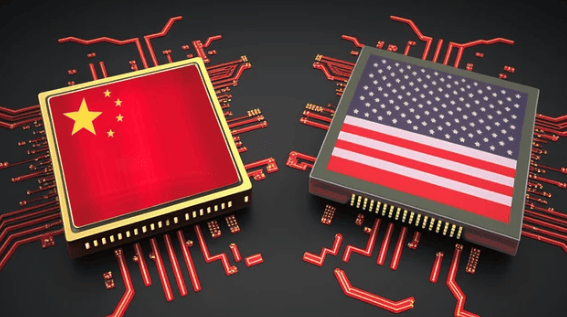
The escalating tech war between the United States and China is no longer confined to mere trade disputes; it has become a full-scale battle for technological dominance, with ripple effects across global supply chains and economic policies. The U.S., determined to maintain its global edge, is using export controls and sanctions to curb China’s technological advancements. Meanwhile, China is ramping up efforts to achieve self-reliance in key sectors like semiconductors, artificial intelligence (AI), and 5G.
Export Controls: The U.S. Strategy to Weaken China’s Tech Ambitions
One of the most significant weapons in the U.S. arsenal is its export control policy, which restricts China’s access to advanced chipmaking tools and semiconductor technologies. This has severely impacted companies like Huawei, which rely on cutting-edge chips for their AI and 5G developments.
The CHIPS Act, a U.S. initiative allocating $52 billion to semiconductor research and production, aims to strengthen America’s hold over chip manufacturing and reduce dependency on China. This move is expected to keep the U.S. at the forefront of the global tech race.
China’s Counter-Moves: Pushing for Self-Sufficiency
In response, China is aggressively boosting its domestic semiconductor industry, with SMIC (Semiconductor Manufacturing International Corporation) leading the charge. Beijing is also making a push to increase the proportion of domestically manufactured chips in its electric vehicle sector and other critical technologies, reducing its reliance on U.S. suppliers.
Beyond Semiconductors: A Race for AI, Quantum Computing, and 5G
The rivalry extends beyond semiconductors into emerging technologies like artificial intelligence, quantum computing, and 5G networks. Both nations are heavily investing in these domains to outpace each other in what is now being termed a technological Cold War.
The Global Fallout: Supply Chain Disruptions and Rising Costs
This tech war is not just impacting the two superpowers—it is disrupting global supply chains and raising manufacturing costs worldwide.
1. Semiconductor Shortages and Production Delays
With China being restricted from accessing advanced chipmaking tools, the global semiconductor supply has slowed, affecting industries worldwide. Major players like Tesla and Apple are experiencing production delays due to chip shortages.
2. Increased Costs for Manufacturers and Consumers
As manufacturers search for alternative suppliers, production costs are rising. The global smartphone industry saw a spike in prices in 2021, largely due to chip scarcity.
3. Shift in Trade Dependencies
Countries like South Korea and Japan, previously dependent on China for semiconductor supply, are restructuring their supply chains. Meanwhile, India and Vietnam are emerging as alternative tech manufacturing hubs, with Apple significantly increasing its investments in India.
4. Higher Prices for Developing Nations
Countries that rely on affordable Chinese tech, such as India and African nations, are now facing higher costs due to U.S. restrictions on Chinese exports.
India’s Strategic Position: Challenges and Opportunities
As the U.S.-China rivalry intensifies, India finds itself in a unique position—balancing diplomatic ties while leveraging opportunities in tech manufacturing.
- Boosting Semiconductor Production: The Indian government’s Production-Linked Incentive (PLI) scheme and investments from Micron Technology could help position India as a major semiconductor hub.
- Balancing Ties with Both Superpowers: Despite being part of the Quad alliance, India remains dependent on Chinese components for its electronics industry.
- Accelerating Self-Reliance in Tech: Programs like “Make in India” could see a major boost, encouraging domestic tech manufacturing.
A New Technological Order: Parallel Tech Ecosystems and Divided Alliances
The world is witnessing the formation of two parallel tech ecosystems—one dominated by the U.S. and its allies, and the other led by China.
- The U.S. is doubling down on domestic R&D, while China is investing in homegrown tech solutions like SMIC.
- Europe is aligning with the U.S., banning Huawei, while Africa remains heavily dependent on Chinese technology.
- Quad nations (India, Japan, Australia, and the U.S.) are strengthening tech collaborations, focusing on areas like 5G infrastructure and undersea cable security.
A Game-Changing Rivalry for the World
The U.S.-China tech war is reshaping global trade policies, supply chains, and geopolitical alliances. This battle for technological supremacy is not just an economic challenge—it is redefining global power structures.
For India and other developing nations, the challenge will be to navigate this shifting landscape while seizing new opportunities in manufacturing, trade, and tech innovation.
What do you think? How will this rivalry reshape the global economy? Share your thoughts in the comments!
Watch the Full video Here: https://youtu.be/R0GGiMEG3do