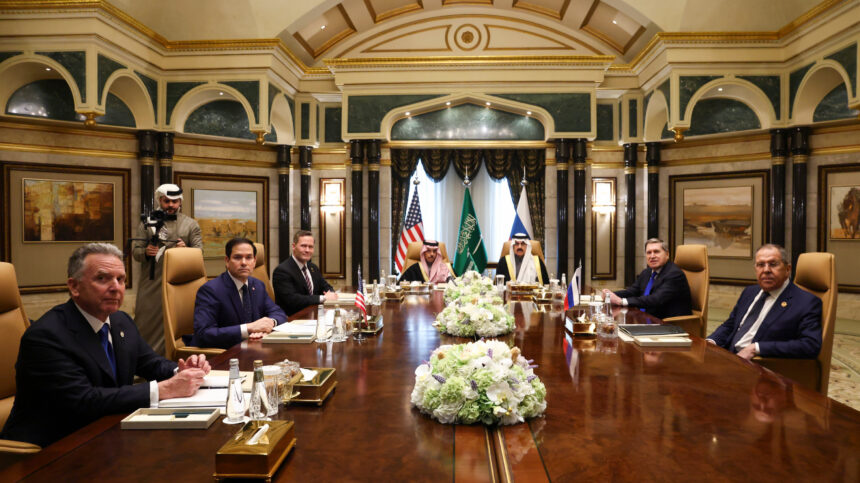
US and Russian officials today (March 24,2025) held a meeting in Saudi Arabia for crucial talks, aiming to finalize a ceasefire in the ongoing Ukraine conflict. The discussions, mediated by US representatives, began with a focus on a maritime ceasefire in the Black Sea to facilitate free shipping and prevent further escalation.
The US-Russia talks follow a series of meetings between U.S. representatives and Ukrainian officials, underscoring the international community’s commitment to resolving the conflict. Just last week, Ukraine and Russia reached a temporary agreement to halt attacks on energy infrastructure for 30 days. The US delegation is now pushing for a more comprehensive ceasefire agreement, with hopes of laying the groundwork for a lasting peace.
The US delegation, led by national security director Andrew Peek and senior State Department official Michael Anton, has already completed discussions with Ukrainian officials, focusing on key issues like energy. Ukrainian Defense Minister Rustem Umerov described the talks as productive, with discussions centered around achieving a “just and lasting peace.”
In parallel, Russia is represented by seasoned diplomats, including Grigory Karasin, who chairs the Federation Council’s foreign affairs committee, and Sergey Beseda, an advisor to the Federal Security Service (FSB). The choice of Beseda has raised eyebrows due to his involvement in early intelligence that shaped Russia’s view on Ukraine.
The US’s broader goal is a comprehensive ceasefire, starting with the Black Sea, which would pave the way for full-scale peace talks. However, challenges remain, with both Moscow and Kyiv holding firm to their demands, including Russia’s insistence on Ukraine’s territorial concessions and NATO neutrality.
While there is cautious optimism surrounding the discussions, many experts doubt the sustainability of even a limited ceasefire, citing past violations of ceasefire agreements. Ukrainian officials have emphasized that they will never accept Russian sovereignty over occupied territories or agree to a reduction in their military capabilities.