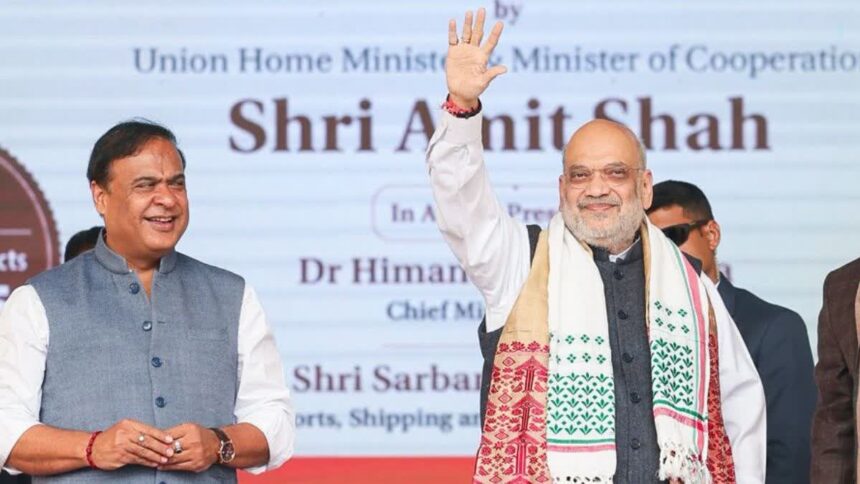
Standing in Nathunpur village in Assam’s Barak Valley, Union Home Minister Amit Shah formally inaugurated the second phase of the Vibrant Villages Programme–II, unveiling a ₹6,839-crore initiative aimed at transforming India’s border settlements into fully developed growth centres. The launch marked a significant policy assertion: that villages located along international borders are not peripheral outposts but strategic anchors of national progress.
The programme will cover 1,954 villages across 334 blocks in 17 states, bringing infrastructure expansion, welfare integration, livelihood generation and connectivity upgrades to regions historically considered remote. In Assam alone, 140 villages spread across nine districts and 26 blocks have been included under the scheme. Chief Minister Himanta Biswa Sarma, senior Union Home Ministry officials, security representatives and state administrators attended the event.
Addressing villagers, Shah emphasised that the conceptual shift from “last village” to “first village” represents a transformation in governance philosophy. For decades, he noted, frontier settlements were described as the nation’s edge—often lacking roads, electricity, healthcare and employment. Under Prime Minister Narendra Modi’s leadership, he said, the government has adopted a new framework that places border communities at the forefront of policy design.
The Vibrant Villages Programme–II seeks to ensure that residents in border areas receive the same public services and development opportunities available elsewhere in India. Planned interventions include road connectivity, telecommunications infrastructure, digital inclusion, clean drinking water supply, renewable energy expansion, school upgrades, healthcare facilities and skill-development initiatives. Officials believe the programme will bridge the infrastructure deficit that has historically triggered migration from these areas.
Beyond physical infrastructure, the scheme also aims to deepen institutional presence by strengthening banking access, social security coverage and local entrepreneurship ecosystems. Government representatives indicated that special focus would be placed on youth employment, women-led self-help groups and agricultural value chains suited to regional geographies.
Border Development as a Pillar of National Security
Amit Shah underscored that the development of border villages is inseparable from national security strategy. According to him, regions suffering from economic stagnation often experience outward migration, demographic imbalance and weakened civic engagement—factors that may indirectly affect border stability. By ensuring prosperity and opportunity within these villages, the government intends to reinforce both security and social resilience.
He stated that a secure Assam contributes directly to a secure India. Improved roads, for instance, will not only facilitate trade and daily mobility but also enable faster emergency response and logistical coordination when required. Telecommunications upgrades will strengthen both civilian access to services and real-time communication networks.
Referring to Assam’s recent trajectory, Shah said peace and stability achieved over the past decade have created conditions conducive to rapid development. He credited coordinated governance between the Centre and the state for reducing insurgency-related incidents and improving law-and-order metrics. This stability, he argued, has allowed the state to accelerate infrastructure delivery.
According to data cited at the event, Assam has upgraded over 24,000 kilometres of roads in recent years and achieved an average road construction rate of 14 kilometres per day over the last five years—among the highest in the country. Multiple bridges have been constructed to enhance intra-state and inter-state connectivity, strengthening economic corridors and access to markets.
The Minister also highlighted that integration of border villages reduces vulnerability to infiltration and unlawful cross-border activities. By increasing administrative visibility and economic engagement in frontier areas, the government aims to consolidate demographic continuity along sensitive stretches.
Economic Expansion and Infrastructure Transformation in Assam
Turning to economic indicators, Shah noted that multidimensional poverty in Assam has declined significantly—from 37 percent a decade ago to 14 percent in 2023. He attributed this reduction to welfare delivery reforms, direct benefit transfers, rural electrification and targeted development programmes. Per capita income in the state, he added, has nearly tripled from ₹49,000 in 2013–14 to ₹1.54 lakh in 2024–25.
Large-scale investments in transport and industry form another pillar of Assam’s transformation narrative. The Centre has allocated approximately ₹30,000 crore for road projects, ₹95,000 crore for railway expansion and ₹10,000 crore for airport modernisation in the state. These investments are expected to strengthen Assam’s connectivity with national markets and global trade routes.
A ₹27,000-crore semiconductor manufacturing facility is currently being established, positioning Assam within India’s emerging high-technology supply chain. Officials described the project as a landmark step in diversifying the state’s industrial base beyond traditional sectors.
Healthcare and education have also received focused attention. New medical colleges, district hospitals and skill-development institutions aim to transform Assam into a healthcare hub for the Northeast region. By aligning Vibrant Villages Programme–II with these macro-level investments, the government seeks to ensure that remote settlements are integrated into broader economic growth cycles.
For residents of Nathunpur and other border villages, the announcement represents both symbolic recognition and tangible expectation. Many villagers expressed optimism that improved infrastructure would reduce travel time, expand educational access and create employment opportunities for youth who previously migrated to urban centres.