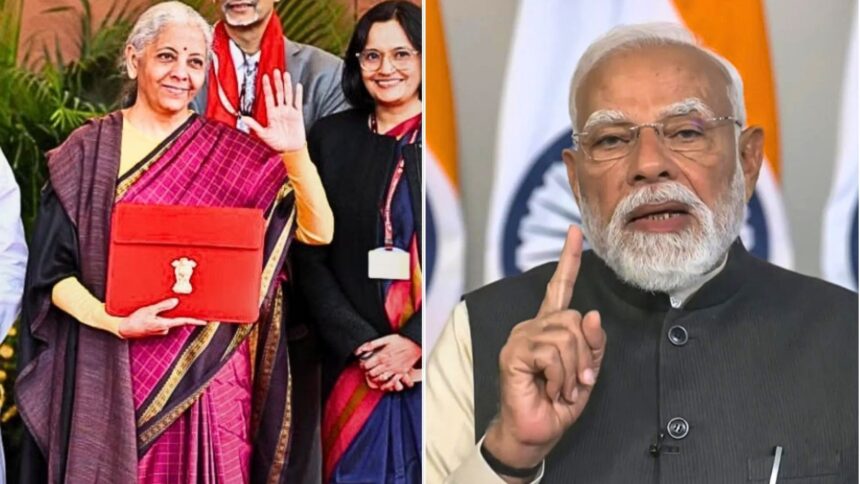
The Union Budget 2026–27, presented by Finance Minister Nirmala Sitharaman for a record ninth consecutive time, has been hailed by Prime Minister Narendra Modi as a historic and transformative fiscal blueprint for India. In his response to the Budget, PM Modi emphasized that it lays out a clear roadmap for a Viksit Bharat by 2047, providing a strong impetus to the nation’s ongoing reform journey and long-term economic vision. With a focus on infrastructure development, manufacturing, tax simplification, and sustainable growth, the Budget aims to address both immediate challenges and strategic priorities, balancing fiscal discipline with ambitious investments. The government has placed a particular emphasis on long-term national objectives, aiming to strengthen India’s economic foundations while creating opportunities for innovation, employment, and global competitiveness. The Finance Minister’s presentation was widely regarded as a reflection of continuity in policy, prudent fiscal management, and the government’s commitment to structural reforms, while also incorporating measures to provide relief to consumers and businesses in targeted areas.
The Budget drew significant attention for its scale and scope, with capital expenditure set at a record Rs 12.2 lakh crore, highlighting the government’s continued focus on building robust infrastructure and supporting industrial growth. It emphasized key sectors such as roads, railways, renewable energy, and urban development, aiming to accelerate the pace of India’s physical and digital transformation. At the same time, the Budget sought to simplify the tax regime, reduce compliance burdens, and promote ease of doing business, reflecting the government’s intent to encourage domestic entrepreneurship and attract foreign investment. While the government highlighted these achievements, opposition parties criticized the Budget, describing it as lacking substantive measures for common citizens and asserting that it disproportionately favored corporate and industrial sectors. Despite this political contention, the administration maintained that the fiscal roadmap balances development priorities with fiscal prudence and strategic reform objectives.
The broader context of the Budget is also significant. As India aims to become the world’s third-largest economy, policymakers have underscored the need for a sustained reform trajectory, investment in skill development, and innovation-driven growth. Initiatives like Make in India, Atmanirbhar Bharat, and a recently signed trade agreement with the European Union, dubbed the “mother of all deals,” were highlighted as complementary strategies that the Budget seeks to reinforce. The Prime Minister underscored the importance of these initiatives in creating employment opportunities, empowering youth and micro, small, and medium enterprises (MSMEs), and positioning India as a global manufacturing and technology hub. In this sense, the Union Budget 2026–27 is both a policy statement and a strategic manifesto, aiming to consolidate India’s growth trajectory and reinforce its international economic position.
Economic Growth, Infrastructure, and Reform Priorities in Budget 2026–27
The Union Budget 2026–27 has been described as a transformative fiscal plan due to its emphasis on boosting infrastructure and capital investment. Capital expenditure has been raised to Rs 12.2 lakh crore, representing a record allocation intended to support projects across multiple sectors, including transportation, energy, urban development, and technology. Roads, railways, airports, and public transport networks are being prioritized to enhance connectivity, stimulate regional growth, and strengthen supply chains, reflecting the government’s strategy of leveraging infrastructure as a catalyst for economic expansion. The Budget also places a strong emphasis on sustainable development and clean energy, with specific allocations designed to support renewable energy projects, promote electric mobility, and encourage energy efficiency measures across industries and municipalities. This dual approach of conventional and green infrastructure investments underscores India’s commitment to inclusive and environmentally sustainable growth.
In addition to infrastructure, the Budget focuses on bolstering manufacturing and industrial competitiveness. Measures to incentivize domestic production, support MSMEs, and promote technology adoption are central to the government’s strategy to position India as a global manufacturing hub. The Finance Minister outlined specific initiatives aimed at reducing compliance burdens, simplifying tax procedures, and enhancing the ease of doing business, with the goal of fostering entrepreneurship and attracting both domestic and foreign investment. The Budget also announced sector-specific incentives for research and development, innovation, and export promotion, reinforcing India’s ambition to enhance productivity, increase high-value manufacturing, and strengthen global trade linkages.
Tax policy reforms were another notable component of the Union Budget 2026–27. While income tax rates remained largely unchanged, selective duty reductions were introduced to provide relief to consumers, particularly on medicines, sports goods, and inputs related to clean energy. Conversely, measures were introduced to tighten taxation on trading activity, corporate payouts, and certain imports, reflecting a targeted approach to fiscal management that balances revenue generation with consumer relief. These measures signal the government’s commitment to fiscal prudence while simultaneously supporting sectors critical to economic growth and social welfare. Analysts have noted that the tax policy adjustments aim to streamline the system, reduce compliance burdens, and incentivize sectors aligned with national strategic priorities.
The Union Budget also has a strong emphasis on long-term reform measures designed to position India as a global economic powerhouse. Initiatives such as Make in India, Atmanirbhar Bharat, and youth empowerment programs have been reinforced through allocations for skill development, innovation, and research, aiming to strengthen human capital and improve labor market outcomes. Additionally, strategic trade agreements, particularly the recently signed pact with the European Union, were highlighted as opportunities to expand market access for Indian businesses, promote exports, and create high-value employment opportunities for the youth. PM Modi described the budgetary focus on reforms and growth-oriented measures as essential for achieving the vision of Viksit Bharat by 2047, underscoring the long-term ambition behind the policy framework.
Despite the government’s emphasis on infrastructure, reform, and fiscal prudence, the Union Budget 2026–27 triggered sharp political reactions. Opposition parties criticized it as failing to deliver tangible benefits for common citizens, particularly in rural areas and among middle-class families facing rising inflation and cost-of-living pressures. Critics argued that the budget disproportionately favors industrial sectors and large businesses, with insufficient direct measures for social welfare, healthcare, and income support. However, the government defended the allocations as strategically designed to generate sustainable growth, create employment, and maintain fiscal stability, stressing that the budget represents a balance between immediate relief and long-term structural reforms. The contrasting interpretations reflect the ongoing political debate over priorities, distribution of benefits, and the role of government in promoting equitable growth.
International Relations and Broader Policy Implications
The Union Budget 2026–27 also carries significance in the context of India’s global positioning and foreign policy. As part of the broader reform and growth strategy, the government highlighted strategic agreements and partnerships aimed at enhancing India’s global competitiveness and market access. PM Modi referred to the recently signed “mother of all deals” with the European Union, which is expected to benefit youth, MSMEs, and key sectors of the economy. These trade and investment initiatives underscore the government’s intent to leverage international cooperation as a driver of domestic growth, employment, and innovation.
The Ministry of External Affairs also addressed international controversies in the immediate aftermath of the Budget presentation. Pakistan’s claims that India was involved in recent attacks in Balochistan were officially rejected, with the ministry categorically describing the allegations as baseless. This diplomatic assertion reflects India’s broader strategic approach of combining domestic reform and economic growth with strong and assertive foreign policy. The Budget, in this sense, is linked to both domestic development priorities and India’s broader international strategy, positioning the country as a resilient, self-reliant, and globally competitive nation.
The presentation of the Union Budget 2026–27 marked several historical and symbolic milestones. Finance Minister Nirmala Sitharaman became the first woman to present a ninth consecutive Budget, symbolizing continuity in leadership and women’s empowerment. The Prime Minister highlighted this aspect, framing it as a reflection of India’s progress in gender equality, leadership opportunities, and institutional stability. This milestone was coupled with substantive policy measures aimed at empowering youth, enhancing skill development, and strengthening economic resilience, reflecting the intersection of symbolic and strategic objectives embedded within the Budget framework.
The long-term objectives of the Budget are closely linked to PM Modi’s vision of Viksit Bharat by 2047. By emphasizing infrastructure investment, industrial growth, fiscal prudence, and international engagement, the government aims to create conditions conducive to sustained economic expansion, job creation, and technological advancement. Investments in clean energy, manufacturing, and research and development are positioned as key drivers of future competitiveness, while measures to simplify taxes and reduce compliance burdens are designed to improve the business climate and encourage entrepreneurship. By integrating immediate relief measures with strategic long-term reforms, the Budget seeks to balance the dual imperatives of growth and equity, reflecting a comprehensive vision for India’s economic future.
In summary, the Union Budget 2026–27 represents a multifaceted approach to economic policy, combining record capital expenditure, infrastructure development, tax simplification, international engagement, and strategic reform initiatives. PM Modi hailed it as historic, underscoring its importance in achieving the vision of Viksit Bharat by 2047. While political reactions remain divided, the Budget’s emphasis on growth, reform, and fiscal discipline reflects the government’s commitment to shaping India’s economic trajectory, strengthening its global standing, and delivering long-term benefits for its citizens. The presentation of the Budget also highlights India’s ongoing efforts to position itself as a global economic leader while addressing domestic priorities, balancing development, equity, and sustainability across multiple sectors.